miércoles, febrero 16, 2011

USDA Approves Use of Genetically Engineered Corn for Ethanol

For Immediate Release
February 11, 2010

Contact:
Nick Berning, 202-222-0748, nberning@foe.org
Kelly Trout, 202-222-0722, ktrout@foe.org

USDA Approves Use of Genetically Engineered Corn for Ethanol

Decision risks contamination of human food supply and threatens environment

Obama administration criticized for reckless boosting of dirty corn ethanol industry

WASHINGTON, D.C.--The U.S. Department of Agriculture announced today that it has approved a form of genetically engineered corn created by the biotechnology corporation Syngenta Seeds, Inc. for use in ethanol production.

The USDA deregulated the crop, meaning it is not subject to a comprehensive Environmental Impact Statement or any restrictions on where and how it can be planted.

Eric Hoffman, biotechnology policy campaigner at Friends of the Earth, criticized the USDA’s decision as “an irresponsible move that puts the interests of the biotechnology and polluting corn ethanol industries above public health and our environment.”

Hoffman warned, “This new strain of genetically engineered corn is not meant for human consumption, but, as we learned in the StarLink corn fiasco, contamination is bound to happen. The USDA decision threatens the safety of our food supply and the biodiversity of American agriculture.”

Eleven years ago, Friends of the Earth discovered that StarLink corn, which was not approved for human consumption, had contaminated the U.S. food supply. This discovery resulted in the recall of tens of millions of supermarket items. In 2003, a group of farmers was awarded a $110 million settlement due to the loss of foreign markets because of StarLink contamination.

Syngenta engineered its corn variety to more easily break down corn starch for ethanol production.

Kate McMahon, biofuels campaign coordinator at Friends of the Earth, noted, “This type of genetically engineered corn would have no reason to exist if it were not for the massive mandate for biofuels consumption passed by Congress in 2007.”

The Renewable Fuel Standard, the law passed by Congress in 2007, requires the consumption of 36 billion gallons of ethanol by 2022, 15 billion gallons of which is projected to be met with corn ethanol. The Environmental Protection Agency recently released a report detailing the harmful impacts that this law continues to have on water, soil and air quality.

McMahon concluded, “The Obama administration is giving the green light to dirty and dangerous forms of corn ethanol despite significant health, food security and environmental concerns. Instead of continuing to risk the health of people and the planet, we should reexamine the existence of the biofuel mandate.”

###
Friends of the Earth and our network of grassroots groups in 76 countries fight to create a more healthy, just world. Our current campaigns focus on clean energy and solutions to climate change, keeping toxic and risky technologies out of the food we eat and products we use, and protecting marine ecosystems and the people who live and work near them.

Etiquetas: , , , , ,

lunes, octubre 18, 2010

New Report Concludes Synthetic Biofuels Won’t Help Solve the Climate Crisis

FOR IMMEDIATE RELEASE
September 30, 2010
1:00 PM

CONTACT: Friends of the Earth
Sarah Mier, 202-222-0751, smier@foe.org
Eric Hoffman, 202-222-0747, ehoffman@foe.org


New report examines the dangers of synthetic biology in biofuels production

WASHINGTON - September 30 - The environmental watchdog group Friends of the Earth released a report today warning policymakers of the dangers of misguided attempts by the biotechnology industry to apply synthetic biology to the climate crisis, including the production of synthetic biofuels.

The report, titled “Synthetic Solutions to the Climate Crisis: The Dangers of Synthetic Biology for Biofuels Production,” concludes that synthetic biology projects including the creation of algae with synthetic DNA to produce fuels or synthetic yeast to break down biomass could have potentially devastating results if these organisms were released into the environment. For example, synthetic algae released into the ocean could grow rapidly, depleting oxygen levels, choking other life, and creating large dead zones.

Friends of the Earth Biotechnology Policy Campaigner Eric Hoffman had the following comment:

“This is uncharted territory, but we know that in the past, Monsanto and other corporations have promised that genetically modified crops would not spread and cross pollinate, and these claims proved false. We are now being asked to believe a similar promise, but the stakes are even higher. Synthetic microbes have no natural predators, and if they escape they may disrupt ecosystems and harm public health. Our report concludes thatthe federal government should put a complete moratorium on the release and commercial use of synthetic organisms. All possible implications of this synthetic biology research, including environmental, economic, social, and public health risks, must be reviewed by regulators.”

“In addition, we have found that despite the industry’s claims, synthetic biofuels will not be a solution to the climate crisis. Any efficiency gains in the production process are likely to be offset by the fact that synthetic biology would lead to more materials being turned into biofuels. This would increase the environmental damage—including deforestation and emissions of heat-trapping gases—and social ills caused by biofuel crop cultivation.”

The report can be viewed at http://www.foe.org/healthy-people/synthetic-biology.

###

Friends of the Earth is the U.S. voice of the world's largest grassroots environmental network, with member groups in 77 countries. Since 1969, Friends of the Earth has fought to create a more healthy, just world.

Etiquetas: , , , ,

martes, abril 27, 2010

One quarter of US grain crops fed to cars - not people, new figures show

New analysis of 2009 US Department of Agriculture figures suggests biofuel revolution is impacting on world food supplies

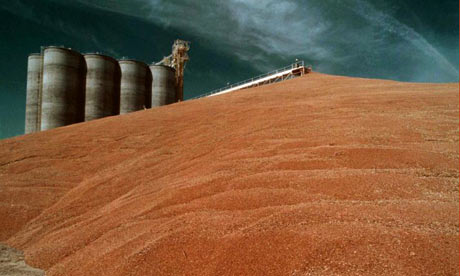
Grain mountain

A grain elevator in Illinois. In 2009, 107m tonnes of grain was grown by US farmers to be blended with petrol. Photograph: AP Photo/Monty Davis

One-quarter of all the maize and other grain crops grown in the US now ends up as biofuel in cars rather than being used to feed people, according to new analysis which suggests that the biofuel revolution launched by former President George Bush in 2007 is impacting on world food supplies.

The 2009 figures from the US Department of Agriculture shows ethanol production rising to record levels driven by farm subsidies and laws which require vehicles to use increasing amounts of biofuels.

"The grain grown to produce fuel in the US [in 2009] was enough to feed 330 million people for one year at average world consumption levels," said Lester Brown, the director of the Earth Policy Institute, a Washington thinktank ithat conducted the analysis.

Etiquetas: ,

lunes, abril 26, 2010

Scientists show ‘growing’ fuel is waste of energy

http://www.grist.org/article/scientists-show-growing-fuel-is-waste-of-energy/

Grist admin avatar badge avatar for Tom Laskawy

by Tom Laskawy

It's no mystery where Grist comes down on the food vs. fuel debate, aka the Great Ethanol Boondoggle. But it's nice to see the science continuing to support our side of the argument (via Science Daily):
Using productive farmland to grow crops for food instead of fuel is more energy efficient, Michigan State University scientists concluded, after analyzing 17 years' worth of data to help settle the food versus fuel debate.

"It's 36 percent more efficient to grow grain for food than for fuel," said Ilya Gelfand, an MSU postdoctoral researcher and lead author of the study. "The ideal is to grow corn for food, then leave half the leftover stalks and leaves on the field for soil conservation and produce cellulosic ethanol with the other half."

Other studies have looked at energy efficiencies for crops over shorter time periods, but this MSU study is the first to consider energy balances of an entire cropping system over many years. The results are published in the April 19 online issue of the journal Environmental Science & Technology.

"It comes down to what's the most efficient use of the land," said Phil Robertson, University Distinguished Professor of crop and soil sciences and one of the paper's authors.

The researchers go on to observe that using some of the crop waste from, say, corn fields to make fuel (while reserving the rest to plow back into the soil) increases the efficiency of the process. But they also point out that that technique won't provide nearly enough fuel for our gas tanks.

They also hold out hope, as do many in the biofuel industry, for cellulosic biofuels that can be grown on marginal land. But the fact is that a cash crop on marginal land is worth even more on prime farmland -- once we go that route it will be very hard to keep biofuel crops from displacing food crops, especially in the developing world.

The conclusion I draw from this study is that it's a terrible idea to put fuel in competition wtih food for productive farmland. The system is designed to favor fuel production at this point and now we know that's actually a waste of energy, rather than a source. With any luck, this new data will be included in the EPA's controversial review of its indirect land-use calculations for the climate impact of biofuels.

Ultimately, I do think biofuels have a role in our economy, but it will be through farmer cooperatives that grow and process biofuel for their own tractors and not for suburban warriors and their SUVs.

Etiquetas: , , ,

lunes, febrero 08, 2010

BIO Proposes Second Wave of Advanced Biofuel Commercialization Policy to Stimulate Job Creation

Obama Administration’s Commitment to Building Advanced Biorefineries Can Create Green Jobs and Economic Growth with Additional Action

WASHINGTON--(BUSINESS WIRE)--Additional Congressional action is needed to follow through on the Obama administration’s recently announced initiative to rapidly build an integrated value chain for the bioeconomy, create jobs and kick start economic growth. The Biotechnology Industry Organization (BIO) today released proposed policy options that provide needed incentives to support U.S. job growth incentivizing commercial scale biorefinery projects for production of advanced biofuels, biobased products and renewable specialty chemicals.

Brent Erickson, executive vice president of BIO’s Industrial and Environmental Section, stated, “The economic recession created an extra hurdle for companies trying to build biorefineries for advanced biofuels and value-added biobased products. Industrial biotechnology solutions for advanced biofuels are ready, and companies have achieved significant successes in achieving research and development goals. Given the current economic climate, what is needed now is significant capital investment.

“The Obama administration correctly recognizes that large-scale production of advanced biofuels can be a significant driver of green job creation, energy security and greenhouse gas reductions. We applaud the policy initiatives announced yesterday, which call for federal coordination of programs to help integrate the complete biofuel value chain. This is a good first step in helping to stimulate the private investment needed to build new biorefineries. However, more needs to be done to de-risk investment in new technologies so that they can scale up to meet national goals. Congress can take action to ensure that these programs are adequately funded and targeted so that the effort will stimulate additional private capital investment.”

BIO’s proposals for new Congressional policy options include:

  • Revise the risk assessment process for advanced biofuels projects in the current Department of Energy loan guarantee program;
  • Double funding for U.S. Department of Agriculture programs to deploy cellulosic feedstocks; include eligibility for value-added biobased materials, products and chemicals;
  • Fund the reverse auction for cellulosic biofuels already incorporated in law;
  • Fund development and deployment programs for biobased products and renewable specialty chemicals.

A recent report commissioned by BIO, U.S. Economic Impact of Advanced Biofuels Production, projects that development of advanced biorefineries could create as many as 29,000 jobs over the next few years. For a copy of the report, U.S. Economic Impact of Advanced Biofuels Production, please visit http://bio.org/ind/EconomicImpactAdvancedBiofuels.pdf.

About BIO

BIO represents more than 1,200 biotechnology companies, academic institutions, state biotechnology centers and related organizations across the United States and in more than 30 other nations. BIO members are involved in the research and development of innovative healthcare, agricultural, industrial and environmental biotechnology products. BIO also produces the BIO International Convention, the world’s largest gathering of the biotechnology industry, along with industry-leading investor and partnering meetings held around the world. The Advanced Biofuels & Climate Change Information Center presents the latest commentary and data on the environmental and other impacts of biofuel production. Drop in and add your comments, at http://biofuelsandclimate.wordpress.com/.

Etiquetas: ,

jueves, mayo 07, 2009

Agrofuels threat looms in Africa


While community cultivation of agrofuel crops in the African continent for local use may be a sustainable source of higher income for farmers, the current land grab by corporations for the large-scale and export-driven expansion of agrofuel production has ominous implications. The article below reveals the looming threat in Africa.

The article was published in Third World Resurgence No. 223 (Mar 2009).

With best wishes,
Lim Li Ching
Third World Network
131 Jalan Macalister,
10400 Penang,
Malaysia
Email: twnet@po.jaring.my
Websites: www.twnside.org.sg, www.biosafety-info.net

Agrofuels: The corporate plunder of Africa

Nnimmo Bassey

AS I sat watching a news programme on television the other day, I was struck by the news that crude oil price had slid to less than US$50 per barrel. One could not help but think about the implications of this price slump and the economic model that is bringing about so much uncertainty. Just a few months ago the price of a barrel of crude had hit US$150 and was straining to burst through the roof. US$50/barrel is the lowest crude has hit in about three years. This will signal a relief for energy-deficient countries, especially those in Africa, whose resources have been hugely impacted by high crude oil prices. Other questions arise, however. Will this slump mean a slowing down on efforts to develop and promote alternative and renewable energy sources? Will this slump kill off the march towards huge investments in agrofuels and in newer-generation bio-fuels?

Agrofuels have been portrayed as the 'green' and golden solution to the energy and ecological problems in the world. The European and American governments, international financial institutions such as the World Bank and multinational agribusiness, oil and transport companies are promoting agrofuels as a solution to world energy needs. Africa looms large on the radar of agrofuels promoters and African governments see in this a potential for energy sovereignty and other benefits.

The rush for African land

The most common and prodigious kinds of crops needed for agrofuels grow best in tropical climates found in Africa, Asia and Latin America. With a persistent picture of Africa as a hopeless continent with a vast land good, the continent is often seen through no other filter than those that suggest her exploitation.1 It is equally well known that the continent is viewed as being over-populated with a huge army of hungry folk. One would expect that such a 'densely populated continent' would have precious little land to play with. However, energy-hungry and importing countries of the North and their agribusiness partners now insist that Africa has so much unused land which they characterise as marginal lands that can now be put to better use to save the world from an energy crunch. Without any evidence of rigorous science, we are told that Africa's marginal lands should be turned into jatropha plantations. In fact, the UN estimates that Africa has at least 500 million hectares of marginal, unused and underused land and that the Democratic Republic of Congo is believed to have around 150 million hectares.2

Furthermore, agrofuels are presented as a sustainable source of higher income for farmers and the business is touted as a ready avenue for employment opportunities for youths.

Agrofuels for a 'green OPEC'?

The president of Senegal inaugurated the so-called 'green OPEC' in 2006. The green OPEC, the Pan-African Non-Petroleum Producers Association (PANPP), is made up of 13 countries without crude oil, but which are poised to become exporters of agrofuels possibly by converting cultivable lands into fuel-crop farms.

According to President Wade, 'The members of PANPP aspire to become leaders in the field of biofuels and alternative energy strategies, following in Brazil's footsteps. But the development of a biofuels industry, particularly cellulosic biofuels made from agricultural wastes and prairie grasses (which President Bush touted in his State of the Union address) could take a decade or more to come to fruition. Africa needs help today.'3

A statement by an American commentator provides a good lesson for Africa. He wrote, 'The only economical way to make ethanol right now is with corn, which means the burgeoning industry is literally eating America's lunch, not to mention its breakfast and dinner.'4 The obvious downside of the investment in large-scale/commercial production of agrofuels has been variously documented. Shifting from fossil fuels to agrofuels following the same market paradigm will not increase the poor's access to energy but would aggravate existing problems such as land grabs and create particular challenges to food supplies due to a shift from food cropping to fuel cropping.

African governments have largely accepted the notion that agrofuels are the panacea to a host of challenges facing the continent. It does appear that such a stand is based on the propensity to adopt externally suggested paths and solutions. The example of the devastating impacts of various structural adjustment programmes imposed on the continent by the World Bank and the International Monetary Fund (IMF) is clear for all to see. An analyst noted that many of the African countries that received intensive treatment from structural adjustment had negative or zero growth. In a rather sharp summation of the continent's dilemma, it has been said that almost all recent cases of collapse into anarchy have been preceded by heavy World Bank and IMF involvement.5

Why agrofuels?

The craze for agrofuels has been largely driven in Africa by the global North, to purportedly address three main issues: climate-change mitigation, energy security and agricultural development. The idea of producing energy from a reproducible source is readily appealing. When that energy source is said to have a multiplicity of benefits, for example, being part of the solution to a global crisis like climate change, then you have a bestseller on your hands. This is how agrofuels have come in.6

However, it is pertinent at this point to say that we do not dispute the use of agrofuels for community use, as in the case of Malian communities where domestic energy needs are met from this source. In such communities they make use of non-edible crops like jatropha and these are grown in hedges around homes or gardens and are not propagated on a large scale. Agrofuels relying on large-scale adoption of intensive monoculture practices are almost certain to impact negatively on people and livelihoods. Common wisdom instructs that when large-scale enterprises go wrong it is much easier to correct the small mistakes rather than the large ones.

An issue that we must repeatedly state is the wrong-headedness of seeing the market as the only route to progress and development. The current economic spirals have eliminated any need for further debate on this. It is also instructive to see that the global commodity market is not concerned with the overall good of humanity but rather with profit maximisation. If the cheapest commodities are agrofuels crops - like oil palm, cassava, maize, groundnuts, etc. - cultivated on cheap African lands, what this means is that we are not only stoking the fires of humanitarian disaster, but also building an environmental disaster.7

In this article we make a distinction between large-scale cultivation of agrofuels monocultures and small-scale, locally produced and owned agrofuels activities. The former is usually accompanied by environmental externalities associated with intensive use of water, chemicals, fertilisers, pesticides, etc. These often result in polluting, depleting and degrading available water resources. This is the type of production model driven by corporate giants and industrial societies. On the other hand, smaller-scale efforts are needs-driven and their impacts are on the positive curve as the entire process is intimately connected to the people. For example, where jatropha is used to produce oils for machines or lamps, the residues are used in producing soaps and other products that all add up to economic empowerment of local women and their families.

Land grabs

The fact that agrofuels have triggered a new scramble for Africa is no longer news. Millions of hectares are being grabbed with little concern for the poor who are bound to face displacement and for the impact that this will have on family farms and other small-scale farms and food production on the continent.

One case in point is an unfolding transaction in Madagascar. There, we are told, a South Korean firm Daewoo Logistics plans to buy a 99-year lease on over a million hectares for the production of 5m tonnes of corn a year by 2023, and to use another 120,000 hectares for the production of palm oil.8 This deal, estimated to cost the company about $6bn over 25 years, is acclaimed as the biggest of its kind in the world.9 The land to be parcelled off to Daewoo Logistics covers arable land about half the size of Belgium. For a mostly arid country with three food crisis situations in five years, this is a huge challenge indeed.

The firm claims that thousands of jobs will be created and that it will use a mainly South African workforce, but the produce will be mainly earmarked for South Korea.10 In other words, that chunk of Africa would simply be a South Korean farm for South Korea. Although the crops are said to be for food, the lesson for land and land rights is the same for agrofuels.

The Guardian article11 from which the Madagascar story was quoted presents us with additional reasons to worry. We are told that in Sudan there are efforts by the state to attract investors for almost 900,000 hectares of its land, while the Ethiopian Prime Minister is reported to have been courting would-be Saudi investors. Commentators believe that these negotiations are lopsided and may weigh against Africa. A number of factors impact the quality and amount of arable lands available in many African countries. In the case of Ethiopia, the pressure on natural resources has led to the burning of animal dung for fuel instead of utilising it as a resource for soil quality improvement. Over 600,000 tonnes are said to be lost in crop production annually due to these pressures on the land. This loss amounts to double the amount of yearly food aid requests from the country.12 The additional pressures that use of land for agrofuels would bring to bear on food deficits in countries in similar conditions are easy to imagine.

A further downside is that small farmers without official land title are already on the losing end. Add to this the fact that details of these land deals are hard to come by. With a lack of transparency there is no assurance of safeguards for the poor or even the overall long-term interest of the continent.

The UN's Food and Agriculture Organisation (FAO) advocates an urgent review of agrofuels policies and subsidies in order to preserve the goal of world food security, protect poor farmers, promote broad-based rural development and ensure environmental sustainability.13 Its head, Jacques Diouf, has clearly warned that the controversial rise in land deals could create a form of 'neo-colonialism', with poor states producing food for the rich (and their machines) at the expense of their own hungry people.14

Etiquetas: , ,

Agrofuels in the Americas

Edited by Richard Jonasse.
As California considers new carbon-accounting standards for liquid fuels; a significant percentage of which will come from agrofuels; it is a perfect time to review what the past several years of the "Agrofuels Gold Rush" have wrought. This book looks primarily at the consequences in the U.S. and Latin America, but the problems with Agrofuels, in terms of Food Security, labor rights, and environmental destruction are widespread.

Individual Articles Below.

Agrofuels in the Americas looks at the ways in which agribusiness and energy corporations are taking advantage of peak oil, climate concerns, and global free trade rules to shape the future of agriculture to their advantage. The following articles illuminate the dynamics of trade relations, global capital flows, and their symbiotic relationship with international financial institutions such as the WTO, the World Bank, and the IMF. They open the black box of biotechnology strategies, the corporate cooptation of the genetic commons, and the voracious land and resource consumption of the agrofuels industry. Finally, these pieces discuss the human tragedy of agrofuels' effects on peasant farmers, rural labor, indigenous peoples, and the environment--and the corporate externalization of their social and environmental costs. They provide a picture of the future of agriculture, labor, and the biosphere if the forces capitalizing on current global crises can push their plans through. Agrofuels in the Americas touches on these key concerns with the aim of informing the current debates around food, fuel, and human rights.

Introduction: Agrofuels and our Endangered World. By Richard Jonasse

I. The Ecological and Social Tragedy of Crop-based Biofuel Production in the Americas. By Miguel Altieri & Elizabeth Bravo

II. When Renewable Isn’t Sustainable: Agrofuels and the Inconvenient Truths Behind the 2007 U.S. Energy Independence and Security Act. By Eric Holt-Giménez and Isabella Kenfield

III. The Free Market in Agrofuels: Regulation and Trade in the Americas. By Gretchen Gordon & Jessica Aguirre

IV. Agribusiness’ Field of Dreams: IFIs and Latin America’s Agrofuel Expansion. By Richard Jonasse

V. The Environmental and Social Consequences of “Green Capitalism” in Brazil. By Maria Luisa Mendonça

VI. Agrofuels Plantations and the Loss of Land for Food Production in Guatemala. By Laura Hurtado

VII. The Agrofuels Trojan Horse: Biotechnology and the Corporate Domination of Agriculture. By Annie Shattuck

VIII. Magical, Myth-Illogical, Biological Fuels?? By Rachel Smolker & Brian Tokar

IX. Will Sustainability Certifications Work? A Look at the Roundtable on Sustainable Biofuels. By Annie Shattuck


DownloadSize
Agrofuels_in_the_Americas.pdf2.88 MB

Etiquetas: ,

martes, diciembre 09, 2008

The Agrofuels Myth


Are there solutions for the current energy and climate crises? What about agrofuels (biofuels)? Can they be sustainable? This video explains in simple terms what we think about it!

This is the second film in a series of three entitled 'Towards Solutions'.

Etiquetas: , , ,

miércoles, noviembre 26, 2008

Social and Environmental Groups Urge No Further Agrofuel Expansion, as Brazil hosts the International Biofuels Conference, Nov 17-21, 2008

November 24,2008, São Paulo, Brazil

The government of Brazil hosted a high profile International Biofuels Conference with over 1000 participants from national governments, international organizations, academia, business and civil society. The purpose of this event was to counter growing skepticism surrounding agrofuels and encourage the expansion of their world market. The European Commission and several EU Member States have been very supportive so far of the international trade in agrofuels. As part of the Renewable Energy Directive, the EU as a whole is proposing targets that will enable agrofuels to contribute 10% of Europe’s transport energy needs by 2020. Countries like Sweden and the Netherlands have also been lobbying hard within the EU to lower the Union’s import tariffs on ethanol in order to favor the import of Brazilian agrofuels. Sweden itself
is temporarily reducing its import tax on ethanol to allow more Brazilian imports to flow into the European market.

Despite having been promoted as a “green” energy sources, agrofuels will not help in the fight against climate change, nor will they free Europe from its oil addiction. Recent evidence of the negative socioeconomic and environmental impacts of agrofuels also raises questions about the sustainability of the commodity itself and of its trade. New evidence based on full life-cycle assessments of agrofuels’ production indicate that agrofuels not only will fail to reduce CO2 emissions, but will lead to an
increase in emissions altogether.1

1. Agrofuels will not solve energy problems in Europe.
Agrofuels are mixed with fossil fuels, and as such provide a way of delaying the search for proper alternatives to fossil fuels in Europe - detracting political attention from more effective solutions to the climate change challenge.

2. Agrofuels undermine people’s right to food in developing countries
As European demand for agrofuels will not be met through domestic production, international investors (including many from Europe) are seeking land, raw materials and labor in developing countries to grow agrofuel crops for exports. Countries including India and the Philippines have already received massive investment from European companies keen to develop agrofuels crops, while countries in Latin America and the African, Caribbean and Pacific (ACP) region are being targeted for their preferential trade routes (lower import tariffs) to Europe. The conversion of arable and forest land into agrofuel plantations is leading to cases of “land grabbing” in these countries, where rural communities are denied their right to food by being forced off the land they depend on for self-subsistence. Moreover, as rural farmers switch from food crops to crops for fuels, their food security is traded away in favor of volatile financial investment and foreign market demand. The switching of arable land into crops for fuel has also been deemed partly responsible for driving up food prices internationally with a resulting food crisis affecting millions of people around the world.2

3. Agrofuels promote deforestation, agri-chemical use and Genetically Modified crops
Agrofuels are also directly responsible for deforestation in many countries, as land is cleared to make space for agrofuels’ crop development. In the case of Brazil, the expansion of agrofuels is also causing soy plantations to be pushed into the Amazon, illustrating the “indirect” role that agrofuels can also play on forest decimation. In addition to this environmental impact there is the increased use of pesticides and fertilizers involved in the production of agrofuels to bare in mind, as well as the additional environmental pressure that will be exerted as a result of Genetically Modified crops currently being developed for agrofuel use.

4. Sustainability standards are a smokescreen
The European Council of Ministers and the European Parliament have promoted the introduction of criteria as a way of ensuring the “sustainability” of agrofuel production. However, their ability to prevent the social and environmental impacts that result from the expansion of monoculture plantations for agrofuels is questionable. The lack of strict monitoring mechanisms, the weakness of the benchmarks suggested, and the preference given to an industry’s self-regulatory approach, suggests that the criteria will legitimize, rather than prevent, any social and environmental impacts of agrofuels.

Civil society calls for Moratorium
Farmer organizations and social movements in Brazil oppose the expansion of industrial monocultures of sugarcane, soy, and palm oil for agrofuel production because of the negative impacts on small-scale
farmers and the environment. The international peasant movement (Via Campesina) has called on the Brazilian government to introduce a five-year moratorium on agrofuels. Similar calls have also been issued by organizations in Africa and the US to their respective governments.

With this letter more than 200 organizations and hundreds of individuals are calling on the EU to also introduce a moratorium on agrofuels, both in terms of national incentives for agrofuel development of large-scale monocultures (including tree plantations), and on agrofuels imported from outside the EU.

These organizations asked the European Commission and Member States not to take part in the International Biofuel Conference in Brazil between 17-21 November, as the event must not lead to the EU supporting further expansion of agrofuel development.

These 200 organizations specifically oppose:
 The lowering of import tariffs for agrofuels internationally, as this will only increase the international flow of agrofuels and the resulting social and environmental impacts;

 The promotion of cooperation agreements between Brazil and partnering countries aimed at facilitating international investment for agrofuels development, particularly in developing countries already proven by the global food crisis;

 The assumption that currently proposed sustainability criteria are adequate to guarantee the sustainability of agrofuels from large-scale plantations.

----------------------------------


1 Searchinger, T., et al. (2008) “Use of US Croplands for Biofuels Increases Greenhouse Gases Through Emissions from Land-Use Change” in Science. March.
2 Ivanic, M., and Martin, W., (2008); ‘Implications of Higher Global Food Prices for Poverty in Low-Income Countries’; Policy Research Working Paper 4594, Washington DC: World Bank.


Declaración a la Conferencia Internacional sobre Biocombustibles en Brasil

São Paulo, Noviembre 2008

Pasados 12 años desde la primera liberación comercial de los cultivos OGMs, la industria biotecnológica NO ha cumplido con la promesa de ‘salvación del hambre en el mundo’, su principal argumento frente a la gran oposición al cultivo de alimentos transgénicos.

Hoy el argumento de la industria es que los transgénicos son una pieza clave para ayudar a solucionar el problema del calentamiento global y del cambio climático. Para eso ahora se promueven los llamados ‘climate-ready crops’, cultivos OGM que serían más resistentes a las sequias, y los cultivos ‘energéticos’, diseñados y destinados a la producción de agrocombustibles y no de alimentos.

Para la industria biotecnológica, los agrocombustibles representan una nueva oportunidad para abrir nuevos mercados e insertarse en países que hasta el momento se han mantenido “libre de transgénicos” con el argumento que estos cultivos no van a entrar en la cadena alimentaria. Al respecto, el presidente Lula afirmó: “(...) una parte del biodiesel será producido a partir de la soya, en vez de que el pueblo coma soya transgénica, nosotros vamos a producir biodiesel de la transgenica, … el carro no lo rechazará, no existe ningún problema , y la gente va a comer la soya buena.[1]

En el 2007, en Estados Unidos se destinaron 7 millones de hectáreas de maíz transgénico para la producción de etanol y cerca de 3,4 millones de hectáreas de soya RR para agrodiesel; a esto se suman las más de 55 mil hectáreas de canola transgénica para agrodiesel en Estados Unidos y Canadá. La producción de agrodiesel podría representar hasta el 25% del consumo total de aceite de soya en Argentina, Brasil, Estados Unidos y la Unión Europea en septiembre de 2008. La soya RR cubre extensas áreas en Argentina, Paraguay, Uruguay y se está extendiendo a Brasil.

La caña de azucar, el principal cultivo para la producción de etanol, es objeto de manipulación transgénica y recientemente fue declarada por la Monsanto ‘un commodity global, al lado de la soya, del maíz y del algodón’; ese nuevo status para la caña fue anunciado en la primera semana de noviembre, cuando la Monsanto compro por US$ 290 millones de dólares las empresas de biotecnología brasileñas con investigaciones más avanzadas para la producción de caña de azúcar y de eucalipto transgenico: CanaVialis y Alellyx (antes propiedad de Votorantin, conglomerado industrial y celulósico brasileño). Con esta adquisición, Brasil se consolida como centro mundial de investigación de caña para Monsanto y lidera los experimentos para agrocombustibles de segunda generación. Teniendo en cuenta el papel de Brasil en promover su modelo de etanol a otros países, consideramos que esto podría transformar los países de América Latina, el caribe y África en grandes zonas de monocultivos de caña de azúcar y eucaliptos transgénicos, para alimentar la industria automovilística mundial, y a medio plazo la cadena emergente de ‘bioplasticos’.

Nosotros de la RALLT y del African Center for Biosafety, entendemos estos graves problemas, por ello rechazamos la promoción de transgénicos para energía. La demanda de producción masiva de biomasa para energía, constituye un cambio estructural sobre la agricultura y un avance de la amenaza transgénica sobre la biodiversidad y soberanía alimentaria de los pueblos.

No aceptamos las falsas soluciones que se presentan a los graves problemas del planeta y de la humanidad: el hambre y el cambio climático son asuntos que exigen cambios estructurales en nuestra sociedad y economía, empezando exige redireccionar urgentemente el fallido modelo agroindustrial petro-dependiente y la urbanización insostenible. No reconocemos el modelo que está destruyendo el planeta, el clima, la biodiversidad y todo el patrimonio natural, atentando contra las bases de la soberanía alimentaria de nuestros pueblos.

Por lo tanto:
· Rechazamos este nuevo intento de querer transformarnos en un nuevo patio trasero de las empresas biotecnológicas, petroleras y automovilísticas.
· Rescatamos nuestro derecho a decidir soberanamente qué, cuando y para que usar nuestros territorios
· Hacemos un llamado a la sociedad civil organizada a iniciar un camino hacia una sociedad post-petrolera, libre de transgénicos, libre de toda tecnología que promueve dependencia y demandamos que se recupere una producción a escala humana.

[1] www.info.planalto.gov.br/download/discursos/PR840.DOC

Etiquetas: , ,

jueves, noviembre 20, 2008

Next-Generation Biofuels

Carmelo Ruiz Marrero | May 1, 2008

Translated from: La próxima generación de agrocombustibles
Translated by: Carmelo Ruiz Marrero


Americas Program, Center for International Policy (CIP)

First-generation biofuels like ethanol and biodiesel debuted on the world stage as the solution to the fossil fuel trap. Soon evidence began to mount indicating that the solution may well prove to be just a new set of problems.

Executives and scientists of agribusiness and biotechnology corporations know the problems caused by first-generation agrofuels, and are wagering that these can be solved by a new generation of agrofuels derived from cellulose.

Cellulose, the most common organic compound on earth, is a key structural component of the cell walls of green plants and many forms of algae. About 33% of all plant matter is cellulose. Scientists have devoted major efforts to find practical ways of turning it into liquid fuel. In nature only fungi and certain bacteria found in the guts of termites and ruminant mammals (such as cows) produce enzymes that can digest cellulose. The ability to turn cellulose into fuel would make it possible to use any vegetable matter, living or dead, to this end.

"WHAT IF WE COULD CONVERT not only corn, but also corn stover—the leaves, stalks, and cob—into ethanol? What if we could transform sugarcane bagasse (leafage) to transportation fuel? Could poplar and pine trees, wheat and rice straw, or even municipal waste become a sustainable source of biofuels? If so, energy crops like fiber cane, switchgrass, and miscanthus could become our country's strategic "oil" reserve, and Oklahoma could be the next member of OPEC. In the past, scientists using traditional chemistries have been unable to cost-effectively convert these residual plant products and energy crops to ethanol. Now, recent advances in industrial biotechnology are providing powerful new tools to solve this historic challenge."

Source: Verenium corporation

In 2006 venture capitalists invested $235 million in the development of cellulose agrofuels. That same year the Chinese government announced it would spend $5 billion over the next decade to expand ethanol production, with a special emphasis on cellulosic ethanol. Meanwhile, the U.S. Energy Department is investing $385 million in cellulosic ethanol facilities for the period 2007-2010.

The development of new-generation cellulosic fuels will undoubtedly be dominated by U.S.-based biotech giant Monsanto, world leader in agricultural biotechnology. In 1982 its scientists created the first GM plants. A quarter-century later, the company has 3,000 scientists on its payroll, and approximately 90% of the world's GM seed is either patented by Monsanto or contains some technology that is patented by Monsanto.

Monsanto became the life sciences behemoth it is today by buying out its competitors. According to Claire H. Cummings' book "Uncertain Peril: Genetic Engineering and the Future of Seeds," the buying spree began in 1996 when it bought Agracetus for $150 million and Calgene for $240 million. Monsanto went on a veritable buying spree, purchasing Dekalb, an American company, for $2.3 billion, Holden Seeds in 1997 for a price that was 23 times its annual earnings, seed companies in Brazil and India, Unilever's European wheat-breeding business, and Cargill's international seed operations for $1.4 billion. Cummings explains that Monsanto sought more than increased market share and production: "... it was about owning the parent seed lines and getting control of the genetics."

In 2005 Monsanto became the world's biggest seed company by adding the Seminis Corporation to its acquisitions for a cool $1.4 billion. Seminis, the world's largest developer, grower, and marketer of fruit and vegetable seeds, was founded in 1994 by Mexican tycoon Alfonso Romo. The company boasted 70 research stations, seed production sites in 32 countries, and sales in 120 countries. At the time Monsanto bought it, Seminis had 40% of the U.S. vegetable seeds market. Monsanto now owns its vast catalog of seeds, which includes 75% of tomatoes sold in the United States, plus numerous varieties of lettuce, cabbage, melon, and spinach.

In 2007 the Mendel Biotechnology company—co-owned by Monsanto—bought the German corporation Tinplant Biotechnik, which owns the world's largest collection of miscanthus varieties. This perennial grass native to Africa, also known as elephant grass, is considered ideal for cellulosic ethanol production because of its rapid growth and high biomass yield.

Mendel is currently developing GM miscanthus varieties and in June 2007 oil giant British Petroleum (BP), the world's fourth largest corporation, announced it would fund Mendel's five-year cellulosic fuel research program. As a result of the deal, BP became a shareholder of Mendel with representation on its board.

"Working with BP, Mendel aims to be at the forefront of seed supply into the future energy grass seed market," according to the company's press release. "Mendel will establish breeding stations in the Midwest and the Southeast United States, and accelerate breeding collaborations with groups in Germany and China."

Other oil corporations that have joined the cellulose trend including Chevron, Shell, and Conoco-Phillips. The latter invested $100 million in a joint venture with Tyson Foods to process animal fat into fuel. Brazil's Petrobras has jumped on the bandwagon with a bio-ethanol agreement with Japan's Itochu.

Monsanto is also interested in the fuel potential of switchgrass (Panicum virgatum), and currently collaborates with the U.S.-based Ceres corporation to research its possibilities. A native of the North American prairie, switchgrass was mentioned by President Bush in his 2006 State of the Union address as an alternative to fossil fuels.

Ceres says it is "improving switchgrass as a crop via selection of improved types but, more importantly, is bringing its proprietary genes, tools, and procedures to enhance the improvements more rapidly and provide the plant with attributes ideally suited to being farmed on large acreages to produce consistently higher yields." The company claims to possess the largest proprietary collection of fully sequenced plant genes, with patents on more than 75,000 genes.

A substantial portion of cellulosic ethanol research is focused on sugarcane. The Brazilian Votorantim conglomerate owns CanaVialis, world leader in the field of sugarcane genetics, and sugarcane genomics company Allelyx. Both subsidiaries are developing GM sugarcane for ethanol. Monsanto announced in 2006 that it is working with Votorantim to commercialize GM sugarcane by 2009.

Meanwhile Syngenta, Monsanto's major European competitor, obtained access to inedible sugarcane strains with ultra-high cellulose content developed by the Celunol biotechnology company. In 2007 Celunol merged with Diversa to form the Verenium Corporation. In February 2008 Verenium, headquartered in Cambridge, Massachusetts, received a grant from the U.S. Department of Energy to develop cellulosic ethanol.

U.S. universities are fishing for big money in the cellulosic ethanol rush. In 2007 BP gave the unprecedented sum of $500 million to the University of Illinois' Lawrence Berkeley Laboratory and the Berkeley campus of the University of California for the development of agrofuels (see sidebar). Stanford University's Global Climate and Energy Project is getting $100 million from Exxon-Mobil, the world's second largest corporation, over a 10-year period, in part to develop new GM agrofuels. Other corporate donors are General Electric and Toyota, each one giving $50 million to Stanford.

$500 Million Corporate Grant Ignites Academic Controversy

British Petroleum (BP) signed in 2007 an agreement with the University of California's Berkeley campus and the University of Illinois' Lawrence Berkeley Laboratory to found the Energy Biosciences Institute (EBI), a "private-public" entity that will employ biotechnology to develop agrofuels.

What's in it for the two universities? $500 million, a private donation without precedent in the history of academia. BP chief Robert A. Malone said, "We are joining with some of the world's best science and engineering talent to meet the world's demand for low-carbon energy. As part of that effort, we will be working to improve and expand the production of clean, renewable energy through the integrated development of better crops, better processing technologies, and new biofuels."

The BP-Berkeley deal has provoked heated opposition from groups of students, faculty, and citizens. "This partnership reflects the rapid, unchecked, and unprecedented global corporate alignment of the world's largest agribusiness, biotech, petroleum, and automotive industries," denounced Berkeley professor Miguel Altieri and Eric Holt-Giménez, director of Food First. "With what for them is a relatively small investment, these industries will appropriate academic expertise built over decades of public support, translating into billions of dollars in revenues for these global partners."

"BP-related employees would be housed in buildings funded and equipped by the public," declared U.C. Berkeley professor and former Shell Oil scientist Ted Patzek. "The public would then be blocked from entering the BP-occupied buildings. Most information would flow through and be filtered by the BP personnel and their UC Berkeley affiliates, who would need to sign non-disclosure agreements, making it impossible to distinguish between their private and public roles."

Patzek notes with great concern that the Berkeley side of the EBI will be run by Mendel Biotechnology CEO Chris Somerville. "Mendel Biotech is 'completely aligned' (their own wording) with Monsanto and Savia Ltd. Monsanto controls most sales of GMO seeds worldwide. Savia is the world's largest dealer of non-commodity crops: trees, flowers, vegetables, grasses, etc., and is deeply vested in GMO manipulations.

"Dr. Somerville's company has received $46 million from Monsanto and Savia to conduct research on genetically modified plants."

"Chris Sommerville, CEO of Mendel, has been apparently rushed in to Berkeley through a secretive and highly irregular flash-hire process to be safely on the UC side as a professor for the signing of the agreement," denounced Professor Ignacio Chapela, long-time critic of the biotechnology industry. "Not surprisingly, there is no outward sign that the Academic Senate even knew about all this ... In this proposal, Berkeley is nothing but a business partner with these corporations, and professors, entrepreneurs, and students, simply cheap labor, paying high fees for the privilege of giving their work to the right corporation."

Source: http://www.berkeley.edu/news/media/releases/2007/02/01_ebi.shtml

Agricultural "Waste"

Environmentalists warn that the use of any plant matter, including forest deadwood and agriculture and garden residues, entails considerable ecological costs.

"As farmers and agronomists know, 'biomass waste' does not exist; it is the organic matter that you have to put back after harvest in order to maintain the soil's fertility," advises GRAIN. "If you don't, you mine the soil and contribute to its destruction. And that is precisely what will happen if the world's topsoil has to compete with the bio-distillers."

If so-called "agricultural waste" is not used to fertilize fields, it will have to be replaced by synthetic fertilizers, which are industrial agriculture's biggest contributor to global warming. Once applied to fields, the nitrogen in fertilizer combines with oxygen to form nitrous oxide, a powerful greenhouse gas. According to the Stern Review on the Economics of Climate Change, a 700- page document commissioned by the British government, agriculture-related greenhouse gas emissions will increase 30% by 2020. Half of this will be due to increased fertilizer use. In the same period, the Third World is expected to double its fertilizer use and much of this increase will be for agrofuels.

A 2005 joint report by the U.S. Departments of Energy and Agriculture notes that the use of wood, grasses, and "plant waste" for the production of cellulosic ethanol would require 1.3 billion tons of dry biomass a year. Obtaining this amount of biomass would be possible only by removing most of the country's agricultural residues, planting 55 million hectares under perennial crops like switchgrass, and putting all U.S. farmland under "no-till" agriculture, say the report's authors.

"The removal of organic residues from fields will require greater use of nitrate fertilizers, thus increasing nitrous oxide emissions, nitrate overloading, and its very serious impacts on the biodiversity on land, freshwater, and oceans," according to a 2007 report authored by 11 civil society organizations, including Argentina's Grupo de Reflexión Rural, Watch Indonesia, EcoNexus, Corporate Europe Observatory, and Friends of the Earth Denmark.

"The complete removal of plant material is also likely to accelerate topsoil losses, causing further decline in soil nutrients. This could have serious implications for human health in terms of future nutrient deficiencies in food crops. It is also likely to reduce soil water retention, making agriculture more vulnerable to droughts."

The report continues, "The removal of dead and dying trees from managed forests already leads to large-scale biodiversity losses and possibly to lower carbon sequestration in forests ... Removing even more 'wood residues' for agrofuels would almost certainly accelerate biodiversity loss and reduce carbon storage in forests. Growing millions of hectares of land under perennial crops for bioenergy will put intense pressure on land both for food production and communities, and for natural ecosystems. Many plants which have been identified as preferred choices for second generation agrofuels already cause serious environmental harm as invasive species, such as miscanthus, switch grass, or reed canary grass."

Translated for the Americas Program by Carmelo Ruiz Marrero.

Carmelo Ruiz-Marrero is a Puerto Rican independent environmental journalist and environmental analyst for the Americas Policy Program (www.americaspolicy.org), a fellow of the Oakland Institute and a senior fellow of the Environmental Leadership Program and founder/director of the Puerto Rico Project on Biosafety (bioseguridad.blogspot.com). His bilingual web page (carmeloruiz.blogspot.com) is devoted to global environment and development issues.

Etiquetas: , , , ,

jueves, octubre 16, 2008

What's for dinner? Corn ethanol, feedlots and what you eat

by Annie Shattuck
April 10, 2008

The debate over renewable energy is raging. The U.S. Congress recently passed a renewable fuels mandate which will effectively create an artificial market for at least 15 billion gallons of corn ethanol per year. Numerous studies have criticized ethanol's environmental footprint. From negligible greenhouse gas savings to increased ground level ozone, and dependency on high-input agriculture–corn ethanol's critics have painted a picture of a costly band-aid for our energy crisis.

None of this analysis examines the full cost of the corn ethanol boom, which actually creates more by-product than it does fuel. Ethanol from corn produces seven pounds of by-product for every gallon of ethanol. This by-product is already in our food. If you eat beef, chances are you have eaten cattle fattened on this ethanol waste.

Dried distillers grains with solubles (DDGS) are the leftovers after corn has been milled and fermented into ethanol. Cattle nutritionists recommend including ethanol by-products in cattle diets at 20%-40% maximum. The quantity of distillers grain available is dictated by government incentives for fuel refining, leaving the ethanol industry to engineer demand for its waste. Without the sale of these ethanol by-products, corn ethanol is vastly less profitable. Industry claims that co-production of distillers grain with ethanol is a win-win proposition. Cattle producers get economical, high-protein feed, and America gets renewable fuel. However, the market for distillers grain is limited, and their disposal, like any other industrial by product, comes with costs to the environment, the economy and public health.

The Problem with Ethanol By-Products

Concentrated phosphorus and nitrogen in cow dung

Feeding distillers grain to cattle increases the amount of nitrogen and phosphorus in their feces. Unfortunately, the ratio of phosphorous to nitrogen is so high in this cow dung that it is of little use as a fertilizer. Cows fed a diet that includes 40% distillers grain, have fecal material with 41% more phosphorous and 33% more nitrogen than cows fed conventional feedlot diets. More than 40 percent more land will be needed to treat the waste of cows consuming this by-product if it is disposed of by spreading it over fields. Even if the proper amount of land can be dedicated to treating wastes, water quality around feedlots will likely worsen. Eutrophication—the process by which streams with high-nutrient runoff clog with vegetation, reducing oxygen in the water, and killing fish and other aquatic organisms—is a proven result of large-scale cattle and dairy operations. More nitrogen and phosphorous cycling through these operations will intensify the deterioration of streams and rivers.

Increasing nitrogen cycling through feedlots also increases greenhouse gas emissions. Nitrous oxide, a greenhouse gas 296 times more potent than carbon dioxide, is a major toxic emission from large-scale agricultural operations. Nitrous oxide forms when bacteria naturally present in soils convert biologically available nitrogen to a gas bound with oxygen. In areas where nitrogen runoff is high, nitrous oxide emission is also high. Cows fed a diet of 40% distillers grain increase the amount of available nitrogen in their excrement by 33% percent. The amount of available nitrogen that forms greenhouse gases varies according to treatment methods applied to the waste. With over 200 billion pounds of by-product slated to be produced annually under Congressional ethanol targets, feedlots all over the nation will increase their nitrogen and phosphorus emissions dramatically.

Food safety: Sulfur, polio and E. coli

The market for ethanol by-products is limited due to sulfur residues. Sulfuric acid and other sulfur compounds used in the distilling process combine with naturally-occurring sulfur in corn to produce unhealthy and potentially lethal levels of sulfur in distillers grain. The sulfur levels in ethanol by-products vary between plants and even between batches at the same plant, making it difficult to label or control. Sulfur, in excess of 0.4% in cattle diets will cause polioencephalomalacia, a deadly form of polio that produces brain lesions. The fine nutritional testing necessary to feed a diet heavy in ethanol waste favors large feedlot operations that can afford to test their water supply and distillers grain for sulfur. Smaller ranchers are unlikely to be able to use ethanol waste to the same degree as feedlots, putting family cattle operations in direct competition with ethanol plants for feed corn.

Feedlots that use ethanol waste also threaten the food supply with E. coli outbreaks. A recent Kansas State University study shows that distillers grain promotes the growth of E. coli. The study's authors warn of “serious ramifications,” predicting strong resistance to feeding ethanol waste. Cattle fed brewers grains, a similar product, are six times more likely to have E. coli in their feces than cattle fed real corn. E. coli outbreaks in factory farms are common. The use of ethanol by-products will doubly increase this phenomenon, both increasing the presence of E. coli and expanding the industrial model that makes our food system vulnerable to contamination in the first place.

The feedlot-refinery connection

Ethanol refineries and factory-style feedlots go hand in hand. For example, at an ethanol plant owned by E3 BioFuels corporation in Mead, Nebraska, manure from a 28,000-cow feedlot helps to power a 25 million gallon per year ethanol plant. In this system, the corn waste from the refinery makes up 40% of the cattle's diet. E3 plans to build larger ethanol plants with feedlots of 60,000-120,000 cattle. Such plants bring in a few jobs, but all of the added value of the ethanol stays with the refiner, while the community is left with despoiled water supplies, bad air quality, and all the other environmental problems associated with feedlots and refineries of that size. The pairing of feedlots and refineries makes sense from an industrial standpoint. Up to one third of the energy produced from ethanol is lost in the drying and shipping of its by-products. Pairing ethanol plants and feedlots eliminates drying and transportation costs. As more ethanol refineries are built around the country we can expect feedlots to follow, spoiling waterways and threatening food safety as they go.

Corporate consolidation and consumer choice

Corporate consolidation is occurring rapidly in the ethanol industry. Of the 119 ethanol plants operating in 2007, 49 of them were owned and operated by farmer cooperatives. But once ethanol refineries currently in construction come on line, farmers will only control 20% of the nation's ethanol (and distillers' grain) production capacity. Just as the refining business favors large corporations, the by-products industry will favor large corporate farms and feed lot operations. As ethanol drives corn prices up and the excess corn by-product becomes cheaper, factory feedlots and dairies are likely to edge out smaller operations that can't or don't want to use distillers grains. Consumers who prefer to avoid factory beef will have to buy from the small number of ranchers who sell to specialty markets.

READ THE REST: http://www.foodfirst.org/en/node/2079


Pouring Fire on the Food


This week’s headlines are ablaze with reports of food riots. Seemingly overnight, the world went from cheap food and surpluses to food prices spiking 80% and countries banning exports of food in an attempt to stave off shortages.

Welcome to the new world food crisis. Except that it has been brewing for decades. Ever since the World Bank and the International Monetary Fund broke down trade barriers in the global south—thus opening the gates for the dumping of subsidized grain from the U.S. and Europe—farmers in poor countries have steadily been driven out of business. Under the banner of “comparative advantage,” many poor countries that had previously been self sufficient in food were turned as a conscious matter of US foreign policy into food importing countries. But with the U.S. hoarding its corn and selling the rest of its food dear, these nations are left holding the poor end of an expensive stick.

Laying the blame on Australian droughts, rising meat consumption in China, the agrofuels boom, and the high cost of oil, our world leaders have been quick to offer a spate of solutions: A “New Deal” from the World Bank, another “Green Revolution” from the Bill and Melinda Gates and Rockefeller Foundations, and a quick $300 million in emergency food aid from the U.S. Billions more will be spent, and it’s a lucrative business. While agribusiness monopolies like ADM, Cargill, Monsanto and food giants like General Foods have remained conspicuously silent, about the crisis, over the pat three years, even as the crisis was unfolding, they were posting record profits of 60-80%.

Emergency measures are urgently needed to make food accessible to poor people. But so are profound changes to a globalized food system in need of repair. Inherently vulnerable to economic and environmental shock, we produce, process, transport and consume food in ways that are structurally dependent on vast amounts of petroleum, obsessed with three or four commodities, and subject to the unaccountable market power of a handful of seed, grain and chemical companies.

Unfortunately, the need for systemic change—not simply more of the same—is absent from official proposals to solve the food crisis. Perhaps this is understandable as it would mean that government, international finance institutions and agribusiness corporations acknowledge that they are part of the problem.

World leaders are rightly concerned about the wave of popular demonstrations against high food prices. With the exception of Haiti (where the poor are eating biscuits made of clay and vegetable oil), these street actions look more like angry rebellions of disenfranchised citizens than they do crazed rioting by starving masses. People are not just upset about high prices; it is the inherent injustice of the global food system that are driving them to revolt.

The International Assessment of Agricultural Science and Technology (IAASTD) recently released its final report in Johannesburg, South Africa. The result of an exhaustive 3-year international consultation similar to that of the Intergovernmental Panel on Climate Change, the IAASTD calls for an overhaul of agriculture dominated by multinational companies and governed by unfair trade rules. The report warns against relying on genetic engineered “fixes” for food production and emphasizes the importance of locally-based, agroecological approaches to farming. The key advantages to this way of farming—aside from its low environmental impact—is that it provides both food and employment to the world’s poor, as well as a surplus for the market. On a pound-per-acre basis, these small family farms have proven themselves to be more productive than large-scale industrial farms. And, they use less oil, especially if food is traded locally or sub-regionally. These alternatives, growing throughout the world, are like small islands of sustainability in increasingly perilous economic and environmental seas. As industrialized farming and free trade regimes fail us, these approaches will be the keys for building resilience back into a dysfunctional global food system.

Expecting solutions from the institutions that created the disaster in the first place is like calling an arsonist to put out the fire. Getting the poor back on the land and providing them the support presently being captured by the world's agri-foods monopolies would be a truly systemic and durable solution to our current global food crisis.


Eric Holt-Giménez, Ph.D.
Executive Director, Food First/Institute for Food and Development Policy
Oakland, California
510-654-4400 Ext 227
fax: 510-654-4551

Etiquetas: , , ,

jueves, octubre 09, 2008

Food First on cellulosic ethanol

http://www.foodfirst.org/en/node/2263

Green Gold: Why cellulosic ethanol is a threat to farmers and the planet

By Annie Shattuck

Cellulosic ethanol has everyone from John McCain to the Natural Resources Defense Council excited with the promise of greening the planet and the economy in one stroke. … The irony of cellulosics however, is the unprecedented threat they pose to small farmers, the environment and our global carbon balance: the very things they pretend to protect.


DownloadSize
greengold21.pdf57.8 KB

Etiquetas: ,

sábado, septiembre 13, 2008

Exposed: Europe’s GM-Hype in Times of Food and Fuel Crisis

http://www.i-sis.org.uk/Exposed_GM-hype.php

By Claire Robinson


Excerpt:

No evidence that GM crops will solve the food and fuel crisis

Most of the EU’s animal feed comes from Brazil and Argentina, which are careful to grow only those varieties of feed, both GM and non-GM, that are approved in the EU, so as not to harm their export markets [10]. An article in the Financial Times quotes a Brazilian diplomatic source saying, “We produce to satisfy our clients. We are not going to produce something they are not going to buy.” The article goes on to say that neither Argentina nor Brazil share the “apocalyptic” scenario currently being put forward by the biotech and livestock industries and intensive farmers [11].

Such scaremongering ignores the well-known fact that GM crops have at best, variable impacts on yields and are therefore not a solution to the food crisis, as was confirmed by the recent IAASTD (International Assessment of Agricultural Knowledge, Science and Technology for Development) report on the future of agriculture [12].

More importantly, it ignores the fact that the major cause of the food and feed crisis is not European GM policy, but the rush to biofuels. Even the World Bank has now confirmed what NGOs have been saying ever since the notion of a food crisis was first mooted, that the Bush-subsidised ethanol boom (with the EU's agrofuel boom following in its wake) is by far the single most important factor in creating the food crisis that is driving 100m people worldwide below the poverty line. The report, which has not been published but was leaked to the UK’s Guardian newspaper, says biofuels have forced global food prices up by 75 percent. The figure emphatically contradicts the US government's claims that plant-derived fuels contribute less than 3 percent to food-price rises. Senior development sources believe the report, completed in April, has not been published to avoid embarrassing President George W. Bush [13].

The irony is that exactly the same people who created this disaster by promoting the rush into agrofuels are now promoting a rush for GMOs as the solution. It is this hype that the European Commission and British politicians appear to be swallowing, without being honest about the vested interests at stake.

Monsanto does a complete about-turn on GMOs being needed to feed the world

And here’s another irony. The truth about GMOs as the solution to the global food crisis is not coming from politicians but from industry itself. Previously, in the face of growing global opposition, Monsanto has long proclaimed that GM crops are vital for feeding a hungry world, while critics countered that the food is there and that distribution is the key to tackling hunger. But as opposition to biofuels is rising in Europe and even in the US on the grounds that they are not a solution to climate change and are contributing to the food crisis, Monsanto is now keen to defend the biofuels gravy-train that sent food prices sky-rocketing, and the company's spin has suddenly gone into complete reverse.

The ethanol boom may be pushing millions towards starvation and hundreds of millions deeper into poverty, but, says Monsanto's chief technology officer Rob Fraley [14], "From a production perspective, we have abundance [of food]". Fraley now says the "challenges" are in distribution and access to food because of wealth distribution, in other words, poverty.

Fraley made his pitch at the launch of a new multi-million dollar lobby group for ethanol, the Alliance for Abundant Food and Energy, that Monsanto has helped set up. There could be no clearer demonstration that Monsanto's concern has never been feeding the hungry; its leading role in the ethanol lobby shows that the hungry can happily starve, just so long as it's good for the company's bottom line.

Given that industry has revealed the truth behind its biofuels agenda, is it too much to ask of Europe’s politicians that they should be equally honest about the vested interests behind the hyping of GM crops?
Claire Robinson is an editor of GMWatch www.GMWatch.org

Etiquetas: , ,