miércoles, mayo 25, 2016

Unholy alliance has plans for African agriculture


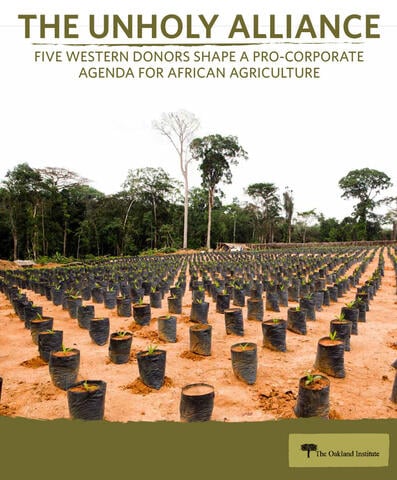
The Unholy Alliance Report Cover

http://www.oaklandinstitute.org/unholy-alliance-five-
western-donors-shape-pro-corporate-agenda-african-agriculture

The Unholy Alliance, Five Western Donors Shape a Pro-Corporate Agenda for African Agriculture, exposes how a coalition of four donor countries and the Bill and Melinda Gates Foundation is shaping a pro-business environment in the agricultural sector of developing countries, especially in Africa.

Etiquetas: , , ,

domingo, abril 10, 2016

For Your Own Good! Embedding Transnational Agribusiness and GMOs into African Agriculture


http://www.counterpunch.org/2016/04/05/for-your-own-good-embedding-
transnational-agribusiness-and-gmos-into-african-agriculture/

This indicates that the GM industry, under the veil of technology donations and public financing, is effectively managing to make further inroads into imposing GM on the African continent. By focusing the research on traits meant to ‘benefit’ farmers and malnourished populations, through inter alia, biofortification, the industry is intent on giving a humanitarian face to the real involvement, vested interests and expanding influence of these MNCs in African agriculture.

- Mariam Mayet, African Center for Biodiversity

Etiquetas: , ,

viernes, febrero 05, 2016

GM Cotton's Future in Africa on Shaky Ground


http://www.biosafety-info.net/article.php?aid=1218

THIRD WORLD NETWORK BIOSAFETY INFORMATION SERVICE

Monsanto’s genetically modified (GM) insect-resistant (Bt) cotton is grown in South Africa and Burkina Faso. A recently published journal paper explains how within 10 years of its introduction, most growers had abandoned Bt cotton altogether in Makhathini, South Africa, and why Burkina Faso has begun a complete phase out of GM cotton, in spite of being Africa's top cotton producer.

Burkina Faso's conventional cotton traditionally had a stellar international reputation and commanded a premium price based on its high quality, namely, its high ginning ratio and long staple length. Both qualities have seriously declined with the GM cotton, seriously undermining the reputation and value of Burkinabè cotton on the international market and compromising the profits of Burkinabè cotton companies. The companies are reportedly demanding that Monsanto compensate them to the tune of USD 280 million for losses incurred due to declines in quality since 2010.

The Burkina Faso case points to the risks of unintended effects in GM crops, in this instance, the insertion of the Bt trait into the local variety appears to have interfered unexpectedly with some of its most important characteristics, affecting commercial value. Also the exclusive focus on pest mitigation contrasts sharply with the Francophone West African breeding programmes, which have spent decades successfully integrating a broad spectrum of adaptability (to local growing conditions) and fibre quality characteristics. While yields were high, the experience of Burkina Faso demonstrate that focus on yield is not the defining factor of a crop’s success.

One possible implication of this phase out is that other Francophone African countries may be reluctant to adopt Bt cotton given the risks to their own highly valued reputations. It may also discourage other African countries that are considering the adoption of Bt cotton in the next few years. According to the paper, a key determinant will be the extent to which African governments and citizens are reassured that the transplantation of GM traits into their own cultivars will leave their most valued characteristics unchanged.

Etiquetas: , , ,

domingo, noviembre 29, 2015

Dangers of the Gates Foundation: Displacing Seeds and Farmers

http://foodfirst.org/dangers-of-the-gates-foundation-displacing-seeds-and-farmers/

From a presentation by Mariam Mayet
Edited by Simone Adler
November 18, 2015
 Mariam is the founder and director of the African Centre for Biodiversity in South Africa.Mariam Mayet - small
 This is the first in a two-part article with Mariam Mayet. Please check back later in this series for further discussion on how the African Centre for Biodiversity is fighting back effectively to keep seeds in the hands of farmers and out of the multinational corporations’.
Our farmer-managed seed systems in Africa are being criminalized and displaced by a very aggressive green revolution project of corporate occupation by big multinational companies. This violent agrarian transformation is facing profound objection. African farmer organizations are outraged because decisions have been made and imposed on us in a very patronizing, patriarchal way, as if the agrarian vision and solution has been designed for us.

Etiquetas: , , ,

domingo, junio 14, 2015

La Fundación Gates y la promoción de transgénicos en África - Boletín 611 de la RALLT

Biodiversidad en América Latina | Fundación Gates y la promoción de transgénicos en África - Boletín 611 de la RALLT


"Sobre las ayudas de la Fundación Gates a la agricultura empobrecida de África podemos defender una tesis más atrevida aún: con los supuestos fondos solidarios, lo que busca la fundación no es frenar el hambre o la malnutrición en África, sino permitir el avance de los negocios agrícolas en los que ha depositado su dinero."
RED POR UNA AMÉRICA LATINA LIBRE DE TRANSGÉNICOS
BOLETÍN 611
Contenido
GATES, AYUDAS QUE LE AYUDAN
¿POR QUÉ EL MUNDO RICO ACAPARA LAS AYUDAS DE BILL GATES?
GATES, MONSANTO Y EL MAÍZ CON USO EFICIENTE DEL AGUA

Etiquetas: , , ,

miércoles, mayo 06, 2015

Gates and Monsanto’s Water Efficient Maize for Africa (WEMA) Project

http://acbio.org.za/index.php/publications/gmos-in-south-africa/479-gates-and-monsantos-water-efficient-maize-for-africa-wema-project

WEMA reportIn this report, the ACB interrogates the Gates Foundation and Monsanto’s Water Efficient Maize for Africa (WEMA) project and exposes it to be nothing more than corporate “green washing,” designed to ensnare small holder farmers into adopting hybrid and GM maize in order to benefit seed and agro-chemical companies.

 Download 1 Mb

Etiquetas: , , ,

lunes, diciembre 08, 2014

¿Cómo gasta la Fundación Gates su dinero para alimentar el mundo?

http://www.grain.org/es/article/entries/5078-como-gasta-la-
fundacion-gates-su-dinero-para-alimentar-el-mundo

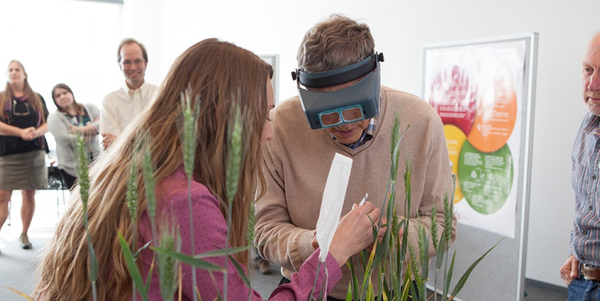
Bill Gates en la Universidad de Cornell intentando hacer polinización cruzada de trigo (Photo: Universidad de Cornell)

La Fundación Gates es posiblemente, como nunca se ha visto, el mayor emprendimiento filantrópico. Actualmente mantiene un fondo por $40 mil millones, captado mayormente a partir de la propia riqueza de Gates y de su amigo multimillonario Warren Buffet. La Fundación tiene un personal de más de 1.200 personas y ha entregado sobre US$30 mil millones en donaciones desde su creación en el año 2000, tres mil seiscientos millones solamente en 2013.2 La mayoría de las donaciones son para los programas globales de salud y trabajo educacional en los Estados Unidos, tradicionalmente las áreas prioritarias de la Fundación. Pero en los años 2006-2007, la fundación expandió de manera masiva su financiamiento para la agricultura, con el lanzamiento de la Alianza para una Revolución Verde en África (AGRA) y una serie de grandes donaciones al sistema internacional de investigación agrícola (CGIAR). En el año 2007 gastó sobre quinientos millones de dólares en proyectos agrícolas y el financiamiento lo ha mantenido cercano a este nivel. La gran mayoría de las donaciones agrícolas de la fundación se centran en África.

Etiquetas: , , ,

domingo, noviembre 30, 2014

GRAIN report: How does the Gates Foundation spend its money to feed the world?

http://www.grain.org/article/entries/5064-how-does-the-gates-
foundation-spend-its-money-to-feed-the-world

GRAIN | 04 November 2014 | Against the grain
Listening to farmers and addressing their specific needs. We talk to farmers about the crops they want to grow and eat, as well as the unique challenges they face. We partner with organizations that understand and are equipped to address these challenges, and we invest in research to identify relevant and affordable solutions that farmers want and will use.”
First guiding principle of the Gates Foundation's work on agriculture.1
At some point in June this year, the total amount given as grants to food and agriculture projects by the Bill and Melinda Gates Foundation surpassed the US$3 billion mark. It marked quite a milestone. From nowhere on the agricultural scene less than a decade ago, the Gates Foundation has emerged as one of the world's major donors to agricultural research and development.
Bill Gates at Cornell University, trying to cross-pollinate wheat. (Photo: Cornell University)
The Gates Foundation is arguably the biggest philanthropic venture ever. It currently holds a $40 billion endowment, made up mostly of contributions from Gates and his billionaire friend Warren Buffet. The foundation has over 1,200 staff, and has given over $30 billion in grants since its inception in 2000, $3.6 billion in 2013 alone.2 Most of the grants go to global health programmes and educational work in the US, traditionally the foundation's priority areas. But in 2006-2007, the foundation massively expanded its funding for agriculture, with the launch of the Alliance for a Green Revolution in Africa (AGRA) and a series of large grants to the international agricultural research system (CGIAR). In 2007, it spent over half a billion dollars on agricultural projects and has maintained funding at around this level. The vast majority of the foundation's agricultural grants focus on Africa.


******

We could find no evidence of any support from the Gates Foundation for programmes of research or technology development carried out by farmers or based on farmers' knowledge, despite the multitude of such initiatives that exist across the continent. (African farmers, after all, do continue to supply an estimated 90% of the seed used on the continent!) The foundation has consistently chosen to put its money into top down structures of knowledge generation and flow, where farmers' are mere recipients of the technologies developed in labs and sold to them by companies.

Etiquetas: , , , ,

jueves, noviembre 06, 2014

¿Por qué el mundo rico acapara las ayudas de Bill Gates?, por Rosa Bosch

http://www.biodiversidadla.org/Principal/Secciones/Noticias/Por_
que_el_mundo_rico_acapara_las_ayudas_de_Bill_Gates

La Bill & Melinda Gates Foundation, uno de los mayores donantes en proyectos de desarrollo, ha invertido en la última década un total de 3.000 millones de dólares en subvenciones para desarrollar la agricultura en los países pobres; la paradoja, según Grain -organización que apoya sistemas alimentarios basados en la biodiversidad y controlados localmente-, es que sólo el 4% de esta cifra, unos 120 millones, ha ido a parar a oenegés africanas.

Etiquetas: , ,

jueves, octubre 16, 2014

Acquisition of Africa’s SeedCo by Monsanto, Groupe Limagrain: Neo-colonial occupation of Africa’s seed systems

fake-Dubai-seeds-kenya
MEDIA RELEASE
Addis Ababa 7 October 2014
The Alliance for Food Sovereignty in Africa (AFSA) is deeply concerned about the recent acquisitions by multi-national seed companies of large parts of SeedCo, one of Africa’s largest home-grown seed companies. Attracting foreign investment from the world’s largest seed companies, most of who got to their current dominant positions by devouring national seed companies and their competitors through mergers and acquisitions, is an inevitable consequence of the fierce drive to commercialise agriculture in Africa.

TO READ THE FULL STATEMENT:
http://seedfreedom.in/acquisition-of-africas-seedco-by-monsanto-groupe-
limagrain-neo-colonial-occupation-of-africas-seed-systems/


Etiquetas: , , ,

miércoles, septiembre 10, 2014

¿África libre de transgénicos?, por Javier Guzmán

http://www.biodiversidadla.org/Principal/Secciones/Documentos/Africa_libre_de_transgenicos

EXTRACTO:
En estos años la gran industria del agronegocio es consciente de que se juega el enorme pastel de la agricultura africana y por ello está invirtiendo ingentes cantidades de dinero con el objetivo de financiar estudios, universidades, ONG y programas que hagan proselitismo de la tecnología transgénica como es el caso de sobra conocido de la Fundación Bill y Belinda Gates que, junto con la Fundación Rockefeller, fundaron la Alianza para la Revolución Verde en África (AGRA).
Una alianza cuyo objetivo expresado es el de “ayudar a millones de campesinos africanos y sus familias a escapar de la pobreza y del hambre, implementando soluciones prácticas para mejorar su productividad”. En efecto, según el AGRA, mejorar la situación del campesinado africano consiste en distribuir semillas transgénicas, fertilizantes y pesticidas. Nada más alejado de la realidad.
Desde sus inicios, AGRA ha generado un amplio movimiento de denuncia y oposición por parte de las propias organizaciones campesinas africanas y de la sociedad civil, más cuando la organización Community Alliance for Global Justice reveló que la Fundación Bill and Belinda Gates es ya propietaria de 500.000 acciones de la principal multinacional de semillas transgénicas, la tristemente célebre Monsanto.
Pero debido a la enorme presión internacional y rechazo de la sociedad civil estas industrias han ido más allá, y para ello necesitan la ayuda de los gobiernos, como es el caso de los Estados Unidos y Reino Unido. Así es como, de la mano de 48 empresas transnacionales (tales como Mosanto, Cargill, Sygenta) nace, en el año 2012, la Nueva Alianza para la Seguridad Alimentaria y Nutrición. La alianza tiene como objetivo movilizar capital privado dirigido a la inversión en la agricultura africana y para ello en el momento histórico donde menos recursos existen para la cooperación internacional, ha recibido compromisos de inversionistas privados por un total de más de 10.000 millones de dólares, según anunciaron funcionarios estadounidenses y africanos en la Cumbre de Líderes de EE UU este pasado mes de agosto. La alianza ofrece financiación para la inversión en agricultura, pero no a cualquier precio. Para poder firmar un acuerdo de este tipo, el gobierno del país africano ha de comprometerse a realizar enormes cambios, por ejemplo, en sus políticas de tierras, semillas y en su modelo de agricultura, para, según palabras de los promotores de la alianza, “adecuarse” al desarrollo de las inversiones. Estas transformaciones ya son conocidas como las leyes Monsanto
Parece que una vez más en el continente africano los lobos llevan piel de cordero. Se trata, sin más, de nueva forma de colonización y expolio de los recursos del continente africano. Se trata, al fin, de la destrucción de su soberanía alimentaria. Estas multinacionales saben perfectamente que quien gane la batalla del control de las semillas controlará la alimentación a nivel global. Ahora es necesario que a nosotros no se nos olvide.
Javier Guzmán es director de VSF Justicia Alimentaria Global.
Fuente: El país

Etiquetas: ,

sábado, octubre 26, 2013

Monsanto's failed SA GM Maize pushed into rest of Africa

http://www.acbio.org.za/index.php/media/64-media-releases/448-monsantos-failed-sa-gm-maize-pushed-into-rest-of-africa

Thursday, 24 October 2013 08:36
BT-Maize-Report-Oct2013Today the African Centre for Biosafety (ACB) released a new report ‘Africa bullied to grow defective Bt Maize: the failure of Monsanto’s MON810 maize in South Africa’i, showing how Monsanto’s GM maize, which utterly failed in SA, is now being foisted on the rest of the continent, through ‘sleight of hand’.

Independent scientists have shown that Monsanto’s GM maize variety, MON810 – which has been growing in SA for 15 years – has completely failed due to the development of massive insect resistance, leading to the GM maize being withdrawn from the SA market. Monsanto has compensated farmers who were forced to spray their crops with pesticides to control the pests, calling into serious question the very rationale for GM crops.

According to the Director of the ACB, Mariam Mayet, ‘Monsanto got the science completely wrong on this one. Independent biosafety scientists have discovered that the inheritance of resistance in African stem borers is a dominant, not recessive, trait as erroneously assumed. Hence the insect resistance management strategies that Monsanto developed, and accepted by our regulators, based on these erroneous assumptions, were utterly ineffective.’

Undeterred, Monsanto is now pushing its flop GM maize onto the rest of the continent. According to the ACB report, Monsanto has now donated its MON810 GM technology ‘royalty-free’ to a Gates Foundation/Monsanto funded ‘philanthropic’ project, Water Efficient Maize for Africa (WEMA). WEMA is being rolled out in Mozambique, Kenya, Uganda and Tanzania. The defective GM maize is set to be approved for commercial growing by 2015.

WEMA was first touted for a good number of years, with much fanfare, as a charitable project intent on bringing drought tolerant maize varieties to resource poor African small farmers. However, with a sleight of hand and stony silence, WEMA has included MON810 into the mix. Field trials with MON810 are already running in Kenya and Uganda. In response to the project, the Mozambican government is now changing its biosafety laws to allow for the cultivation of GM crops while WEMA is pressurising the Tanzanian government to change the country’s biosafety law that will hold Monsanto strictly liable for damages that may arise.

According to researcher with the ACB, Haidee Swanby, ‘WEMA is a convenient vehicle for Monsanto to gain regulatory approval for its controversial technology in African countries. However, “royalty-free” seed simply means that resource strapped commercial farmers will get the seed at the same price as hybrid seed, which means that these seeds will be prohibitively expensive. The patents on the gene sequences still reside with Monsanto, and farmers will have to pay premium prices for the GM seeds.’

The ACB report also highlights that Monsanto’s MON810 GM trait has been genetically engineered into a local Egyptian maize variety called Ajeeb. ‘Ajeeb Yieldgard’ has now been patented by Monsanto and ‘approved’ for commercial growing through circumvention of the Egyptian biosafety law. Significantly, the report highlights that the Egyptian government has published peer reviewed independent and publically funded biosafety studies on MON810 showing serious risks to human and animal health.

Said Swanby, ‘The scariest revelation is that GM producers and regulatory authorities are making it all up as they go along, while the massive biotech PR machinery spreads the myth that these crops are connected to feeding the poor in Africa.’

Download the full report.

Etiquetas: , , , ,

GMO fiasco in Africa


Etiquetas: , ,

viernes, octubre 18, 2013

Implications and challenges of GM crops in Africa

http://www.biosafety-info.net/article.php?aid=1011

THIRD WORLD NETWORK BIOSAFETY INFORMATION SERVICE  

Dear friends and colleagues,


Re: Implications and challenges of GM crops in Africa


We are pleased to highlight two papers published in a scientific volume on the ecological effects, on a landscape scale, of GM crop cultivation. The papers look at the co-existence challenges in small-scale farming when farmers share and save seed, and the implications of GM crops in subsistence-based agricultural systems in Africa.


The first paper presents preliminary investigations from a small-scale maize farming community in Zambia, to illustrate the significance of seed saving and sharing for patterns of gene flow (Item 1). Given the high density, small sizes and close distances between fields observed, non-GM fields would rapidly be cross-contaminated by pollen flow. Moreover, open pollinated varieties have higher outcrossing rates than hybrids, hence farming practices that use an increasing proportion of open pollinated varieties/landraces will be more vulnerable to cross-contamination by pollen.


The practice of re-using seeds was a common feature among the farmers and was seen as an important part of local food security and independence. The farmers re-used not only local maize varieties, but sometimes also commercial hybrid varieties, linking the formal and informal seed systems. Thus, although transgenes would likely be introduced as commercial hybrid seeds in the formal seed system, they might eventually find their way into the informal seed system. The combination of pollen flow and the tradition to re-using seeds would potentially spread and keep transgenes, if introduced, in circulation from year to year.


The practice of sharing seeds with family members and friends was also common, primarily within the local community. In a GM maize scenario, seed sharing would spread transgenes quickly within the community, and also across communities as exemplified by a farmer sharing seeds up to a distance of 100 km. This would mean that the diffusion of transgenes would not be limited to the community of introduction, but also lead to spread across a larger region.


Both pollen flow between closely positioned maize fields, and sharing of seeds between farmers represent high rates of gene flow. Thus, the paper concludes, if transgenes are introduced into small-scale agricultural contexts, uncontrolled diffusion and further spread seems unavoidable, while removal of transgenes as well as the regulatory implications are highly challenging.


The second paper concludes that the potential introduction of GM crops into small-scale farming in Africa would lead to huge consequences from emerging ecological, economic and trade impacts (Item 2). From an ecological perspective, GM crops would lead to uncontrolled large-scale spread and persistence of transgenes within the small-scale agricultural systems in Africa, with unpredictable recombination and evolution in crop meta-population. Socio-cultural implications relate to intellectual property rights, which threaten traditional seed use patterns. Impurities in harvest would prevent development and export options. Major challenges in regulatory decision-making are envisaged since traceability, administrative regulation and resistance management regimes are difficult to impossible. The paper therefore makes a strong call for a precautionary approach to biosafety in the face of uncertainty.


With best wishes,


Lim Li Ching


Third World Network


TO READ THE PAPERS:

http://www.biosafety-info.net/article.php?aid=1011

Etiquetas: , ,

domingo, septiembre 08, 2013

AGRA: helping agribusiness conquer African agriculture?

http://www.greenpeace.org/international/en/news/Blogs/makingwaves/agra-agribusiness-africa-agriculture/blog/46511/

Blogpost by Iza Kruszewska and Glen Tyler - September 6, 2013

Finally, we have confirmation of what we have long suspected: AGRA, the Alliance for a Green Revolution in Africa, has been created to facilitate the corporate takeover of African agriculture, not support African smallholder farmers with real solutions.
AGRA’s African Agriculture Status Report 2013 released two days ago confirms the organisation’s Green Revolution agenda, despite the legacy of soil degradation and water depletion left by the Green Revolution in Asia.
AGRA, founded by the Gates and Rockefeller Foundations in 2006, claims that it is spurring a “uniquely African Green Revolution”, but there’s little original thinking here. Instead, it seems to be more of the same agenda that locks farmers into a spiral of corporate control, making them dependent on seeds and fertilisers from transnational corporations which dictate price and product delivery times.
Farming In Kenya

Etiquetas: , , ,

miércoles, agosto 28, 2013

Africa’s Food Sovereignty Under Attack By Corporate Interests

Press Release
15 August 2013
Alliance for Food Sovereignty in Africa

Alliance for Food Sovereignty in Africa (AFSA), a coalition of pan-African networks, with members in 50 African countries and representing smallholder farmers, indigenous peoples and civil society, met in Addis Ababa 12-16th August 2013 to formulate an action plan to safeguard Africa’s sovereignty over its food, seeds and natural resources from the assault on Africa’s food systems.
Africa’s diversity and knowledge systems are being threatened by corporate and genetically modified (GM) seeds, agro-chemicals, resource grabs and laws that prevent farmers from freely using, sharing or selling their seed.
These threats come from amongst others, the Alliance for a Green Revolution in Africa (AGRA) and the G8 "New Alliance for Food Security and Nutrition" that strongly promote the interests of multinational seed, fertilizer and agro-chemical companies at the expense of the rights and interests of smallholder farmers.
Currently, 80% of seed in Africa is bred by smallholder farmers, who freely save and share seed, resulting in a wide diversity of agricultural crops and a safety net for food security. “We are outraged at the way African governments are being strong-armed into adopting draconian seed laws that ensure the dominance of corporate seeds; giving private breeders monopoly and exclusive marketing rights over seeds” said Elizabeth Mpofu, from La Via Campesina Africa.
The entry point for corporate agribusiness into Africa is through valuable cash crops such as cotton. Bt cotton is promoted as necessary for African farmers to compete on the global cotton market. "Bt cotton production in Burkina Faso and South Africa has failed to achieve its promise. Small farmers are finding that yields and quality of Bt cotton are extremely low. For this reason Bt cotton planting this year has plunged from 400,000 hectares to 200,000 hectares in Burkina Faso." Fatou Batta, Association Nourrir Sans Détruire, Burkina Faso.
The G8 New Alliance places a heavy emphasis on nutrition that focuses almost exclusively on the bio-fortification of key staple crops.  According to Bernard Guri from COMPAS Africa  “Bio-fortification is a dangerous distraction from real solutions for nutrition such as increasing crop diversity. We cannot look to dependence on so-called ‘fortified’ crops, whilst ignoring the real socio-economic causes of malnutrition.”
The many pan-African networks belonging to AFSA all note with great concern the increasing acquisition of huge areas of African land by mining conglomerates and biofuel and export agribusiness.  Smallholder farmers such as those displaced by these land grabs feed 70% of the world. Their model of agro-ecological family farming is the most efficient and productive in the world. We must support them instead of undermining their knowledge and practice." said Million Belay, Coordinator of AFSA
Notes to Editors
The ALLIANCE FOR FOOD SOVEREIGNTY IN AFRICA (AFSA) is a Pan African platform comprising networks and farmer organisations working in Africa including the African Biodiversity network (ABN), Coalition for the Protection of African Genetic Heritage (COPAGEN), Comparing and Supporting Endogenous Development (COMPAS) Africa, Friends of the Earth- Africa, Indigenous Peoples of Africa Coordinating Committee (IPACC), Participatory Ecological Land Use Management (PELUM) Association, Eastern and Southern African Small Scale Farmers‟ Forum (ESSAFF), La Via Campesina Africa , FAHAMU, World Neighbours, Network of Farmers' and Agricultural Producers' Organizations of West Africa (ROPPA), Community Knowledge Systems (CKS), Plate forme Sous Régionale des Organisations Paysannes d'Afrique Centrale (PROPAC) and African Centre for Biosafety (ACB).
AFSA members represent small holder farmers, pastoralists, hunter/gatherers, indigenous peoples, citizens and environmentalists from Africa who possess a strong voice that shapes policy on the continent in the area of community rights, family farming, promotion of traditional knowledge and knowledge systems, the environment and natural resource management. Thus, providing a forum to analyse, discuss issues, challenge policies and identify ways forward.
Member countries of COMESA in collaboration with the African Seed Trade Association (AFSTA) and ACTESA (The Alliance for Commodity Trade in Eastern and Southern Africa have drafted seed registration law that will be considered by COMESA governments in September 2013. These draft Regulations create a compulsory regional registration system allowing only marketing of private sector seeds while criminalizing the sale of smallholder farmer varieties that have evolved over centuries.
In addition, African regional institutions such as the African Regional Intellectual Property Office (ARIPO) and the South African Development Community (SADC) have also developed draft intellectual property frameworks that only grants proprietary rights to the private sector varieties, while preventing small-holder farmers from continuing their sustainable farming practices of freely using,
exchanging and selling seeds. Theseframeworks enables corporate take-over of African seeds and undermines seedsovereignty.

Etiquetas: ,

jueves, marzo 21, 2013

GM crops a failure in developing countries, says Friends of the Earth

viernes, marzo 15, 2013

BILL'S EXCELLENT AFRICAN ADVENTURE: A TALE OF TECHNOCRATIC AGROINDUSTRIAL PHILANTHROCAPITALISM

http://www.councilforresponsiblegenetics.org/GeneWatch/GeneWatchPage.aspx?pageId=459

Article by Philip Bereano


From 2009 to 2011, Bill Gates' foundation spent $478,302,627 to influence African agricultural development. Adding in the value of agricultural grants going to multiple regions and those for 2012, the Foundation's outlay to influence African agriculture is around $1 billion. Of course, Gates is not an African, not a scholar of Africa, not a farmer, and not a development expert. But he is a very rich man, and he knows how he wants to remake the world.

Etiquetas: , , , ,

martes, febrero 26, 2013

El Centro Africano para la Bioseguridad denuncia informe de la industria biotecnológica por malicioso y erróneo

viernes, junio 22, 2012

Burkina Faso: ALGODÓN DE MONSANTO DESTRUYE LA TIERRA


Location of  Burkina Faso  (dark blue)– in Africa  (light blue & dark grey)– in the African Union  (light blue)  —  [Legend]


En la India: Monsanto admite el fracaso de su algodón Bt
En Burkina: Gobierno y SOFITEX ¡ se obstinan !
 
Para estimular a los algodoneros burkinabé a que se dedicasen al algodón Bt de Monsanto, alabaron, sin matices, las ventajas de su algodón OGM. Tanto es así que muchos productores esperaban una planta milagrosa, Hoy están desilusionados.
 
« La euforia no duró mucho tiempo... muy por debajo de sus expectativas ». Abdou Nignan, presidente de la Unión Provincial de Productores de Sissili, dijo estar muy decepcionado Mientras que en 2008, contaba con un rendimiento de 1 200 kg por hectárea, se encontró con menos de una tonelada en la última cosecha. 
 
« Idrissa Kabore de Nayala piensa tirar la toalla en los próximos años. No soporta más el andar de un lado para otro cada año. Debido al mal inicio de las lluvias, se vio obligado a sembrar por segunda vez siendo el precio de la simiente muy alto » (27 000 F los 10 kg para el algodón Bt, frente a 1 000 F los 50 kg para el algodón convencional ¡ 135 veces más caro !)
 
« Además, las moscas destruyeron las cápsulas de su algodón Bt, cuando, según tenía entendido, se suponía que el Bt resolvía esos problemas. 
 
A esto, hay que añadir también las noticias provenientes de India. « Gran noticia en India : Monsanto admite el fracaso de su algodón Bt».
 
En el 2002, se autorizó el algodón Bt Bollgard I y éste se cultivó en nueve estados de la India. Después de ocho años de comercialización, Monsanto anuncia haber detectado una deficiencia en este algodón Bt : los gusanos rosas de la cápsula se han vuelto resistentes a la toxina producida por este algodón Bt.
 
La resistencia se ha descubierto gracias a pruebas ‘en campo’ realizadas por Monsanto en cuatro condados (Amreli, Bhavnagar, Junagarh y Rajkot) del Estado de Gujarat en 2009, pruebas efectuadas para evaluar la eficacia de este algodón Bollgard I.
 
Para la empresa, la resistencia al algodón Bollarg I «es natural e incluso esperada». No porque este algodón sea intrínsecamente malo, sino, según Montsanto, porque los algodoneros indios que no habrían respectado las zonas refugio que este tipo de cultivo requiere.
 
Esta resistencia es ¡ natural y esperada ! De acuerdo, pero, que yo sepa, es la primera vez que Montsanto habla con claridad. Y, aquí, en Burkina, nunca he oído hablar de eso a la Sofitex o al Gobierno. En cuanto a ‘las zonas refugio’ que no se han sido respectadas, también era previsible y esperado. Los pequeños productores burkinabé no lo harán mejor. Sólo los grandes terratenientes pueden respectarlas.
 
Pero, frente a este “fracaso” del algodón Bollgard I, Monsanto recuerda que ya dispone del algodón Bollgard II, precisando que es «más eficaz». Según Devinder Sharma, del Foro sobre Biotecnologías y Seguridad Alimentaria, el verdadero motivo de Monsanto para reconocer públicamente el fracaso de su primer algodón radica en la intención prioritaria de comercializar el algodón Bollgard II. El Bollgard II, comercializado en la India desde el 2006, contiene dos proteínas tóxicas en lugar de una.
 
¡ Sólo que su semilla es 2 o 3 veces más cara !
 
En Burkina Faso, que yo sepa, todavía estamos en Bollgard I. Todavía no he oído a la Sofitex (Sociedad burkinabé de fibras textiles) ni al Gobierno alertar a los algodoneros. ¿A quién se le ha dicho que la resistencia al algodón Bt es natural y esperada? ¿ Qué agricultor burkinabé está dispuesto a pagar 300.000 F por un saco de 50 kg se semillas Bollgard II ? (es más: 500.000 F, si se aplica el precio de Monsanto en India, para esta semilla).
 
Y, esto no es todo. El estudio más acertado, que aún faltaba, se refiere al impacto del cultivo del algodón Bt sobre el suelo. Hoy en día, este estudio existe. Merece una amplia difusión. «Un reciente estudio científico realizado por Navdanya ha comparado la tierra de los campos en los que se ha plantado el algodón Bt durante 3 años con la de los campos vecinos». Resultado: una degradación muy significativa de los suelos.
 
Es el primer estudio sobre el impacto a largo plazo del algodón Bt sobre los organismos del suelo. En 3 años, el algodón Bt redujo drásticamente la población de los microorganismos del suelo. A ese ritmo, una decena de años de cultivo del algodón OGM Bt podría destruir los organismos del suelo, dejando la tierra muerta, incapaz de producir alimentos.
 
Hace unos años, pedimos una moratoria de 5 años antes de introducir el cultivo del algodón OGM. Hoy, no se permite dudar. Hay que prohibir el cultivo del algodón Bt de Monsanto en Burkina (como lo ha hecho el gobierno de Andhra Pradesh, un estado al sur de la India), y en toda la CEDEAO.
 
Kudugu, 17 de abril 2010
Maurice Oudet
Présidente del SEDELAN

M

Etiquetas: , , , , ,