jueves, octubre 16, 2008

What's for dinner? Corn ethanol, feedlots and what you eat

by Annie Shattuck
April 10, 2008

The debate over renewable energy is raging. The U.S. Congress recently passed a renewable fuels mandate which will effectively create an artificial market for at least 15 billion gallons of corn ethanol per year. Numerous studies have criticized ethanol's environmental footprint. From negligible greenhouse gas savings to increased ground level ozone, and dependency on high-input agriculture–corn ethanol's critics have painted a picture of a costly band-aid for our energy crisis.

None of this analysis examines the full cost of the corn ethanol boom, which actually creates more by-product than it does fuel. Ethanol from corn produces seven pounds of by-product for every gallon of ethanol. This by-product is already in our food. If you eat beef, chances are you have eaten cattle fattened on this ethanol waste.

Dried distillers grains with solubles (DDGS) are the leftovers after corn has been milled and fermented into ethanol. Cattle nutritionists recommend including ethanol by-products in cattle diets at 20%-40% maximum. The quantity of distillers grain available is dictated by government incentives for fuel refining, leaving the ethanol industry to engineer demand for its waste. Without the sale of these ethanol by-products, corn ethanol is vastly less profitable. Industry claims that co-production of distillers grain with ethanol is a win-win proposition. Cattle producers get economical, high-protein feed, and America gets renewable fuel. However, the market for distillers grain is limited, and their disposal, like any other industrial by product, comes with costs to the environment, the economy and public health.

The Problem with Ethanol By-Products

Concentrated phosphorus and nitrogen in cow dung

Feeding distillers grain to cattle increases the amount of nitrogen and phosphorus in their feces. Unfortunately, the ratio of phosphorous to nitrogen is so high in this cow dung that it is of little use as a fertilizer. Cows fed a diet that includes 40% distillers grain, have fecal material with 41% more phosphorous and 33% more nitrogen than cows fed conventional feedlot diets. More than 40 percent more land will be needed to treat the waste of cows consuming this by-product if it is disposed of by spreading it over fields. Even if the proper amount of land can be dedicated to treating wastes, water quality around feedlots will likely worsen. Eutrophication—the process by which streams with high-nutrient runoff clog with vegetation, reducing oxygen in the water, and killing fish and other aquatic organisms—is a proven result of large-scale cattle and dairy operations. More nitrogen and phosphorous cycling through these operations will intensify the deterioration of streams and rivers.

Increasing nitrogen cycling through feedlots also increases greenhouse gas emissions. Nitrous oxide, a greenhouse gas 296 times more potent than carbon dioxide, is a major toxic emission from large-scale agricultural operations. Nitrous oxide forms when bacteria naturally present in soils convert biologically available nitrogen to a gas bound with oxygen. In areas where nitrogen runoff is high, nitrous oxide emission is also high. Cows fed a diet of 40% distillers grain increase the amount of available nitrogen in their excrement by 33% percent. The amount of available nitrogen that forms greenhouse gases varies according to treatment methods applied to the waste. With over 200 billion pounds of by-product slated to be produced annually under Congressional ethanol targets, feedlots all over the nation will increase their nitrogen and phosphorus emissions dramatically.

Food safety: Sulfur, polio and E. coli

The market for ethanol by-products is limited due to sulfur residues. Sulfuric acid and other sulfur compounds used in the distilling process combine with naturally-occurring sulfur in corn to produce unhealthy and potentially lethal levels of sulfur in distillers grain. The sulfur levels in ethanol by-products vary between plants and even between batches at the same plant, making it difficult to label or control. Sulfur, in excess of 0.4% in cattle diets will cause polioencephalomalacia, a deadly form of polio that produces brain lesions. The fine nutritional testing necessary to feed a diet heavy in ethanol waste favors large feedlot operations that can afford to test their water supply and distillers grain for sulfur. Smaller ranchers are unlikely to be able to use ethanol waste to the same degree as feedlots, putting family cattle operations in direct competition with ethanol plants for feed corn.

Feedlots that use ethanol waste also threaten the food supply with E. coli outbreaks. A recent Kansas State University study shows that distillers grain promotes the growth of E. coli. The study's authors warn of “serious ramifications,” predicting strong resistance to feeding ethanol waste. Cattle fed brewers grains, a similar product, are six times more likely to have E. coli in their feces than cattle fed real corn. E. coli outbreaks in factory farms are common. The use of ethanol by-products will doubly increase this phenomenon, both increasing the presence of E. coli and expanding the industrial model that makes our food system vulnerable to contamination in the first place.

The feedlot-refinery connection

Ethanol refineries and factory-style feedlots go hand in hand. For example, at an ethanol plant owned by E3 BioFuels corporation in Mead, Nebraska, manure from a 28,000-cow feedlot helps to power a 25 million gallon per year ethanol plant. In this system, the corn waste from the refinery makes up 40% of the cattle's diet. E3 plans to build larger ethanol plants with feedlots of 60,000-120,000 cattle. Such plants bring in a few jobs, but all of the added value of the ethanol stays with the refiner, while the community is left with despoiled water supplies, bad air quality, and all the other environmental problems associated with feedlots and refineries of that size. The pairing of feedlots and refineries makes sense from an industrial standpoint. Up to one third of the energy produced from ethanol is lost in the drying and shipping of its by-products. Pairing ethanol plants and feedlots eliminates drying and transportation costs. As more ethanol refineries are built around the country we can expect feedlots to follow, spoiling waterways and threatening food safety as they go.

Corporate consolidation and consumer choice

Corporate consolidation is occurring rapidly in the ethanol industry. Of the 119 ethanol plants operating in 2007, 49 of them were owned and operated by farmer cooperatives. But once ethanol refineries currently in construction come on line, farmers will only control 20% of the nation's ethanol (and distillers' grain) production capacity. Just as the refining business favors large corporations, the by-products industry will favor large corporate farms and feed lot operations. As ethanol drives corn prices up and the excess corn by-product becomes cheaper, factory feedlots and dairies are likely to edge out smaller operations that can't or don't want to use distillers grains. Consumers who prefer to avoid factory beef will have to buy from the small number of ranchers who sell to specialty markets.

READ THE REST: http://www.foodfirst.org/en/node/2079


Pouring Fire on the Food


This week’s headlines are ablaze with reports of food riots. Seemingly overnight, the world went from cheap food and surpluses to food prices spiking 80% and countries banning exports of food in an attempt to stave off shortages.

Welcome to the new world food crisis. Except that it has been brewing for decades. Ever since the World Bank and the International Monetary Fund broke down trade barriers in the global south—thus opening the gates for the dumping of subsidized grain from the U.S. and Europe—farmers in poor countries have steadily been driven out of business. Under the banner of “comparative advantage,” many poor countries that had previously been self sufficient in food were turned as a conscious matter of US foreign policy into food importing countries. But with the U.S. hoarding its corn and selling the rest of its food dear, these nations are left holding the poor end of an expensive stick.

Laying the blame on Australian droughts, rising meat consumption in China, the agrofuels boom, and the high cost of oil, our world leaders have been quick to offer a spate of solutions: A “New Deal” from the World Bank, another “Green Revolution” from the Bill and Melinda Gates and Rockefeller Foundations, and a quick $300 million in emergency food aid from the U.S. Billions more will be spent, and it’s a lucrative business. While agribusiness monopolies like ADM, Cargill, Monsanto and food giants like General Foods have remained conspicuously silent, about the crisis, over the pat three years, even as the crisis was unfolding, they were posting record profits of 60-80%.

Emergency measures are urgently needed to make food accessible to poor people. But so are profound changes to a globalized food system in need of repair. Inherently vulnerable to economic and environmental shock, we produce, process, transport and consume food in ways that are structurally dependent on vast amounts of petroleum, obsessed with three or four commodities, and subject to the unaccountable market power of a handful of seed, grain and chemical companies.

Unfortunately, the need for systemic change—not simply more of the same—is absent from official proposals to solve the food crisis. Perhaps this is understandable as it would mean that government, international finance institutions and agribusiness corporations acknowledge that they are part of the problem.

World leaders are rightly concerned about the wave of popular demonstrations against high food prices. With the exception of Haiti (where the poor are eating biscuits made of clay and vegetable oil), these street actions look more like angry rebellions of disenfranchised citizens than they do crazed rioting by starving masses. People are not just upset about high prices; it is the inherent injustice of the global food system that are driving them to revolt.

The International Assessment of Agricultural Science and Technology (IAASTD) recently released its final report in Johannesburg, South Africa. The result of an exhaustive 3-year international consultation similar to that of the Intergovernmental Panel on Climate Change, the IAASTD calls for an overhaul of agriculture dominated by multinational companies and governed by unfair trade rules. The report warns against relying on genetic engineered “fixes” for food production and emphasizes the importance of locally-based, agroecological approaches to farming. The key advantages to this way of farming—aside from its low environmental impact—is that it provides both food and employment to the world’s poor, as well as a surplus for the market. On a pound-per-acre basis, these small family farms have proven themselves to be more productive than large-scale industrial farms. And, they use less oil, especially if food is traded locally or sub-regionally. These alternatives, growing throughout the world, are like small islands of sustainability in increasingly perilous economic and environmental seas. As industrialized farming and free trade regimes fail us, these approaches will be the keys for building resilience back into a dysfunctional global food system.

Expecting solutions from the institutions that created the disaster in the first place is like calling an arsonist to put out the fire. Getting the poor back on the land and providing them the support presently being captured by the world's agri-foods monopolies would be a truly systemic and durable solution to our current global food crisis.


Eric Holt-Giménez, Ph.D.
Executive Director, Food First/Institute for Food and Development Policy
Oakland, California
510-654-4400 Ext 227
fax: 510-654-4551

Etiquetas: , , ,

miércoles, julio 16, 2008

Overview: Genetically Engineered Crops Will Not Solve the Global Food Crisis

We've compiled a list of reports on claims about GM solving the food crisis.

When the President of the American Farm Bureau Federation spoke at the UK's National Farmers Union (NFU) conference back in February of this year, he had a clear message:

"I think the debate about higher prices and being able to meet the demand of people in the world for food is a perfect opportunity to make the case (for GMO crops)...

"We may have a window of opportunity here and I would encourage you to exploit that." http://www.planetark.com/avantgo/dailynewsstory.cfm?newsi...

That exploitation has occurred big time ever since, but the reasons advanced for the adoption of GM crops have been spectacularly misleading - or in the words of Prof Dennis Murphy, the pro-GM head of biotechnology at the University of Glamorgan: "they're making these claims about GM crops solving the problem of drought or feeding the world, that's bullshit." http://www.spiked-online.com/index.php?/site/article/5438/

The publication today of GM Freeze's report on GM and drought confirms exactly what Prof Murphy says. http://www.gmfreeze.org/uploads/drought_briefing_final.pdf

And the new report is just one in a whole list of recent reports and articles debunking the claims being made for GMOs as a magic solution for the food crisis.

MUST READ ARTICLE

Superb overview of the misleading hype being promoted about GM crops. "Let's be clear. As of this year, there are no commercialized GE crops that inherently increase yield. Similarly, there are no GE crops on the market that were engineered to resist drought, reduce fertilizer pollution or save soil. Not one." -- Doug Gurian-Sherman, senior scientist at the Union of Concerned Scientists in Washington, formerly the EPA's biotech specialist and an advisor on biotech to the FDA, "Genetic engineering - a crop of hyperbole", The San Diego Union Tribune, 18 June 2008 http://www.signonsandiego.com/uniontrib/20080618/news_lz1...

REPORTS

*Debunking claims that GM crops are becoming the norm. Last year 97.6% of agricultural land globally was non-GM, and in the EU GM crops made up a mniscule percentage of agricultural land (0.21%). http://www.gmfreeze.org/uploads/GM_crops_land_area_final.pdf

*Debunking claims of increased yields with GM crops. Data comparing the yields of GM and conventionally bred crops show that GM crops have made no difference to yields, and in some cases have actually reduced yield by as much as 10%. http://www.gmfreeze.org/uploads/89D_yields_briefing%5B1%5...

*Debunking the claims of cheaper GM animal feed. GM animal feed has seen the fastest rate of feed price inflation! http://www.foeeurope.org/GMOs/animal%20feed/Briefing_anim... 08.pdf

*Debunking claims the EU's "zero-tolerance" policy on non-approved GMOs is no longer workable. http://www.foeeurope.org/GMOs/ZERO_TOLERANCE_Campaigner_b... http://www.foeeurope.org/GMOs/zero_tolerance.html

*Debunking claims of GM crops resistant to drought. http://www.gmfreeze.org/uploads/drought_briefing_final.pdf

Other recent reports:

*Briefing on solving the global food crisis http://www.foe.co.uk/resource/media_briefing/food_crisis.pdf

*Briefing on the main recommendations and findings of the International Assessment of Agricultural Knowledge Science and Technology for Development (IAASTD) report, which found GM was not the answer to the food crisis. http://www.gmfreeze.org/uploads/special_IAASTD_brieifing.pdf

Etiquetas: ,

jueves, julio 10, 2008

Organic Bytes #138: 7/7/2008

Twenty-Nine Nations Cut-Off Food Exports

Breaking NewsWhile U.S. consumers struggle to cope with steadily rising food and energy costs, a billion rural farmers and low-income families are suffering from what can only be described as a global food crisis. The New York Times reported last week that at least 29 countries have sharply curbed or completely cut-off grain exports to make sure their own populations have enough to eat. According to the article, "When it comes to rice, India, Vietnam, China and 11 other countries have limited or banned exports. Fifteen countries, including Pakistan and Bolivia, have capped or halted wheat exports. More than a dozen have limited corn exports."

Learn More Here

GNA Video Alert of the Week

GNA Survey LinkWatch this inspiring message from Ronnie Cummins, director of the Organic Consumers Association, along with an amazing song by progressive hip-hop artist Head-Roc and great images from the "real food" movement.

In the video, Ronnie talks about the Grassroots Netroots Alliance, a project the Organic Consumers Fund created to survey every local, state and federal politician on their position on organic food and farming and what they're going to do to support safe, affordable, and sustainable food systems.

As food grows less safe and more expensive, we can't continue to let candidates side-step this important issue. The current crisis requires that candidates address all of the interconnected life-and-death issues that face us from food, jobs, housing, health and energy to climate change and war.

Click Here to Watch

Alert: OCA Launches Kellogg's Boycott

Genetically Engineered Sugar to Hit Supermarket Shelves This Year

The Organic Consumers Association's (OCA) and allies are calling for a boycott of all Kellogg’s products after Kellogg’s refuses to source only GE-Free Sugar.

Eating CerealMonsanto’s RoundUp Ready Genetically Engineered Sugar is due to hit stores this year, exposing millions of consumers to untested and unlabeled “Franken Foods” that threaten human heath, the environment and farmers' rights everywhere.

Action Links:

Political Plunder of the Week

White House Lies to the World About Biofuels

Lies

A new report from the International Monetary Fund estimates that biofuels are responsible for as much as 30% of the global food shortage. Despite this fact, at the United Nation's emergency food summit in Rome, USDA Secretary of Agriculture, Edward Schafer, defended the U.S. government's decision to spend billions of dollars subsidizing corn and soybean-based ethanol and biofuel, falsely claiming that biofuels contributed only 2% to 3% of the overall increase in global food prices over the past year. According to USDA spokesman, Jim Brownlee, Mr. Schafer was unaware that his statistics were off by nearly 90%. Take Action: Click to Sign OCA's Biofuel Moratorium Petition

Vandana ShivaQuote of the Week

Organic Farming Can Feed the World

"The $1.2 billion the World Bank says will solve the food crisis in Africa is a $1.2 billion subsidy to the chemical industry. Countries are made dependent on chemical fertilizers when their prices have tripled in the last year due to rising oil prices. I say to governments: spend a quarter of that on organic farming and you've solved your problems."

-Vandana Shiva, an Indian physics professor and Organic Consumers Association Advisory board Member, speaking in Italy in response to the the U.N. food summit in Rome last month, where the World Bank pledged $1.2 billion in grants to help with the food crisis, most of which is earmarked for chemical fertilizers, pesticides and genetically modified (GM) crops.

Source: www.organicconsumers.org/articles/article_13332.cfm

Syngenta Confesses

Genetically Modified Crops Cannot Feed the World

SyngentaIn a revealing interview with the Guardian UK last week, Martin Taylor, the chairman of one of the world's leading sellers and promoters of seeds for GM crops, Syngenta, admitted that biotech foods cannot feed the world. Taylor told the Guardian, "GM won't solve the food crisis, at least not in the short term." This is in stark contrast to the biotech industry's ongoing propaganda that the world must embrace genetically engineered crops in order to feed the world's growing population. Although Syngenta and other biotech giants like Monsanto regularly also claim that GM crops are environmentally sustainable, Syngenta's chairman confessed the biotech industry's real focus is on lucrative crops and high-priced seeds and pesticides with "hardly any environmental benefits".

Learn more: www.organicconsumers.org/articles/article_13337.cfm

Related Study of the Week

Genetic Farmer"Assessment of the GM technology lags behind its development, information is anecdotal and contradictory, and uncertainty about possible benefits and damage is unavoidable."

Source: A report released earlier this year from the United Nations World Food Program. The study was funded by the biotech industry and 60 nations, including the U.S., and clearly admits that genetically modified crops are not the solution to the food crisis. Upon finding out the results, the US, UK, Australia and Canada refused to endorse the international study. The study also warns that biofuels and climate change are leading causes of the global food crisis.

Read study here: www.agassessment.org/

Sustainability News of the Week

Positive Solutions - from Panic to Organic

Ronnie CumminsWhile consumers struggle to fuel their cars and put food on the table, oil companies (like Exxon Mobil, BP and Conoco Phillips) and seed companies (like Monsanto, Cargill and ADM) are raking in record profits. In a fiery essay posted on the Common Dreams website and circulated widely on the internet, The Organic Consumers Association's National Director, Ronnie Cummins, shows how the food, climate and energy crisis are connected and how the time for positive change is now:
"Fortunately, there are hopeful signs that we can move beyond crisis to positive solutions. Connecting the dots in our food-climate-energy crisis, millions of green consumers are voting with their dollars for foods and products that are healthy, locally produced, energy efficient, and eco-friendly. A growing number of politicians, mainly at local and state levels, are also waking up. Organic food and farmers markets are booming. Chemical-free lawns and gardens, green buildings, solar panels, wind generators, "buy local" networks, and bike paths are sprouting. A critical mass of organic-minded Americans are waking up to the fact that we must green the economy, drastically reduce petroleum use and greenhouse gas pollution, re-stabilize the climate, and heal ourselves, before it's too late."

Read the full essay here: www.organicconsumers.org/articles/article_12893.cfm

Donate Here!

Donate Now!Help OCA Fight for Health, Justice, and the Environment - Support OCA with your stimulus check - During a recession, non-profits need private donor help more than ever.
www.organicconsumers.org/donations.htm

Etiquetas: , , , , , ,

martes, julio 08, 2008

The food emergency and food myths

http://www.grain.org/seedling/?id=552

Why Bush is wrong to blame Indians for the rise in food prices

Vandana Shiva *

United States President George W. Bush has a new analysis of the global rise in food prices. At an interactive session in the US state of Missouri on the economy, Bush argued that prosperity in countries like India had triggered increased demand for better nutrition. “There are 350 million people in India who are classified as middle-class. That’s bigger than America. Their middle class is larger than our entire population. And when you start getting wealthy, you start demanding better nutrition and better food so demand is high and that causes the price to go up.”

The myth that Bush is propagating is that of growth. It is being repeatedly stated that the rise in the price of food is due to “surging demand” in emerging economies like China and India. The argument is that, since the economies of China and India have grown, their people have become richer and are eating more, and this increased demand is leading to a price rise. This story might succeed in diverting US political debate away from the role of US agribusiness in the current food crisis, both through speculation and through the hijacking of food into biofuels, and in presenting economic globalisation as having benefited Indians, but the truth is that President Bush’s statement is false on many counts.

First, while the Indian economy has grown, the majority of Indians have become poorer because they have lost their land and livelihoods as a result of globalisation. Most Indians are, in fact, eating less today than a decade ago, before the era of globalisation and trade liberalisation. Per capita availability of food has declined from 177 kilograms per person per year (485 grams per day) in 1991 to 152 kg per person per year (419 g per day) today. Economic growth has gone hand in hand with growth in hunger. One million children in India die every year for lack of food.

Secondly, nutrition has deteriorated, even for the middle classes, from how it was before globalisation. The poor are worse off because their food and livelihoods have been destroyed. The middle classes are worse off because they are eating less healthily, as junk food and processed food enter India through globalisation. India is now at the epicentre of the problems of both malnutrition of the poor, who do not get enough food, and malnutrition of the rich, whose diets are being degraded. India has today not only the world’s largest number of hungry children but also the world’s largest number of diabetics.

India is perceived as an economic superpower with 9 per cent growth. Yet because this growth is based on a large-scale takeover of the land of tribals and peasants and large-scale destruction of the livelihoods of millions in agriculture, textiles and small-scale industry, poverty has grown.

In the past Indian farmers had seed security because 80 per cent of seed was farmers’ own seed, and 20 per cent came from the public sector seed farms. Globalisation has forced India to allow biotech giants such as Monsanto into the seed market. And Monsanto’s growth comes at the cost of farmers’ lives. More than 150,000 have committed suicide as they have got trapped in debt created by high cost, non-renewable, unreliable seed.

Indian farmers had market security. While producing the diverse crops they ate, they also used to grow rice and wheat for the national food security system, which, while paying the farmers a remunerative price, also provided the poor with affordable food through the Public Distribution System (PDS). Globalisation has destroyed the security of both the producers and the poor by integrating the local and domestic food economy into the speculative global commodity trade controlled by agribusiness.

Force-feeding is not free trade

While Indians are eating less, India is buying much more soya and wheat on the international market. These imports have been forced on India by US agribusiness, aided by the pressure of WTO rules and the US government. Such imports were not necessary before, because India was self-sufficient in wheat and edible oils.

The new food imports are the not the result of “demand” from India, but of the imposition of bad food. In 1998 India imported soya, even though we had adequate edible oils. With the US product benefiting from subsidies of nearly US$200 per tonne, these imports amounted to dumping. Millions of India’s coconut, mustard, sesame, linseed and groundnut farmers lost their market, their incomes and their livelihoods. And India’s healthy edible oils were replaced by unhealthy, genetically engineered soya oil and palm oil – industrial oils that have not been eaten in any traditional culture.

In 2005 India imported wheat as part of the US–India agreement on agriculture, even though India produced 74 million tonnes of wheat and did not need more. These imports are designed to destroy domestic production to create markets for US agribusiness. This is force-feeding, not free trade. The US wheat was declared unfit to eat, but the US arm-twisted India to dilute its health standards. Destruction of domestic production worldwide can only result in food scarcity and food insecurity. When food gets into the hands of global agribusiness, which makes profits through price fixing and speculation, a food emergency is inevitable.

We are seeing the serious consequences of the forced integration of the world’s food systems into a global commodity market through access rules of “free trade” controlled by agribusiness. The perturbations this is causing in local food systems are serious. Production everywhere is getting destabilised by speculative trade, creating both an absolute decline in local food production capacity and a relative decline in the entitlement of the poor, because of rising food prices.

The absolute decline in food production arises from three factors. First, the transformation of ecological biodiverse systems to chemical monocultures that produce more commodities but less food for the household and for local economies. Second, the shift from food crops to cash crops for export. Third, the vulnerabilities created by climate change, to which industrial farming and globalised food systems make a significant contribution.

Food security requires a strengthening of local and domestic food economies, the defence of rural livelihoods and small farmers, and the reining in of the global grain giants and their price fixing. We need anti-trust action against the agribusiness corporations which are at the heart of the current food crisis.

GMOs are a problem for food security, not a solution

There is increasing reference to new seeds and GMOs as a solution to the food crisis. GMOs, however, are part of the cause of the food crisis. Bt cotton has destroyed food production in India and has pushed farmers to suicide. Cotton used to be grown as an intercrop with food crops. Now it is a monoculture. With high production costs and low prices for their crops, farmers are trapped in both debt and hunger. GMOs do not, in any case, produce more food. There are only two traits commercialised in twenty years – herbicide resistant crops, and Bt toxin crops. Neither is a trait to improve yield. In fact, research shows a yield drag in GM crops. In India we see high risks of crop failure, with average yields of Bt cotton at 300–400 kg/acre, not the 1,500 kg/acre advertised by Monsanto.

It is a myth that industrial, chemical agriculture produces more food. Industrial monocultures produce more commodities, not more food. This is good for Cargill, ADM and Conagra. It is bad for farmers, the poor and the planet.

Food sovereignty is the answer to the food emergency

The current food emergency is a result of half a century of farming unsustainably, and one and a half decades of trading unfairly in food. The United Nations called an emergency meeting in early June 2008 to address the food emergency. Even the World Bank felt the need for an urgent response. Will the response intensify unsustainability and injustice, or will the global community use the crisis to advance sustainability, justice and fairness?

There are already signs that global agribusiness, which has created the crisis both historically and currently, will use it to increase its stranglehold on the world food system. Reducing import duties has been one response of governments to deal with rising food prices. But lowering import duties encourages the destruction of domestic markets and domestic production, thus aggravating the agrarian crisis, pushing more farmers into poverty and leading to an overall decline in food production. The crisis of rising food prices is a direct result of countries being forced by the World Bank, the WTO and regional and bilateral agreements to import food from US agribusiness that they did not need. Mexico was forced to import maize. India has been forced to import soya oil and wheat.

The World Bank’s call for contributions to the World Food Programme to increase by US$500 million and President Bush’s request to Congress to add US$770 million to the country’s food aid could become another subsidy to Cargill and ADM if the additional money is not accompanied by the creation of fair markets for farmers at local and regional levels. Emergency food aid cannot correct the distortions, unfairness or unsustainability of the food system as it is currently organised. Both trade rules and the paradigm of food production need to be changed.

The globalised system under corporate control is a recipe for food disasters and famines. Either we stop the damage through food democracy and rebuild food sovereignty by strengthening local economies and sustainable agriculture, or the corporate powers that have created the emergency will use it to deepen and expand their profits and control, while billions are condemned to starvation and death. And while people suffer, the corporations’ close allies, such as Bush, will continue to put a false spin on the causes of the food crisis.

China not to blame

GRAIN

Vandana Shiva argues forcefully that Indians are not eating better and, despite what President Bush says, the food crisis cannot be blamed on their “better nutrition” and “better food”. But it is also true that a small elite in both India and China are eating more meat. As Vandana Shiva points out, much of this meat is being consumed in the form of junk food and is thus less healthy, but could this additional demand nonetheless be contributing to the food crisis?

Daryll Ray, an investigator at the University of Tennessee, shows that this is not the case with respect to China. In a recent policy article, he looked at meat consumption in China. [1] Beef consumption indeed rose from 1.1 million tonnes in 1990 to 7.4 million tonnes in 2007. However, China supplied this additonal demand with additional domestic production, even achieving a small surplus, which it exported. The same with pork: consumption increased from 23 million tonnes to 45 million tonnes, but once again domestic production met the demand. It is almost the same with poultry: chicken consumption rose from 2.4 million tonnes to 11.5 million tonnes, with domestic production satisfying all the increased demand until 2007, when a small quantity (124,000 tonnes) was imported.

What about rice? Did China import a lot, thus causing scarcity elsewhere? Again the answer is “no”. Consumption rose from 124 million tonnes in 1990 to 134 million tonnes in 1999, but domestic production met the additional demand and provided a surplus, which was exported. And maize for animal feed? Yet again, China covers its own consumption and is an important exporter. Daryll Ray concludes: “The data do not support the often-stated implication that the sharp increase in grain prices is attributable to the Chinese diet change.”

So what does lie behind the food crisis? University lecturer Alejandro Nadal, commenting on Daryll Ray’s figures in an article in the Mexican newspaper La Jornada, has no doubts: “Today conglomerates like Archer Daniels Midland, Cargill, Bunge, Monsanto and Syngenta have so much control over markets and infrastructure that they can manage stocks, invest in grain futures and manipulate prices on a world scale so that they can obtain huge profits. But neither the WTO or the FAO are interested in tackling this problem.” [2]

1 http://agpolicy.org/weekcol/408.html
2 Alejando Nadal, “Precios de alimentos: adiós al factor China”, La Jornada, 11 June 2008, http://tinyurl.com/5lr3k8

Etiquetas: , , , ,

sábado, julio 05, 2008

So much for biofools- oh, I meant biofuels

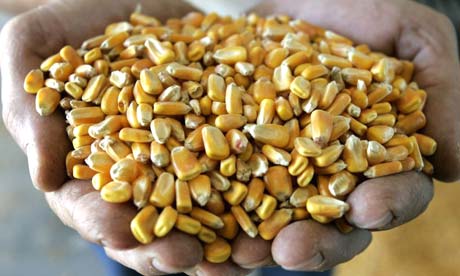
Corn used for biofuel

Secret Report: Biofuels Are Causing Food Crisis

NOTE from GM Watch: So now even the World Bank is confirming what we all knew - that the Bush-subsidised ethanol boom (with the EU's "biofuel" coming along in itswake) was by far the single most important factor in creating the food crisis that's driving 100m people worldwide below the poverty line. And exactly the same people that created this disaster by promoting the rush into "biofuels" are now promoting a rush for biotech as the solution!

EXTRACTS: Biofuels have forced global food prices up by 75%... The figure emphatically contradicts the US government's claims that plant-derived fuels contribute less than 3% to food-price rises. Senior development sources believe the report, completed in April, has notbeen published to avoid embarrassing President George Bush.
------
Secret report: biofuel caused food crisis
Aditya Chakrabortty
The Guardian, July 4 2008

http://www.guardian.co.uk:80/environment/2008/jul/03/biof...

Etiquetas: ,

lunes, junio 16, 2008

EU in bed with hunger profiteers : Dying for money


Monday, 16 June 2008

The farmers organisations and social movements CPE, COAG and Seattle to Brussels Network staged a symbolic action in Brussels on Fiday the 13th of June, 2008, to denounce the EU involvment in the corporate profit over the food crisis.

Last week in FAO conference on food security, the EU promoted more free-trade by concluding the Doha Round, fuelling cars instead of feeding people and more pesticides and fertilizers.

Over the last years, these so-called « solutions » have lead to more profits for the big agribusiness corporations and more poverty and hunger for the people.

Image

These figures are for just three months at the beginning of 2008.

Number of hungry people:

+ 100 million people, reaching one billion hungry people in the world (1/6 of the world total population)

Grain Trading:

Archer Daniels Midland (ADM): Gross profit: $1.15 billion, up 55% from last year

Cargill: Net earnings: $1.03 billion, up 86%

Bunge: Consolidated gross profit: $867 million, up 189%.

Seeds & herbicides:

Monsanto: Gross profit: $2.23 billion, up 54%.

Dupont Agriculture and Nutrition: Pre-tax operating income: $786 million, up 21%

Fertilizer

Potash Corporation: Net income: $66 million, up 185.9%

Mosaic: Net earnings: $520.8 million, up more than 1,200%


Meanwhile, local markets are being destroyed and land, water and seeds are being privatized, preventing peasants and small-scale farmers to supply their communities with appropriate food.

Small-scale food producers are able to produce healthy food for everybody. They supply local markets all over the world, while cooling down the earth and protecting biodiversity. For them to continue to do so and prevent further food crisis, we need market regulation and agrarian reform, we need food sovereignty.

STOP FREE-TRADE AGREEMENTS !

IMPLEMENT FOOD SOVEREIGNTY !

Contacts:

Seattle to Brussels Network: Tom Kurschaz +34 619949053

CPE: Morgan Ody +32 486888845


More information:
www.cpefarmers.org
www.coag.org
www.s2bnetwork.org
www.viacampesina.org

Etiquetas: ,

miércoles, mayo 07, 2008

Proteger vidas no es una palabra sucia
Tuesday, 06 May 2008

Documento de opinión – La Vía Campesina


(Yakarta, 6 de mayo de 2008) Mientras estallan los disturbios por hambre en todo el mundo, dirigentes mundiales como Pascal Lamy (Director General de la OMC), Dominique Strauss-Kahn, director del Fondo Monetario Internacional (FMI) y el Secretario General de la ONU Ban Ki-Moon están alertando de los peligros del proteccionismo. Según el señor Ban, “Más comercio, no menos nos sacará del agujero en el que estamos” (1)

Durante la década pasada, la comida se ha convertido en una mercancía en los mercados mundiales igual que cualquier otro bien, como las motocicletas o las camisetas de algodón.

La alimentación ha sido siempre negociada en los mercados internacionales, pero las reglas del juego cambiaron dramáticamente en 1995, cuando el acuerdo en la OMC sobre la agricultura entró en vigor. Muchos países que hasta entonces producían suficiente comida para su propia alimentación fueron obligados a abrir sus mercados a productos agrícolas del extranjero. México comenzó a importar maíz, Indonesia arroz, Europa soja. Al mismo tiempo, la mayoría de las regulaciones estatales sobre existencias de reserva, precios, producciones o control de las importaciones y exportaciones fueron desmanteladas gradualmente. Como resultado, las pequeñas explotaciones agrícolas y ganaderas de todo el mundo no han sido capaces de competir en el mercado mundial. Se arruinaron. En Europa, una explotación desaparece cada minuto. En el mundo en vías de desarrollo, ser agricultor o ganadero no es considerado como un trabajo; es un estado de pobreza.

Bajo las reglas del comercio libre, la protección de los alimentos se ha convertido en un crimen. El proteccionismo se ha convertido en una palabra sucia.

Mientras tanto, los países se ha convertido en adictos a las importaciones de alimentos baratos, y ahora que los precios se están disparando, la fea cabeza del hambre está creciendo.

El 30 de abril, el anterior Secretario General de la ONU, Kofi Annan, dijo que África podría alimentarse a sí misma. “África no puede continuar viviendo de comida importada o de subsidios a la alimentación”, dijo a la BBC. El movimiento internacional de campesinos La Vía Campesina, con sus cientos de millones de miembros en África y en todo el globo, está de acuerdo con estas palabras. Estamos convencidos que los países pueden y deben alimentarse a sí mismos. El movimiento ha defendido la soberanía alimentaria durante más de una década, firmemente convencido de que los mercados locales y las pequeñas explotaciones sostenibles son la más eficaz y limpia manera de producir alimentos.

Proteger la producción nacional es el derecho de todo país a proteger a sus propios habitantes del hambre y de permitir a sus propios campesinos vivir con dignidad. El mercado es, desde luego, una herramienta muy útil cuando permite que se cumplan las necesidades de las mujeres, de los hombres y de los niños. Pero esto reina cuando la lógica del provecho comienza a devastar la propia supervivencia de las personas. Por ejemplo, cuando se vuelve más rentable utilizar maíz y soja para producir combustible que para alimentar seres humanos.

Teniendo en cuenta las consecuencias mortales de la actual adicción a la importación de alimentos, es obvio que la ayuda alimentaria no resolverá la actual crisis; sólo incrementará la dependencia. Ni la agricultura industrial ni los OMG son la solución, ya que consumen grandes cantidades de energía fósil, destruyen el medio ambiente y dejan a los pequeños campesinos fuera del negocio.

Para encarar el reto actual de alimentar al mundo, ha llegado ahora el tiempo para que los gobiernos garanticen que los pequeños campesinos accedan a la tierra, a las semillas y al agua, que protejan los mercados locales de alimentos y que apoyen a agricultura y la ganadería campesina sostenibles. Estas políticas prácticas permitirían a millones de familias campesinas vivir decentemente y con dignidad, y contribuirán a sanear el medio ambiente terrestre herido. Y alimentarán al mundo.

Proteger vidas es una maravillosa palabra.

Henry Saragih,
Coordinador Internacional de La Vía Campesina

(1) http://www0.un.org/apps/news/infocus/sgspeeches/search_full.asp?statID=222

Etiquetas: ,

martes, abril 29, 2008

Making a killing from the food crisis

A new report by GRAIN -
http://www.grain.org/2/?id=39

The world food crisis is hurting a lot of people, but global agribusiness firms, traders and speculators are raking in huge profits.

Much of the news coverage of the world food crisis has focussed on riots in low-income countries, where workers and others cannot cope with skyrocketing costs of staple foods. But there is another side to the story: the big profits that are being made by huge food corporations and investors. Cargill, the world’s biggest grain trader, achieved an 86% increase in profits from commodity trading in the first quarter of this year. Bunge, another huge food trader, had a 77% increase in profits during the last quarter of last year. ADM, the second largest grain trader in the world, registered a 67% per cent increase in profits in 2007.

Nor are retail giants taking the strain: profits at Tesco, the UK supermarket giant, rose by a record 11.8% last year. Other major retailers, such as France’s Carrefour and Wal-Mart of the US, say that food sales are the main sector sustaining their profit increases. Investment funds, running away from sliding stock markets and the credit crunch, are having a heyday on the commodity markets, driving prices out of reach for food importers like Bangladesh and the Philippines.

These profits are no freak windfalls. Over the last 30 years, the IMF and the World Bank have pushed so-called developing countries to dismantle all forms of protection for their local farmers and to open up their markets to global agribusiness, speculators and subsidised food from rich countries. This has transformed most developing countries from being exporters of food into importers. Today about 70 per cent of developing countries are net importers of food. On top of this, finance liberalisation has made it easier for investors to take control of markets for their own private benefit.

Agricultural policy has lost touch with its most basic goal: that of feeding people. Rather than rethink their own disastrous policies, governments and think tanks are blaming production problems, the growing demand for food in China and India, and biofuels. While these have played a role, the fundamental cause of today's food crisis is neoliberal globalisation itself, which has transformed food from a source of livelihood security into a mere commodity to be gambled away, even at the cost of widespread hunger among the world’s poorest people.

=============

GRAIN, "Making a killing from hunger: We need to overturn food policy, now!" Against the grain, April 2008,
http://www.grain.org/2/?id=39
and in PDF
http://www.grain.org/2/?id=39&pdf

Etiquetas: ,

lunes, abril 28, 2008

The World Food Crisis

The only surprising thing about the global food crisis to Jim Goodman is the notion that anyone finds it surprising. "So," says the Wisconsin dairy farmer, "they finally figured out, after all these years of pushing globalization and genetically modified [GM] seeds, that instead of feeding the world we've created a food system that leaves more people hungry. If they'd listened to farmers instead of corporations, they would've known this was going to happen." Goodman has traveled the world to speak, organize and rally with groups such as La Via Campesina, the global movement of peasant and farm organizations that has been warning for years that "solutions" promoted by agribusiness conglomerates were designed to maximize corporate profits, not help farmers or feed people. The food shortages, suddenly front-page news, are not new. Hundreds of millions of people were starving and malnourished last year; the only change is that as the scope of the crisis has grown, it has become more difficult to "manage" the hunger that a failed food system accepts rather than feeds.

The current global food system, which was designed by US-based agribusiness conglomerates like Cargill, Monsanto and ADM and forced into place by the US government and its allies at the World Bank, the International Monetary Fund and the World Trade Organization, has planted the seeds of disaster by pressuring farmers here and abroad to produce cash crops for export and alternative fuels rather than grow healthy food for local consumption and regional stability. The only smart short-term response is to throw money at the problem. George W. Bush's release of $200 million in emergency aid to the UN's World Food Program was appropriate, but Washington must do more. Rising food prices may not be causing riots in the United States, but food banks here are struggling to meet demand as joblessness grows. Congress should answer Senator Sherrod Brown's call to allocate $100 million more to domestic food programs and make sure, as Representative Jim McGovern urges, that an overdue farm bill expands programs for getting fresh food from local farms to local consumers.

Beyond humanitarian responses, the cure for what ails the global food system - and an unsteady US farm economy - is not more of the same globalization and genetic gimmickry. That way has left thirty-seven nations with food crises while global grain giant Cargill harvests an 86 percent rise in profits and Monsanto reaps record sales from its herbicides and seeds. For years, corporations have promised farmers that problems would be solved by trade deals and technology - especially GM seeds, which University of Kansas research now suggests reduce food production and the International Assessment of Agricultural Science and Technology for Development says won't end global hunger. The "market," at least as defined by agribusiness, isn't working. We "have a herd of market traders, speculators and financial bandits who have turned wild and constructed a world of inequality and horror," says Jean Ziegler, the UN's right-to-food advocate. But try telling that to the Bush Administration or to World Bank president (and former White House trade rep) Robert Zoellick, who's busy exploiting tragedy to promote trade liberalization. "If ever there is a time to cut distorting agricultural subsidies and open markets for food imports, it must be now," says Zoellick. "Wait a second," replies Dani Rodrik, a Harvard political economist who tracks trade policy. "Wouldn't the removal of these distorting policies raise world prices in agriculture even further?" Yes. World Bank studies confirm that wheat and rice prices will rise if Zoellick gets his way.

Instead of listening to the White House or the World Bank, Congress should recognize - as a handful of visionary members like Ohio Representative Marcy Kaptur have - that current trends confirm the wisdom of the Institute for Agriculture and Trade Policy's call for "an urgent rethink of the respective roles of markets and governments." That's far more useful than blaming Midwestern farmers for embracing inflated promises about the potential of ethanol - although we should re-examine whether aggressive US support for biofuels is not only distorting corn prices but harming livestock and dairy producers who can barely afford feed and fertilizer. Instead of telling farmers they're wrong to seek the best prices for their crops, Congress should make sure that farmers can count on good prices for growing the food Americans need. It can do this by providing a strong safety net to survive weather and market disasters and a strategic grain reserve similar to the strategic petroleum reserve to guard against food-price inflation.

Congress should also embrace trade and development policies that help developing countries regulate markets with an eye to feeding the hungry rather than feeding corporate profits. This principle, known as "food sovereignty," sees struggling farmers and hungry people and says, as the Oakland Institute's Anuradha Mittal observes, that it is time to "stop worshiping the golden calf of the so-called free market and embrace, instead, the principle [that] every country and every people have a right to food that is affordable." As Mittal says, "When the market deprives them of this, it is the market that has to give."

John Nichols is a co-founder of Free Press and the co-author with Robert W. McChesney of TRAGEDY & FARCE: How the American Media Sell Wars, Spin Elections, and Destroy Democracy - The New Press.

© 2008 The Nation

original story at: http://www.thenation.com/doc/20080512/nichols


End Food-to-Fuel Diversion: The World Is Getting Hungry

by Lester Brown and Jonathan Lewis

The willingness to try, fail and try again is the essence of scientific progress. The same sometimes holds true for public policy.

It is in this spirit that we call upon Congress to revisit recently enacted federal mandates requiring the diversion of foodstuffs for production of biofuels.

These “food-to-fuel” mandates were meant to move America toward energy independence and mitigate global climate change. But the evidence irrefutably demonstrates that this policy is not delivering on either goal. In fact, it is causing environmental harm and contributing to a growing global food crisis.

Food-to-fuel mandates were created for the right reasons. The hope of using American-grown crops to fuel our cars seemed like a win-win-win scenario: Our farmers would enjoy the benefit of crop-price stability. Our national security would be enhanced by having a new domestic energy source. Our environment would be protected by a cleaner fuel.

But new evidence has shown that the justifications for these mandates were inaccurate.

It is now abundantly clear that food-to-fuel mandates are leading to increased environmental damage. First, producing ethanol requires huge amounts of energy — most of which comes from coal. Second, the production process creates a number of hazardous byproducts, and some production facilities are reportedly dumping these in local water sources.

Third, food-to-fuel mandates are helping drive up the price of agricultural staples, leading to significant changes in land use with major environmental harm. Here in the United States, farmers are pulling land out of the federal conservation program, threatening fragile habitats.

Increased agricultural production also means increased fertilizer use. The National Academy of Sciences reported last month that meeting the congressional food-to-fuel mandate by 2022 would lead to a 10 percent to 19 percent increase in the size of the Gulf of Mexico’s “dead zone” — an area so polluted by fertilizer runoff that no aquatic life can survive there.

Most troubling, though, is that the higher food prices caused in large part by food-to-fuel mandates create incentives for global deforestation, including in the Amazon basin.

The result is devastating: We lose an ecological treasure and critical habitat for endangered species, as well as the world’s largest “carbon sink.” And when the forests are cleared and the land plowed for farming, the carbon that had been sequestered in the plants and soil is released. Princeton scholar Tim Searchinger has modeled this impact and reports in Science magazine that the net impact of the food-to-fuel push will be an increase in global carbon emissions.

Meanwhile, the mandates are not reducing our dependence on foreign oil. Last year, the United States burned about a quarter of its national corn supply as fuel - and this led to only a 1 percent reduction in the country’s oil consumption.

Turning one-fourth of our corn into fuel is affecting global food prices. U.S. food prices are rising at twice the rate of inflation, hitting the pocketbooks of lower-income Americans and people living on fixed incomes.

Globally, the United Nations and other relief organizations are facing gaping shortfalls as the cost of food outpaces their ability to provide aid for the 800 million people who lack food security. Deadly food riots have broken out in dozens of nations in the past few months, most recently in Haiti and Egypt. World Bank President Robert Zoellick warns of a global food emergency.

The immediate necessary step is a major increase in global food aid. But beyond that, America must stop contributing to food price inflation through mandates that force us to use food to feed our cars instead of to feed people.

Taking these together — the environmental damage, the human pain of food price inflation, the failure to reduce our dependence on oil — it is impossible to avoid the conclusion that food-to-fuel mandates have failed.

Congress took a big chance on biofuels that, unfortunately, has not worked out. Now, in the spirit of progress, let us learn the appropriate lessons from this setback, and let us act quickly to mitigate the damage and set upon a new course that holds greater promise for meeting the challenges ahead.

Lester Brown is founder and president of the Earth Policy Institute. Jonathan Lewis is a climate specialist and lawyer with the Clean Air Task Force. They wrote this article for the Washington Post.

Etiquetas: , ,

miércoles, abril 23, 2008

IPA on the food crisis and biofuels

Institute for Public Accuracy (IPA)

http://www.accuracy.org/newsrelease.php?articleId=1698


MARIA LUISA MENDONÇA
Maria Luisa Mendonça is based in São Paulo, Brazil, and is director of the Social Network for Justice and Human Rights. She co-wrote an article titled "Agrofuels: Myths and Impacts." She said today: "In many regions of [Brazil], the increase in ethanol production has caused the expulsion of small farmers from their lands, and has generated a dependency on the so-called 'sugarcane economy,' where only precarious jobs exist in the sugarcane fields. Large landowners' monopoly on land blocks other economic sectors from developing, and generates unemployment, stimulates migration, and submits workers to degrading conditions.

"This model has caused negative impacts on peasant and indigenous communities, who have their territories threatened by the constant expansion of large plantations. The lack of policies in support of food production leads peasants to substitute their crops for agrofuels, and, as a result, compromises our food sovereignty. In Brazil, small- and medium-sized farmers are responsible for 70 percent of the food production for the internal market.

"It is necessary to strengthen rural workers' organizations to promote sustainable peasant agriculture, prioritizing diversified food production for local consumption. It is crucial to advocate for policies that guarantee subsidies for food production through peasant agriculture. We cannot keep our tanks full while stomachs go empty."


RACHEL SMOLKER
Research biologist at the Global Justice Ecology Project, Smolker said today: "The massive diversion of crops and land to producing biofuel crops instead of food is a major factor in the very dramatic food price increases. Governments and industries have foolishly pursued biofuels in spite of this and in spite of a cascade of scientific studies and statements from all levels of society which clearly demonstrate that biofuels are not only exacerbating hunger, but also rural displacement, climate change and deforestation. Last week the UK instated its Renewable Transport Fuel Obligation for the use of biofuels even as the European Environment Agency warned that the EU-wide mandate should be reconsidered. Even the World Bank recently stated that biofuels are contributing to rising food prices and hunger.

"Incentives and mandates for the use of biofuels are being promoted by agribusiness giants like Monsanto, ADM and Cargill along with big oil, biotechnology and automobile industries -- all of whom stand to profit enormously. The price is being paid right now by those who can no longer afford food or access to land. Civil society is pushing back: this week the Round Table on Responsible Soy is meeting in Buenos Aires and will be met with intense opposition as people denounce the entire concept of 'sustainable industrial agriculture' of the sort that has despoiled so much of Argentina, Paraguay and Brazil.

"The International Assessment of Agricultural Science and Technology for Development report took a strong position opposing industrial agriculture and GE [genetically engineered] crops while a major new report from University of Kansas makes it clear that GE crops have not delivered on the promise of increased yields. We need new models for food and energy production that do not leave people hungry and displaced, do not contaminate our crop biodiversity and pollute our water and soils, and do not leave food and energy production in the hands of profit-seeking multinational corporations. People are beginning to wake up to this fact.

"Meanwhile, the food crisis is pushing biofuel proponents to argue that the next generation of technologies based on cellulose will avert problems with food competition and deliver greater climate benefits. In fact they could worsen the problems: There is limited space available and we are losing land to desertification and deforestation at an alarming rate. A few weeks ago, [the journal] Science published a pair of articles showing that the greenhouse gas emissions that result from indirect land use changes far outweigh any gains from substituting fossil fuel use. Wood is considered to be one of the most promising feedstocks. But demand for wood is skyrocketing as countries attempting to meet Kyoto commitments are shifting to wood and other biomass for heat and electricity production, as well as chemicals and manufacturing processes.

"On top of that, the pulp and paper industry is undergoing a planned fivefold expansion and China has a very rapidly expanding wood products industry. The scale of demand for wood to satisfy all of these demands can only be met by further deforestation and by enormous industrial monocultures of fast-growing trees. The biotechnology industries are racing to genetically engineer both trees and microorganisms for these uses. Next month at the Convention on Biological Diversity, civil society organizations will be asking for a moratorium on the commercialization of GE trees because of the potential risks of contaminating native forests."


For more information, contact at the Institute for Public Accuracy:
Sam Husseini, (202) 347-0020; or David Zupan, (541) 484-9167

Etiquetas: , ,

lunes, abril 21, 2008

NYT propaganda

http://www.nytimes.com/2008/04/21/business/21crop.html?ex=1209441600&en=8c90c540d0afd69f&ei=5070&emc=eta1

Paulo Fridman/Bloomberg News

A soybean harvest in Campo Verde, Brazil. Genetically modified crops typically contain genes that help plants resist insects.

In Lean Times, Biotech Grains Are Less Taboo

Article Tools Sponsored By
Published: April 21, 2008

Soaring food prices and global grain shortages are bringing new pressures on governments, food companies and consumers to relax their longstanding resistance to genetically engineered crops.

In Japan and South Korea, some manufacturers for the first time have begun buying genetically engineered corn for use in soft drinks, snacks and other foods. Until now, to avoid consumer backlash, the companies have paid extra to buy conventionally grown corn. But with prices having tripled in two years, it has become too expensive to be so finicky.

“We cannot afford it,” said a corn buyer at Kato Kagaku, a Japanese maker of corn starch and corn syrup.

In the United States, wheat growers and marketers, once hesitant about adopting biotechnology because they feared losing export sales, are now warming to it as a way to bolster supplies. Genetically modified crops contain genes from other organisms to make the plants resistance to insects, herbicides or disease. Opponents continue to worry that such crops have not been studied enough and that they might pose risks to health and the environment.

“I think it’s pretty clear that price and supply concerns have people thinking a little bit differently today,” said Steve Mercer, a spokesman for U.S. Wheat Associates, a federally supported cooperative that promotes American wheat abroad.

The group, which once cautioned farmers about growing biotech wheat, is working to get seed companies to restart development of genetically modified wheat and to get foreign buyers to accept it.

Even in Europe, where opposition to what the Europeans call Frankenfoods has been fiercest, some prominent government officials and business executives are calling for faster approvals of imports of genetically modified crops. They are responding in part to complaints from livestock producers, who say they might suffer a critical shortage of feed if imports are not accelerated.

In Britain, the National Beef Association, which represents cattle farmers, issued a statement this month demanding that “all resistance” to such crops “be abandoned immediately in response to shifts in world demand for food, the growing danger of global food shortages and the prospect of declining domestic animal production.”

The chairman of the European Parliament’s agriculture committee, Neil Parish, said that as prices rise, Europeans “may be more realistic” about genetically modified crops: “Their hearts may be on the left, but their pockets are on the right.”

With food riots in some countries focusing attention on how the world will feed itself, biotechnology proponents see their chance. They argue that while genetic engineering might have been deemed unnecessary when food was abundant, it will be essential for helping the world cope with the demand for food and biofuels in the decades ahead.

Through gene splicing, the modified crops now grown — mainly canola, corn, cotton and soybeans — typically contain bacterial genes that help the plants resist insects or tolerate a herbicide that can be sprayed to kill weeds while leaving the crop unscathed. Biotechnology companies are also working on crops that might need less water or fertilizer, which could have a bigger impact on improving yield.

Certainly any new receptivity to genetically modified crops would be a boon to American exporters. The United States accounted for half the world’s acreage of biotech crops last year.

But substantial amounts of corn, soy or canola are grown in Argentina, Brazil and Canada. China has developed insect-resistant rice that is awaiting regulatory approval in that country.

The pressure to re-evaluate biotech comes as prices of some staples like rice and wheat have doubled in the last few months, provoking violent protests in several countries including Cameroon, Egypt, Haiti and Thailand. Factors behind the price spikes include the diversion of crops to make biofuel, rising energy prices, growing prosperity in India and China, and droughts in some regions — including Australia, a major grain producer.

Etiquetas: ,

Stuffed and Starved: Amy Goodman entrevista a Raj Patel

http://www.democracynow.org/2008/4/8/stuffed_and_starved_as_food_riots
http://www.democracynow.org/2008/4/16/stuffed_and_starved_as_food_riots

Patelbkweb

Stuffed and Starved: As Food Riots Break Out Across the Globe, Raj Patel Details “The Hidden Battle for the World Food System”

Global food prices have risen dramatically, adding a new level of danger to the crisis of world hunger. In Africa, food riots have swept across the continent, with recent protests in Burkina Faso, Cameroon, Ivory Coast, Mauritania and Senegal. In most of West Africa, the price of food has risen by 50 percent—in Sierra Leone, 300 percent. In the United States there has been a 41 percent surge in prices for wheat, corn, rice and other cereals over the past six months. We speak with Raj Patel, author of Stuffed and Starved: The Hidden Battle for the World Food System.

AMY GOODMAN: For our last segment, we look at the dramatic rise in global food prices, adding a new level of danger to the crisis of world hunger. In Africa, food riots have swept across the continent, with recent protests in Burkina Faso, Cameroon, Ivory Coast, Mauritania, Senegal. In most of West Africa, the price of food has risen by 50 percent—in Sierra Leone, 300 percent. Last week, African finance ministers warned the rise in international food prices “poses significant threats to Africa’s growth, peace and security.” Other protests have been held this past week in countries like Cambodia, Indonesia, Egypt. In Haiti, at least five people have died in riots over 50 percent price hikes for rice, beans and fruit since last year. The demonstrations continued Monday outside the national palace in Port-au-Prince.

    HAITIAN DEMONSTRATOR: We are protesting voluntarily. It is not for money. The parliament is responsible for all of this. All we ask for is for the government to cut down on prices of food.

AMY GOODMAN: Last month, the World Food Program issued a rare appeal for an additional $500 million in funding. For its part, the Bush administration has reduced emergency food aid. Last month, the US Agency for International Development said that a 41 percent surge in prices for wheat, corn, rice and other cereals over the past six months has generated a $120 million budget shortfall that will force the agency to reduce emergency operations.

What’s causing this food price hike? What can be done to reverse it? Raj Patel explores this question in his new book Stuffed and Starved: the Hidden Battle for the World Food System. He’s a writer, activist, former policy analyst with Food First, formerly worked for the World Bank, the World Trade Organization, the United Nations, and has also protested them on four continents. He joins us from San Francisco.

Etiquetas: , ,
