


CU scientist terms corn-based ethanol 'subsidized food burning'
Neither increases in government subsidies to corn-based ethanol fuel nor hikes in the price of petroleum can overcome what one Cornell agricultural scientist calls a fundamental input-yield problem: It takes more energy to make ethanol from grain than the combustion of ethanol produces.
At a time when ethanol-gasoline mixtures (gasohol) are touted as the American answer to fossil fuel shortages by corn producers, food processors and some lawmakers, Cornell's David Pimentel takes a longer range view.
"Abusing our precious croplands to grow corn for an energy-inefficient process that yields low-grade automobile fuel amounts to unsustainable, subsidized food burning," said the Cornell professor in the College of Agriculture and Life Sciences. Pimentel, who chaired a U.S. Department of Energy panel that investigated the energetics, economics and environmental aspects of ethanol production several years ago, subsequently conducted a detailed analysis of the corn-to-car fuel process. His findings will be published next month in the forthcoming Encyclopedia of Physical Sciences and Technology.
Among his findings:
* An acre of U.S. corn yields about 7,110 pounds of corn for processing into 328 gallons of ethanol. But planting, growing and harvesting that much corn requires about 140 gallons of fossil fuels and costs $347 per acre, according to Pimentel's analysis. Thus, even before corn is converted to ethanol, the feedstock costs $1.05 per gallon of ethanol.
* The energy economics get worse at the processing plants, where the grain is crushed and fermented. As many as three distillation steps are needed to separate the 8 percent ethanol from the 92 percent water. Additional treatment and energy are required to produce the 99.8 percent pure ethanol for mixing with gasoline.
* Adding up the energy costs of corn production and its conversion to ethanol, 131,000 Btu are needed to make 1 gallon of ethanol. One gallon of ethanol has an energy value of only 77,000 Btu. "Put another way," Pimentel said, "about 70 percent more energy is required to produce ethanol than the energy that actually is in ethanol. Every time you make 1 gallon of ethanol, there is a net energy loss of 54,000 Btu."
* Ethanol from corn costs about $1.74 per gallon to produce, compared with about 95 cents to produce a gallon of gasoline. "That helps explain why fossil fuels -- not ethanol -- are used to produce ethanol," Pimentel said. "The growers and processors can't afford to burn ethanol to make ethanol. U.S. drivers couldn't afford it either, if it weren't for government subsidies to artificially lower the price."
* Most economic analyses of corn-to-ethanol production overlook the costs of environmental damages, which Pimentel says should add another 23 cents per gallon. "Corn production in the U.S. erodes soil about 12 times faster than the soil can be reformed, and irrigating corn mines groundwater 25 percent faster than the natural recharge rate of ground water. The environmental system in which corn is being produced is being rapidly degraded. Corn should not be considered a renewable resource for ethanol energy production, especially when human food is being converted into ethanol," Pimentel said.
* The approximately $1 billion a year in current federal and state subsidies (mainly to large corporations) for ethanol production are not the only costs to consumers, the Cornell scientist observes. Subsidized corn results in higher prices for meat, milk and eggs because about 70 percent of corn grain is fed to livestock and poultry in the United States. Increasing ethanol production would further inflate corn prices, Pimentel said, noting: "In addition to paying tax dollars for ethanol subsidies, consumers would be paying significantly higher food prices in the marketplace."
Nickels and dimes aside, some drivers still would rather see their cars fueled by farms in the Midwest than by oil wells in the Middle East, Pimentel acknowledges, so he calculated the amount of corn needed to power an automobile:
* The average U.S. automobile, traveling 10,000 miles a year on pure ethanol (not a gasoline-ethanol mix), would need about 852 gallons of the corn-based fuel. This would take 11 acres to grow, based on net ethanol production. This is the same amount of cropland required to feed seven Americans.
* If all the automobiles in the United States were fueled with 100 percent ethanol, a total of about 97 percent of U.S. land area would be needed to grow the corn feedstock. Corn would cover nearly the total land area of the United States.
jueves, octubre 01, 2015
miércoles, febrero 16, 2011
USDA Approves Use of Genetically Engineered Corn for Ethanol
For Immediate Release
February 11, 2010
Contact:
Nick Berning, 202-222-0748, nberning@foe.org
Kelly Trout, 202-222-0722, ktrout@foe.org
USDA Approves Use of Genetically Engineered Corn for Ethanol
Decision risks contamination of human food supply and threatens environment
Obama administration criticized for reckless boosting of dirty corn ethanol industry
WASHINGTON, D.C.--The U.S. Department of Agriculture announced today that it has approved a form of genetically engineered corn created by the biotechnology corporation Syngenta Seeds, Inc. for use in ethanol production.
The USDA deregulated the crop, meaning it is not subject to a comprehensive Environmental Impact Statement or any restrictions on where and how it can be planted.
Eric Hoffman, biotechnology policy campaigner at Friends of the Earth, criticized the USDA’s decision as “an irresponsible move that puts the interests of the biotechnology and polluting corn ethanol industries above public health and our environment.”
Hoffman warned, “This new strain of genetically engineered corn is not meant for human consumption, but, as we learned in the StarLink corn fiasco, contamination is bound to happen. The USDA decision threatens the safety of our food supply and the biodiversity of American agriculture.”
Eleven years ago, Friends of the Earth discovered that StarLink corn, which was not approved for human consumption, had contaminated the U.S. food supply. This discovery resulted in the recall of tens of millions of supermarket items. In 2003, a group of farmers was awarded a $110 million settlement due to the loss of foreign markets because of StarLink contamination.
Syngenta engineered its corn variety to more easily break down corn starch for ethanol production.
Kate McMahon, biofuels campaign coordinator at Friends of the Earth, noted, “This type of genetically engineered corn would have no reason to exist if it were not for the massive mandate for biofuels consumption passed by Congress in 2007.”
The Renewable Fuel Standard, the law passed by Congress in 2007, requires the consumption of 36 billion gallons of ethanol by 2022, 15 billion gallons of which is projected to be met with corn ethanol. The Environmental Protection Agency recently released a report detailing the harmful impacts that this law continues to have on water, soil and air quality.
McMahon concluded, “The Obama administration is giving the green light to dirty and dangerous forms of corn ethanol despite significant health, food security and environmental concerns. Instead of continuing to risk the health of people and the planet, we should reexamine the existence of the biofuel mandate.”
###
Friends of the Earth and our network of grassroots groups in 76 countries fight to create a more healthy, just world. Our current campaigns focus on clean energy and solutions to climate change, keeping toxic and risky technologies out of the food we eat and products we use, and protecting marine ecosystems and the people who live and work near them.
Etiquetas: Agrofuels, Biofuels, Corn, en, Ethanol, Friends of the Earth
lunes, octubre 18, 2010
New Report Concludes Synthetic Biofuels Won’t Help Solve the Climate Crisis

| FOR IMMEDIATE RELEASE | CONTACT: Friends of the Earth
|
New report examines the dangers of synthetic biology in biofuels production
WASHINGTON - September 30 - The environmental watchdog group Friends of the Earth released a report today warning policymakers of the dangers of misguided attempts by the biotechnology industry to apply synthetic biology to the climate crisis, including the production of synthetic biofuels.
The report, titled “Synthetic Solutions to the Climate Crisis: The Dangers of Synthetic Biology for Biofuels Production,” concludes that synthetic biology projects including the creation of algae with synthetic DNA to produce fuels or synthetic yeast to break down biomass could have potentially devastating results if these organisms were released into the environment. For example, synthetic algae released into the ocean could grow rapidly, depleting oxygen levels, choking other life, and creating large dead zones.
Friends of the Earth Biotechnology Policy Campaigner Eric Hoffman had the following comment:
“This is uncharted territory, but we know that in the past, Monsanto and other corporations have promised that genetically modified crops would not spread and cross pollinate, and these claims proved false. We are now being asked to believe a similar promise, but the stakes are even higher. Synthetic microbes have no natural predators, and if they escape they may disrupt ecosystems and harm public health. Our report concludes thatthe federal government should put a complete moratorium on the release and commercial use of synthetic organisms. All possible implications of this synthetic biology research, including environmental, economic, social, and public health risks, must be reviewed by regulators.”
“In addition, we have found that despite the industry’s claims, synthetic biofuels will not be a solution to the climate crisis. Any efficiency gains in the production process are likely to be offset by the fact that synthetic biology would lead to more materials being turned into biofuels. This would increase the environmental damage—including deforestation and emissions of heat-trapping gases—and social ills caused by biofuel crop cultivation.”
The report can be viewed at http://www.foe.org/healthy-people/synthetic-biology.
###
Etiquetas: Agrofuels, Biofuels, en, Friends of the Earth, Synthetic Biology
lunes, mayo 24, 2010
21 May 2010: Creation of ‘Synthetic Cell’ Holds Promise for New Types of Biofuels
J. Craig Venter, the genome pioneer, has created a “synthetic cell” by synthesizing a complete bacterial genome and using it to take over a cell. Venter’s breakthrough, reported in the online edition of Science, represents a preliminary step toward the goal of creating microbes from scratch in the lab and using them to make biofuels, vaccines, and other products. Venter’s achievement could one day lead to a technology where, though engineering the genome, individual cells could be turned into their own miniature refineries for harvesting carbon dioxide and generating hydrocarbons. In 2005, Venter — one of the first people to sequence the human genome, doing it faster and cheaper than government scientists — set up a company, Synthetic Genomics, to create synthetic cells, and the advance reported in Science represents a milestone for the company and for so-called synthetic biology. Synthetic Genomics has a contract with Exxon to generate biofuels from algae. Although some experts hailed Venter’s breakthrough, others said his approach is unpromising because it will take years to design new organisms to produce biofuels, while progress toward making biofuels is already being achieved with conventional genetic engineering approaches.Etiquetas: Biofuels, Synthetic Biology, Venter, Yale
sábado, mayo 15, 2010
Biofuels from algae plagued with problems, says review
7 May 2010 | EN

Biofuels made from algae might not be as efficient as hoped for
Flickr\SandiaLabs
Hopes that algae could become a source of biodiesel that is friendly both to the environment and the poor may be premature, according to a review.
When early sources of biofuels — mostly derived from food crops — incurred widespread criticism for being harmful to the environment, undermining food security, and being unlikely to reduce overall carbon emissions, algae emerged as a potential biofuel source that could sidestep these problems.
But they have serious drawbacks that may mean they can never compete with other fuels, according to Gerhard Knothe, a research chemist with the US Department of Agriculture's Agricultural Research Service.
READ THE REST:
http://www.scidev.net/en/news/biofuels-from-algae-plagued-with-problems-says-review-1.html
sábado, mayo 08, 2010
Friends of the Earth Reacts to Exxon-Synthetic Genomics Deal to Develop Novel Algae Biofuel
http://www.foe.org/friends-earth-reacts-exxon-synthetic-genomics-deal-develop-novel-algae-biofuel
The $600M investment by Exxon into Synthetic Genomics, J. Craig Venter's synthetic biology company, is just the latest in a string of controversial and what should be eyebrow-raising investment deals between the oil industry and synthetic biology research ventures. The BP-Berkeley deal was the first major investment by Big Oil into synthetic biology research, in which BP invested $500M over 10 years to fund researching synthetic biology for the development of new biofuels in 2007. Since then, almost all major oil companies have invested, steeply, in synthetic biology research for biofuels. Here is a report from ETC Group outlining all of these investments.
Friends of the Earth is concerned with synthetic biology because it is an extreme form of genetic engineering where engineers are using biology to re-design and design from scratch life using its most basic component -- DNA. Scientists are making DNA from scratch in an attempt to create new, streamlined life that will do things they want. While this particular science is fascinating, it also potentially presents a vast array of harms and ethical concerns, such as environmental safety, emergence of new disease, control and ownership of life, bioweapons, and sustainable energy development. Although we only hear about the potential promises of synthetic biology, we also must think of the potential dangers. One scenario is that these super microorganisms could mutate to overcome the genetic control switch that is supposed to prevent it from surviving in nature and started digesting all cellulosic material. Until we have strict oversight to protect human health and the environment, we do not think this technology should be commercialized.
In general, while it is promising to see the oil industry investigate alternative sources of energy production, investing in biofuels is not necessarily sustainable or "green." Biofuels, if anything, are a short-term way to transition us from using fossil fuels to more long-term, truly sustainable sources of energy like wind and solar power. The oil industry invests heavily in these new types of biofuels because it is the easiest way for them to stay in business and guarantee their place in the energy market. Many of these oil companies are making steep investments in synthetic biology because they can literally own the very microorganisms that aim to produce fuel because of the current patentability of DNA. If synthetic biology proves successful, Big Oil will not only own the fuel itself, but own the very life form that produces it.
The biofuel industry is currently facing a shift from conventional, first-generation biofuels to so-called advanced biofuels as it becomes more clear that corn-based ethanol and soybean biodiesel are neither ecologically, socially or economically sustainable. Advanced biofuels -- algae, synthetic biology, cellulosic -- are still being researched, and it is still uncertain whether many of these potential fuels will be sustainable. However, each of these types of biofuel will require a massive amount of plant material. This means that some sort of plant will have to be mass produced and harvested, which corporate agribusiness has demonstrated is unsustainable, and even then it is estimated that we cannot produce enough biomass to meet current fuel demand projections.
Exxon is one of the dirtiest companies that exist today. It is amazing that they were the biggest global warming deniers, yet today they are the latest Big Oil company to be investing in alternative energy technologies. We need to see if this is purely a public relations stunt -- will they spend the same amount of money advertising this investment as the investment itself? Are they investing in any truly "green" technology such as wind or solar? The jury is out.
In summary, biofuels, even these super so-called advanced biofuels, are not a solution to our climate and energy problems. Today's biofuels can create far more global warming pollution than gasoline, and it is unclear whether tomorrow's biofuels will be any better. Instead of investing in biofuels in order to wean ourselves from oil and gasoline, we should be looking at our transportation sector in a holistic way. We must invest in truly sustainable sources of energy, such as wind and solar. And we must electrify our transportation sector to no longer run off of liquid fuels and instead be energized from a green and clean electrical grid. Additionally, we must look critically on the demand for transportation energy and make investments in green transportation infrastructure that give people affordable transportation options, such as high-speed passenger rail, public transportation, transit, and infrastructure for biking and walking. We should not be wasting money and time on these unsustainable and potentially dangerous technologies.
For more information, see Friends of the Earth's position on synthetic biology.
CNN article quoting Friends of the Earth on Exxon-Synthetic Genomics Deal
Also, see
Woodrow Wilson Center's Synthetic Biology Project
Etiquetas: Biofuels, Exxon, Friends of the Earth, Synthetic Biology, Venter
martes, abril 27, 2010
- guardian.co.uk, Friday 22 January 2010
- Article history
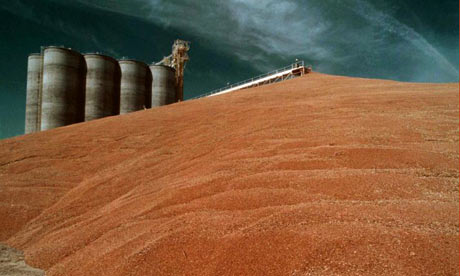
A grain elevator in Illinois. In 2009, 107m tonnes of grain was grown by US farmers to be blended with petrol. Photograph: AP Photo/Monty Davis
One-quarter of all the maize and other grain crops grown in the US now ends up as biofuel in cars rather than being used to feed people, according to new analysis which suggests that the biofuel revolution launched by former President George Bush in 2007 is impacting on world food supplies.
The 2009 figures from the US Department of Agriculture shows ethanol production rising to record levels driven by farm subsidies and laws which require vehicles to use increasing amounts of biofuels.
"The grain grown to produce fuel in the US [in 2009] was enough to feed 330 million people for one year at average world consumption levels," said Lester Brown, the director of the Earth Policy Institute, a Washington thinktank ithat conducted the analysis.
lunes, abril 26, 2010
Scientists show ‘growing’ fuel is waste of energy
http://www.grist.org/article/scientists-show-growing-fuel-is-waste-of-energy/

 It's no mystery where Grist comes down on the food vs. fuel debate, aka the Great Ethanol Boondoggle. But it's nice to see the science continuing to support our side of the argument (via Science Daily):
It's no mystery where Grist comes down on the food vs. fuel debate, aka the Great Ethanol Boondoggle. But it's nice to see the science continuing to support our side of the argument (via Science Daily): Using productive farmland to grow crops for food instead of fuel is more energy efficient, Michigan State University scientists concluded, after analyzing 17 years' worth of data to help settle the food versus fuel debate."It's 36 percent more efficient to grow grain for food than for fuel," said Ilya Gelfand, an MSU postdoctoral researcher and lead author of the study. "The ideal is to grow corn for food, then leave half the leftover stalks and leaves on the field for soil conservation and produce cellulosic ethanol with the other half."
Other studies have looked at energy efficiencies for crops over shorter time periods, but this MSU study is the first to consider energy balances of an entire cropping system over many years. The results are published in the April 19 online issue of the journal Environmental Science & Technology.
"It comes down to what's the most efficient use of the land," said Phil Robertson, University Distinguished Professor of crop and soil sciences and one of the paper's authors.
The researchers go on to observe that using some of the crop waste from, say, corn fields to make fuel (while reserving the rest to plow back into the soil) increases the efficiency of the process. But they also point out that that technique won't provide nearly enough fuel for our gas tanks.
They also hold out hope, as do many in the biofuel industry, for cellulosic biofuels that can be grown on marginal land. But the fact is that a cash crop on marginal land is worth even more on prime farmland -- once we go that route it will be very hard to keep biofuel crops from displacing food crops, especially in the developing world.
The conclusion I draw from this study is that it's a terrible idea to put fuel in competition wtih food for productive farmland. The system is designed to favor fuel production at this point and now we know that's actually a waste of energy, rather than a source. With any luck, this new data will be included in the EPA's controversial review of its indirect land-use calculations for the climate impact of biofuels.
Ultimately, I do think biofuels have a role in our economy, but it will be through farmer cooperatives that grow and process biofuel for their own tractors and not for suburban warriors and their SUVs.
viernes, marzo 19, 2010
BIO Proposes Second Wave of Advanced Biofuel Commercialization Policy to Stimulate Job Creation
Obama Administration’s Commitment to Building Advanced Biorefineries Can Create Green Jobs and Economic Growth with Additional Action
WASHINGTON--(BUSINESS WIRE)--Additional Congressional action is needed to follow through on the Obama administration’s recently announced initiative to rapidly build an integrated value chain for the bioeconomy, create jobs and kick start economic growth. The Biotechnology Industry Organization (BIO) today released proposed policy options that provide needed incentives to support U.S. job growth incentivizing commercial scale biorefinery projects for production of advanced biofuels, biobased products and renewable specialty chemicals.
Brent Erickson, executive vice president of BIO’s Industrial and Environmental Section, stated, “The economic recession created an extra hurdle for companies trying to build biorefineries for advanced biofuels and value-added biobased products. Industrial biotechnology solutions for advanced biofuels are ready, and companies have achieved significant successes in achieving research and development goals. Given the current economic climate, what is needed now is significant capital investment.
“The Obama administration correctly recognizes that large-scale production of advanced biofuels can be a significant driver of green job creation, energy security and greenhouse gas reductions. We applaud the policy initiatives announced yesterday, which call for federal coordination of programs to help integrate the complete biofuel value chain. This is a good first step in helping to stimulate the private investment needed to build new biorefineries. However, more needs to be done to de-risk investment in new technologies so that they can scale up to meet national goals. Congress can take action to ensure that these programs are adequately funded and targeted so that the effort will stimulate additional private capital investment.”
BIO’s proposals for new Congressional policy options include:
- Revise the risk assessment process for advanced biofuels projects in the current Department of Energy loan guarantee program;
- Double funding for U.S. Department of Agriculture programs to deploy cellulosic feedstocks; include eligibility for value-added biobased materials, products and chemicals;
- Fund the reverse auction for cellulosic biofuels already incorporated in law;
- Fund development and deployment programs for biobased products and renewable specialty chemicals.
A recent report commissioned by BIO, U.S. Economic Impact of Advanced Biofuels Production, projects that development of advanced biorefineries could create as many as 29,000 jobs over the next few years. For a copy of the report, U.S. Economic Impact of Advanced Biofuels Production, please visit http://bio.org/ind/EconomicImpactAdvancedBiofuels.pdf.
About BIO
BIO represents more than 1,200 biotechnology companies, academic institutions, state biotechnology centers and related organizations across the United States and in more than 30 other nations. BIO members are involved in the research and development of innovative healthcare, agricultural, industrial and environmental biotechnology products. BIO also produces the BIO International Convention, the world’s largest gathering of the biotechnology industry, along with industry-leading investor and partnering meetings held around the world. The Advanced Biofuels & Climate Change Information Center presents the latest commentary and data on the environmental and other impacts of biofuel production. Drop in and add your comments, at http://biofuelsandclimate.wordpress.com/.
Etiquetas: Biofuels
martes, febrero 16, 2010
Algae biofuels for war
Cost-Competitive Algae Jet Fuel Just Months Away: Pentagon
by Sami Grover, Carrboro, NC, USA  on 02.16.10

Image credit: US Department of Defense
I'm not sure whether the Pentagon's clean energy projects count toward the idea that environmentalism is socialist, or whether they get a free pass because, well, they are the Pentagon and they know a thing or two about the importance of energy independence—but I guess we'll see in the comments that follow. Matthew reported early last year on the Pentagon's investment in algae-based jet fuels. At the time, claims by insiders that the air force could get itself very close to a zero carbon footprint within a decade seemed somewhat optimistic, to say the least. But the Defense Department is reporting that its development of algae-based fuels is well ahead of schedule. In fact, it is claimed that it could be cost competitive with fossil fuels within months.
Suzanne Goldberg over at The Guardian tells us that Pentagon researchers are claiming they are only months away from producing jet fuel from algae that is cost competitive with its fossil fuel counterpart.
Given that the Defense Advanced Research Projects Agency (Darpa)—the department responsible for this project—previously played a key roll in developing both the internet and satellite navigation systems, this could for once be much more than just hot air. In fact, says Goldberg, this is an innovation that could have huge implications for global transportation:
"Darpa's research projects have already extracted oil from algal ponds at a cost of $2 per gallon. It is now on track to begin large-scale refining of that oil into jet fuel, at a cost of less than $3 a gallon, according to Barbara McQuiston, special assistant for energy at Darpa. That could turn a promising technology into a market-ready one. Researchers have cracked the problem of turning pond scum and seaweed into fuel, but finding a cost-effective method of mass production could be a game-changer."
Of course there were recent reports that algae biofuels may not be as green as they seem—but that particular study seemed to be based on some pretty astoundingly worst-case scenarios. With the potential to locate algae biofuel production to soak up power-station emissions, or waste-water runoff, algae holds some significant promise as a biofuel feedstock—especially when compared to corn ethanol or palm oil biodiesel.
Meanwhile, there's no word on how Exxon's investment in algae is paying off.
http://www.treehugger.com/files/2010/02/cost-competitive-algae-jet-fuel.php
Etiquetas: Algae, Biofuels, Pentagon, Treehugger
lunes, febrero 08, 2010
BIO Proposes Second Wave of Advanced Biofuel Commercialization Policy to Stimulate Job Creation
Obama Administration’s Commitment to Building Advanced Biorefineries Can Create Green Jobs and Economic Growth with Additional Action
WASHINGTON--(BUSINESS WIRE)--Additional Congressional action is needed to follow through on the Obama administration’s recently announced initiative to rapidly build an integrated value chain for the bioeconomy, create jobs and kick start economic growth. The Biotechnology Industry Organization (BIO) today released proposed policy options that provide needed incentives to support U.S. job growth incentivizing commercial scale biorefinery projects for production of advanced biofuels, biobased products and renewable specialty chemicals.
Brent Erickson, executive vice president of BIO’s Industrial and Environmental Section, stated, “The economic recession created an extra hurdle for companies trying to build biorefineries for advanced biofuels and value-added biobased products. Industrial biotechnology solutions for advanced biofuels are ready, and companies have achieved significant successes in achieving research and development goals. Given the current economic climate, what is needed now is significant capital investment.
“The Obama administration correctly recognizes that large-scale production of advanced biofuels can be a significant driver of green job creation, energy security and greenhouse gas reductions. We applaud the policy initiatives announced yesterday, which call for federal coordination of programs to help integrate the complete biofuel value chain. This is a good first step in helping to stimulate the private investment needed to build new biorefineries. However, more needs to be done to de-risk investment in new technologies so that they can scale up to meet national goals. Congress can take action to ensure that these programs are adequately funded and targeted so that the effort will stimulate additional private capital investment.”
BIO’s proposals for new Congressional policy options include:
- Revise the risk assessment process for advanced biofuels projects in the current Department of Energy loan guarantee program;
- Double funding for U.S. Department of Agriculture programs to deploy cellulosic feedstocks; include eligibility for value-added biobased materials, products and chemicals;
- Fund the reverse auction for cellulosic biofuels already incorporated in law;
- Fund development and deployment programs for biobased products and renewable specialty chemicals.
A recent report commissioned by BIO, U.S. Economic Impact of Advanced Biofuels Production, projects that development of advanced biorefineries could create as many as 29,000 jobs over the next few years. For a copy of the report, U.S. Economic Impact of Advanced Biofuels Production, please visit http://bio.org/ind/EconomicImpactAdvancedBiofuels.pdf.
About BIO
BIO represents more than 1,200 biotechnology companies, academic institutions, state biotechnology centers and related organizations across the United States and in more than 30 other nations. BIO members are involved in the research and development of innovative healthcare, agricultural, industrial and environmental biotechnology products. BIO also produces the BIO International Convention, the world’s largest gathering of the biotechnology industry, along with industry-leading investor and partnering meetings held around the world. The Advanced Biofuels & Climate Change Information Center presents the latest commentary and data on the environmental and other impacts of biofuel production. Drop in and add your comments, at http://biofuelsandclimate.wordpress.com/.
miércoles, febrero 03, 2010
Biotech biofuels
Bacteria May Affordably Turn Plants into Diesel by 2012
by Ben Block on February 1, 2010 Photo courtesy Lawrence Berkeley National LaboratoryThe manipulated E. coli strain creates more fatty acids than the bacterium itself requires and can generate biodiesel when interacted with biomass sugars." class="caption" align="" height="250" width="250">
Photo courtesy Lawrence Berkeley National Laboratory
The manipulated E. coli strain creates more fatty acids than the bacterium itself requires and can generate biodiesel when interacted with biomass sugars.
Bacteria that convert plants into diesel could become a widely available method for creating alternative fuels at commercial prices within the next two years.
U.S. researchers announced progress last week in converting sugars directly into biodiesel by modifying the Escherichia coli bacterium (E. coli). Their biodiesel, a fossil fuel alternative, can be transported in diesel pipelines and burned in standard diesel engines, releasing far fewer greenhouse gases than conventional diesel.
Analysts have linked grain-based biofuels such as corn ethanol to increased food prices and tropical deforestation. E. coli-generated biodiesel fuel may not compete with leading food sources, however, if the bacteria can effectively convert cellulosic feedstock such as switchgrass or corn husks.
The development, a collaboration of government, university, and private researchers, was hailed as a "milestone" in producing biodiesel at lower costs. Similar biodiesel efforts require expensive chemical processes to convert biomass into fuel.
"The fact that our microbes can produce a diesel fuel directly from biomass with no additional chemical modifications is exciting and important," said project leader Jay Keasling, chief executive officer for the U.S. Department of Energy's Joint BioEnergy Institute, in a prepared statement. "Given that the costs of recovering biodiesel are nowhere near the costs required to distill ethanol, we believe our results can significantly contribute to the ultimate goal of producing scalable and cost effective advanced biofuels and renewable chemicals."
U.S. Energy Secretary Steven Chu called Keasling last week to ask whether the E. coli process could become commercially viable without government subsidies. "He said we will know in two years," Chu said at an electric vehicle conference in Washington, D.C.
E. coli was previously known to synthesize fatty acids, key ingredients in forming biofuels efficiently. But the bacterium manufactures only as many fatty acids as it needs to survive - a limitation that had challenged inventors hoping to create enough biodiesel to replace conventional fuels.
The research team from the Joint BioEnergy Institute and biotech firm LS9 were able to manipulate an E. coli strain to create more fatty acids than the bacterium itself would need. When the E. coli interacted with Brazilian sugar cane, it fermented the plant's sugars and generated a surplus of fatty acids, producing biofuel straight from the biomass, the team explains in the current issue of the journal Nature..
LS9 and the U.S. Department of Energy's Argonne National Laboratory calculated that the newly developed biodiesel reduces greenhouse gas emissions 85 percent compared with conventional diesel, calculated over the fuel's life cycle.
LS9 Vice President Stephen del Cardayre described the breakthrough as "a significant step toward the development of scalable, low-cost drop-in-compatible cellulosic fuels and chemicals." The project's next step will be adapting the process for fibers other than sugar cane, expanding its potential applications to grass or crop waste.
After LS9 struggled for funding in 2008 and 2009 due to decreased oil prices and the economic recession, the company received support from several funders, including the U.S. government and oil company Chevron. LS9 plans to open a commercial-scale demonstration plant this year.
Ben Block is a staff writer with the Worldwatch Institute.
Etiquetas: Bacteria, Biodiesel, Biofuels, LS9, Worldwatch Institute
martes, agosto 11, 2009
BP Gets Into Algae: Signs Multi-year Development Agreement with Martek Biosciences
by Matthew McDermott, New York, NY on 08.11.09

photo: Rosa y Dani via flickr
Another fossil fuel company investing in algae: BP has announced that it will be partnering with Martek Biosciences to work on advancing development of conversion of sugars into biodiesel, using Martek's "unique algae-based technologies and intellectual property."
BP Biofuels CEO Phillip New touted the technology:
As an alternative to conventional vegetable oils, we believe sugar to diesel technology has the potential deliver economic, sustainable and scaleable biodiesel supplies. In partnering with Martek, we combine the world's leading know-how in microbial lipid production with out expertise in fuels markets and applications, and our more recent experience in biofuels production and commercialization.This technology is also a perfect fit with out other strategic choices for biofuels...It is part of our approach of integrating sugar cane and lignocellulosic biofuels with advanced technologies to produce products with a wide range of uses.
Some of that recent experience was finding out that jatropha is much more difficult feedstock to work with on a large commercial scale that thought: BP recently disentangled itself from its partnership with D1 Oils.
Can Be Used For Diesel or Jet Fuels - 90% Emission Reductions
BP pumps up the fact that production of biofuels via the fermentation of sugars offers to potential to produce fuels with greenhouse gas emissions reductions of 80-90% below traditional fossil fuels, can be use with a wide variety of biomass feedstocks, and has the ability to tailor the end product for a variety of diesel and jet fuel needs.
In the initial phase of the multi-year collaboration Martek will perform all the R&D, for which BP will be contributing $10 million.
Algae BiofuelsExxonMobil Bets on Algae in First Major Biofuels Investment
Plankton Power to Build Algae Biofuel Facility on Cape Cod
Solazyme: Millions of Gallons of Algae Biodiesel Within 3 Years
http://www.treehugger.com/files/2009/08/bp-algae-biofuels-agreement-martek-biosciences.php?dcitc=th_rss
martes, julio 28, 2009
FYI
27 Jul 2009: Biofuel Startup Announces
Huge Yields from Engineered Organism
A Massachusetts company, Joule Biotechnologies, has unveiled what it says is a technological breakthrough that uses genetically engineered organisms, sunlight, water, and concentrated carbon dioxide to produce up to 20,000 gallons of biofuel per acre. The much-watched startup claims that its
secret organisms, coupled with photo bioreactors, not only directly produce an ethanol-like fuel but also secrete the fuel continuously. As a result, Joule officials say, its so-called “helioculture process” can produce up to 20,000 gallons of biofuel per acre — four to 10 times greater than algae-based biofuel experiments — and can do so at $50 per gallon, which is far cheaper than other algal biofuel processes. Independent observers said that while Joule’s technology looks promising, it still faces many hurdles as it attempts to take its breakthrough from the lab and mass-produce fuel. Joule says it will open a pilot plant in the Southwest early next year and commercially produce biofuels by the end of 2010. Joule’s project is one of several well-financed efforts to genetically engineer organisms to produce biofuels.
SOURCE: http://e360.yale.edu/content/digest.msp?id=1989
viernes, abril 24, 2009
April 14, 2009
The Dubious Revolution
Biofuels, the Next Generation
By CARMELO RUIZ-MARRERO
The promotion of biofuels is a central component of president Obama's energy policy. But biofuel crops, which are mostly corn, sugar cane, oil palm and soy, are in big trouble because of the overwhelming and continuously growing evidence of the environmental harm that they cause. And besides, all large-scale industrial agriculture requires large amounts of fossil fuel, so biofuels are hardly a cure for petroleum addiction.
The Obama administration and an increasing number of biofuel supporters acknowledge these problems but they wager that these will be solved by a new generation of biofuels made from cellulose.
And what's so great about cellulose? For one, it is everywhere. Cellulose is the most common organic compound on earth and a key structural component of the cell walls of green plants and many forms of algae. About one third of all plant matter in the world is cellulose.
In spite of the best efforts of scientists, the cellulose molecule stubbornly resists all cost-effective attempts at transforming it into fuel. So they are now looking to nature for answers: fungi and certain bacteria found in the guts of termites and ruminant mammals (such as cows) that produce enzymes that can digest cellulose.
The ability to turn cellulose into fuel would make it possible to use any vegetable matter, living or dead, to this end- corn stalks, suburban lawn clippings, dead wood, you name it. According to their enthusiastic supporters, the main advantage of cellulose-based fuels is that they will not compete with food crops. You can get a Nobel prize for less than this.
And that's where biotechnology comes in. The biotech industry proudly claims to be a major player in both the energy business and global warming prevention strategies by virtue of its cutting edge research and development into, among other things, cellulose biofuels.
The president's cabinet is equal to the task. When he was Iowa governor, current agriculture secretary Tom Vilsack was named Governor of the Year 2001 by the Biotechnology Industry Organization for his passionate defense of the biotech industry and its products. And energy secretary Steven Chu was the main architect of a controversial $500 million dollar deal between the BP corporation and the University of California's Berkeley campus. This money, a sum that has no precedent in the history of academia, will be used to develop novel biofuels through biotechnology.
But some scientists and environmentalists warn that the cellulose boom will in no way solve the problems of the current generation of biofuels, and in fact will create new ones.
Last January a coalition of diverse groups, that included Food First and the Institute for Social Ecology, issued an open letter that denounced biofuels as a false solution to global warming and specifically contested the assertion that cellulose-based fuel production will not compete with food production.
The open letter's basic arguments are not new at all. Back in 2007 a group of eleven non-governmental organizations, from countries such as Argentina, Indonesia and Denmark, produced a report titled “Agrofuels: Towards a Reality Check”. The document was particularly emphatic in warning that using so-called agriculture “waste” to meet global energy needs is not a smart idea at all.
What the numerous objections to the biofuels revolution- whether the current generation or yet-to-exist biotech fuels- come down to is that the feedstock for this energy source must come from somewhere. Looking at the promo literature for new generation biotech biofuels one gets the impression that these are made out of thin air. But the fact is that all those fuels come from organisms, hence the prefix “bio”. And all those organisms, whether they be farm crops or engineered microbes, ultimately need to be nourished with physical inputs like nutrients and water, which are not cheaply available. They are renewable but not infinite.
So how much raw material would the cellulose boom require? The U.S. Departments of Energy and Agriculture set out to find the answer and in 2005 issued a joint report which concluded that the use of wood, grasses, and "plant waste" for the production of cellulosic ethanol would require 1.3 billion tons of dry biomass a year. Obtaining this amount would be possible only by removing most of the country's agricultural residues, planting an area three times the size of Missouri with perennial cellulose-rich crops like switchgrass, and putting all U.S. farmland under "no-till" agriculture, say the report's authors.
In these times of economic and ecological collapse it is hard not to get carried away by the lure of technological quick fixes, like biofuels. I beg to differ from most renewable energy advocates: this is not a matter of “bad” non-renewable energy sources vs. “good” renewable ones. The ultimate root problem behind environmental catastrophe and the energy crisis is the voracious and ever-increasing energy demand, which unfortunately many environmentalists and eco-entrepreneurs have come to accept as a given.
Rather than jumping headlong into a dubious biofuels revolution, our best bet for survival will be the realization that increased energy consumption and higher standards of living are not synonymous.
Carmelo Ruiz-Marrero, a self-described renaissance hack and impractical humanist, is a Puerto Rican journalist, environmental educator and author. He is as Senior Fellow of the Environmental Leadership Program, a Fellow of the Oakland Institute, and directs the Puerto Rico Project on Biosafety (http://bioseguridad.blogspot.com/). Whenever he is not writing or working at a call center, he distributes farm produce for something that resembles a CSA. Ruiz-Marrero, a compulsive blogger, blogs away at: http://carmeloruiz.blogspot.com/
SOURCE:
http://counterpunch.org/ruiz04142009.html
Etiquetas: Biofuels, Carmelo, Cellulose, Counterpunch
lunes, marzo 09, 2009
70 Percent More Energy Required to Make Ethanol than Actually is in Ethanol: Cornell
- By Roger Segelken
Cornell Chronicle, March 6, 2009
Straight to the Source
sábado, febrero 28, 2009
WORLDWATCH AND SIERRA CLUB FUMBLE ON BIOFUELS
This report should be regarded with skepticism and concern. Its authors are good at pointing out the pitfalls and problems of biofuels but in the end- and against all logic- conclude that biofuel production can be made sustainable with a few reforms here and there. They assume from the start that biofuels are desirable and inevitable. The industrialized North's voracious and irresponsible consumption is unadressed, and endless economic growth remains unquestioned. Reports like these can do more harm than good, since their most immediate and obvious effect will be to confound and divide the environmental movement on this issue.
- CARMELO
----- Forwarded Message ----
From: Julia Tier
FOR IMMEDIATE RELEASE
February 18, 2009
Contact:
Josh Dorner, Sierra Club, 202.675.2384
Julia Tier, Worldwatch Institute, 202.452.1992, ext. 594
Time to Get “Smart” on Biofuels
Sierra Club, Worldwatch Institute Outline “Smart Choices for Biofuels” in New Report
Washington, D.C.—The Sierra Club and Worldwatch Institute today released a report, Smart Choices for Biofuels, highlighting the need for important policy reforms at this critical juncture in America’s effort to increase the use of biofuels. The report outlines the economic and environmental impacts of first-generation biofuels such as corn ethanol, proposes strategies to make the biofuels industry more sustainable, and offers specific policy recommendations in four broad categories:
- Developing sustainability standards
- Advancing biofuels production and new technologies
- Creating green jobs through biofuels
- Promoting policy coherence across energy sectors
“At a time of volatile gas prices and rising concern about global warming, it has become clear that biofuels can play a role in reducing dependence on oil and curbing climate change,” said Christopher Flavin, President of Worldwatch Institute. “However, the large and growing scale of the industry make it critical that Congress now make smart choices that promote sustainable biofuels—rather than just more biofuels—as part of a clean energy economy.”
SE RENTA APARTAMENTO #703 en Edificio Darlington de Río Piedras. Avenida Muñoz Rivera #1007. (787) 781-8522, 771-4473, 203-2615. Para residencia u oficina.
U.S. biofuels production in 2008 topped 9 billion gallons—the vast majority of which was corn ethanol—and successive Congressional mandates call for the use of 36 billion gallons of biofuels by the year 2022. Domestic biofuels output has more than doubled since 2005, and the report explores the many issues associated with this dramatic increase in the production of renewable fuels, including: the global warming emissions profile of corn ethanol; the effect on the Conservation Reserve Program; other effects on the nation’s air, water, and land; and the lower-than-expected economic benefits for rural communities.
“The headlong rush toward biofuels—corn ethanol in particular—has had many consequences, some foreseen and others not,” said Carl Pope, Sierra Club Executive Director. “The downside risks to our land, air, water, and economy have become readily apparent, but the good news is that with smart choices we can make biofuels work for the environment, economy, and climate, while enhancing our energy security.”
Smart Choices for Biofuels maps a future path for biofuels to ensure that they are more environmentally and socially sustainable and that the use of renewable fuels for transportation contributes to the global effort to reduce global warming pollution. The steps proposed in the report include an accelerated transition to cellulosic feedstocks such as switchgrass and the use of more effective agricultural practices to decrease erosion and soil nutrient depletion. The report also recommends complementary steps beyond improvements in biofuels production, such as the promotion of plug-in hybrid vehicles and increased investments in public transportation, which could also help achieve crucial energy and climate goals.
Finally, the report concludes that if a renewable fuels mandate is to contribute effectively to reducing foreign oil dependence and curbing global warming, it must be reevaluated in light of changing circumstances. Changes in four broad policy categories—sustainability standards, advancing biofuels production and new technologies, creating green jobs, and promoting policy coherence across energy sectors—are detailed in the report.
Sierra Club and Worldwatch Institute previously collaborated on biofuels and sustainability when they released a report in October 2007 focused solely on Iowa , titled Destination Iowa : Getting to a Sustainable Biofuels Future.
The full Smart Choices for Biofuels report is available online at: www.worldwatch.org/smartchoicesforbiofuels
Etiquetas: Biofuels, Carmelo, Worldwatch Institute
jueves, febrero 05, 2009
Study Finds that Biofuels Require Increased Fossil Fuel Usage and Take Food off Peoples' Tables
- Science Now, January 29, 2009
Straight to the Source
Study highlights problems linked to converting crops into biofuels. Taking up valuable land and growing edible crops for biofuels poses a dilemma: Is it ethical to produce inefficient renewable energies at the expense of an already malnourished population?
David Pimentel and his colleagues from Cornell University in New York State highlight the problems linked to converting a variety of crops into biofuels. Not only are these renewable energies inefficient, they are also economically and environmentally costly and nowhere near as productive as projected. Their findings are published online in Springer's journal Human Ecology.
In the context of global shortages of fossil energy - oil and natural gas in particular - governments worldwide are focusing on biofuels as renewable energy alternatives. In parallel, almost 60 percent of the world's population is malnourished increasing the need for grains and other basic foods. Growing crops, including corn, sugarcane and soybean, for fuel uses water and energy resources vital for the production of food for human consumption.
Professor Pimentel and his team review the availability and use of land, water and current energy resources globally, and then look at the situation in the US specifically. They also analyze biomass resources and show that there is insufficient US biomass for both ethanol and biodiesel production to make the US oil independent.
Their paper then looks at the efficiency and costs associated with converting a range of crops into energy and shows that in each case more energy is required for this process than they actually produce as fuel. The research finds a negative energy return of 46 percent for corn ethanol, 50 percent for switchgrass, 63 percent for soybean biodiesel and 58 percent for rapeseed. Even the most promising palm oil production results in a minus 8 percent net energy return. There are also a number of environmental problems linked to converting crops for biofuels, including water pollution from fertilizers and pesticides, global warming, soil erosion and air pollution.
In the researchers' opinion, there is simply not enough land, water and energy to produce biofuels. They also argue that ironically, the US is becoming more oil-dependent, not less, as was intended through the production of biofuels. In most cases, more fossil energy is required to produce a unit of biofuel compared with the energy that it provides. As a result, the US is importing more oil and natural gas in order to make the biofuels.
The authors conclude that "Growing crops for biofuels not only ignores the need to reduce natural resource consumption, but exacerbates the problem of malnourishment worldwide by turning food grain into biofuelsŠIncreased use of biofuels further damages the global environment and especially the world food system."
David Pimentel and his colleagues from Cornell University in New York State highlight the problems linked to converting a variety of crops into biofuels. Not only are these renewable energies inefficient, they are also economically and environmentally costly and nowhere near as productive as projected. Their findings are published online in Springer's journal Human Ecology.
In the context of global shortages of fossil energy - oil and natural gas in particular - governments worldwide are focusing on biofuels as renewable energy alternatives. In parallel, almost 60 percent of the world's population is malnourished increasing the need for grains and other basic foods. Growing crops, including corn, sugarcane and soybean, for fuel uses water and energy resources vital for the production of food for human consumption.
Professor Pimentel and his team review the availability and use of land, water and current energy resources globally, and then look at the situation in the US specifically. They also analyze biomass resources and show that there is insufficient US biomass for both ethanol and biodiesel production to make the US oil independent.
Their paper then looks at the efficiency and costs associated with converting a range of crops into energy and shows that in each case more energy is required for this process than they actually produce as fuel. The research finds a negative energy return of 46 percent for corn ethanol, 50 percent for switchgrass, 63 percent for soybean biodiesel and 58 percent for rapeseed. Even the most promising palm oil production results in a minus 8 percent net energy return. There are also a number of environmental problems linked to converting crops for biofuels, including water pollution from fertilizers and pesticides, global warming, soil erosion and air pollution.
In the researchers' opinion, there is simply not enough land, water and energy to produce biofuels. They also argue that ironically, the US is becoming more oil-dependent, not less, as was intended through the production of biofuels. In most cases, more fossil energy is required to produce a unit of biofuel compared with the energy that it provides. As a result, the US is importing more oil and natural gas in order to make the biofuels.
The authors conclude that "Growing crops for biofuels not only ignores the need to reduce natural resource consumption, but exacerbates the problem of malnourishment worldwide by turning food grain into biofuelsŠIncreased use of biofuels further damages the global environment and especially the world food system."
Journal reference:
1. Pimentel D et al. Food versus biofuels: environmental and economic costs. Human Ecology, DOI: 10.1007/s10745-009-9215-8
miércoles, febrero 04, 2009
For Immediate Release January 15, 2009
"Next Generation Biofuels": Bursting The New "Green" Bubble
Letter challenges unrealistic promises from an unsustainable industry
United States--A diverse alliance of organizations published an open letter [1] today in the U.S. and internationally warning of the dangers of industrially produced biofuels (called agrofuels by critics). The letter explains why large-scale industrial production of transport fuels and other energy from plants such as corn, sugar cane, oilseeds, trees, grasses, or so-called agricultural and woodland waste threatens forests, biodiversity, food sovereignty, community-based land rights and will worsen climate change. With the new Obama Administration slated to take office Tuesday, the letter's originators warn that if Obama's "New Green Economy" runs on agrofuels it may trap the U.S. in a dangerous "Green Bubble" of unrealistic promises from an unsustainable industry.
Indications that the incoming Obama Administration may be ideologically wedded to continuing the agrofuel disaster are clear. President Obama's "New Green Deal" includes support for notoriously destructive agrofuel corporations, the creation of a pro-agribusiness cabinet that includes Tom Vilsack, Ken Salazar and Steven Chu, promotion of cellulosic fuel technologies, and references to increasing the Renewable Fuel Standard biofuel target. Additionally, Obama, a former Senator from a corn-growing state, has indicated that the already troubled U.S. ethanol industry will receive a financial boost soon, despite mounting evidence that the industry simply cannot meet the demand for fuel in any just or sustainable way.
"This no longer about corn ethanol-turning any plants into fuel is simply not renewable," stated Dr. Rachel Smolker, co-author of the letter and Global Justice Ecology Project agrofuels specialist. "All plants, edible or not, require soils, water, fertilizers and land, all of which are in shortening supply. Yet these unsustainable technologies are commanding the vast majority of renewable energy tax incentives, at the expense of genuine cleaner energy solutions like conservation, efficiency, wind, solar, and ocean power. Additionally, because agrofuel crops rely on fertilizers, 44% of which are imported, they cannot even satisfy the calls for U.S. energy independence."
Corn and sugar based agrofuels have already come under extreme scrutiny due to their documented contribution to the food crisis, with venture capital investment in these so-called 'first generation biofuels' dropping to zero. The open letter exposes the further problems that will result from the so-called 'second generation' of agrofuels. These problems range from wholesale destruction of the world's rainforests and other sensitive forests, to the forced displacement of entire communities to make way for agrofuel expansion, and the biosafety risks of gambling on novel technologies like Synthetic Biology and genetically engineered trees. The letter also makes clear that agrofuels made from inedible plant feedstocks (cellulosic fuels) will continue to exacerbate the food crisis by monopolizing additional agricultural lands for the growing of agrofuel crops such as grasses and trees, instead of food crops.
The groups originating the letter have called on others to join them in preventing another ill-conceived push into agrofuels similar to that which last year raised food prices and hunger levels to crisis proportions. "The last administration's enthusiastic foray into biofuels exacerbated global environmental destruction, land theft and hunger in just a very short space of time," explains Kathy Jo Wetter of the ETC Group. "Redoubling that biofuels push is a continuation of disastrous policies rather than the change we need."
The groups originating the letter include some of the same U.S. groups that issued a prescient call in early 2007 for an immediate moratorium on further U.S. incentives for agrofuel development: Global Justice Ecology Project, Rainforest Action Network, Food First, Family Farm Defenders, and Grassroots International. Additional groups making this call include: ETC Group, Institute for Social Ecology, Heartwood, Dogwood Alliance, Energy Justice Network, and Native Forest Council.
"Next Generation Biofuels": Bursting The New "Green" Bubble
Letter challenges unrealistic promises from an unsustainable industry
United States--A diverse alliance of organizations published an open letter [1] today in the U.S. and internationally warning of the dangers of industrially produced biofuels (called agrofuels by critics). The letter explains why large-scale industrial production of transport fuels and other energy from plants such as corn, sugar cane, oilseeds, trees, grasses, or so-called agricultural and woodland waste threatens forests, biodiversity, food sovereignty, community-based land rights and will worsen climate change. With the new Obama Administration slated to take office Tuesday, the letter's originators warn that if Obama's "New Green Economy" runs on agrofuels it may trap the U.S. in a dangerous "Green Bubble" of unrealistic promises from an unsustainable industry.
Indications that the incoming Obama Administration may be ideologically wedded to continuing the agrofuel disaster are clear. President Obama's "New Green Deal" includes support for notoriously destructive agrofuel corporations, the creation of a pro-agribusiness cabinet that includes Tom Vilsack, Ken Salazar and Steven Chu, promotion of cellulosic fuel technologies, and references to increasing the Renewable Fuel Standard biofuel target. Additionally, Obama, a former Senator from a corn-growing state, has indicated that the already troubled U.S. ethanol industry will receive a financial boost soon, despite mounting evidence that the industry simply cannot meet the demand for fuel in any just or sustainable way.
"This no longer about corn ethanol-turning any plants into fuel is simply not renewable," stated Dr. Rachel Smolker, co-author of the letter and Global Justice Ecology Project agrofuels specialist. "All plants, edible or not, require soils, water, fertilizers and land, all of which are in shortening supply. Yet these unsustainable technologies are commanding the vast majority of renewable energy tax incentives, at the expense of genuine cleaner energy solutions like conservation, efficiency, wind, solar, and ocean power. Additionally, because agrofuel crops rely on fertilizers, 44% of which are imported, they cannot even satisfy the calls for U.S. energy independence."
Corn and sugar based agrofuels have already come under extreme scrutiny due to their documented contribution to the food crisis, with venture capital investment in these so-called 'first generation biofuels' dropping to zero. The open letter exposes the further problems that will result from the so-called 'second generation' of agrofuels. These problems range from wholesale destruction of the world's rainforests and other sensitive forests, to the forced displacement of entire communities to make way for agrofuel expansion, and the biosafety risks of gambling on novel technologies like Synthetic Biology and genetically engineered trees. The letter also makes clear that agrofuels made from inedible plant feedstocks (cellulosic fuels) will continue to exacerbate the food crisis by monopolizing additional agricultural lands for the growing of agrofuel crops such as grasses and trees, instead of food crops.
The groups originating the letter have called on others to join them in preventing another ill-conceived push into agrofuels similar to that which last year raised food prices and hunger levels to crisis proportions. "The last administration's enthusiastic foray into biofuels exacerbated global environmental destruction, land theft and hunger in just a very short space of time," explains Kathy Jo Wetter of the ETC Group. "Redoubling that biofuels push is a continuation of disastrous policies rather than the change we need."
The groups originating the letter include some of the same U.S. groups that issued a prescient call in early 2007 for an immediate moratorium on further U.S. incentives for agrofuel development: Global Justice Ecology Project, Rainforest Action Network, Food First, Family Farm Defenders, and Grassroots International. Additional groups making this call include: ETC Group, Institute for Social Ecology, Heartwood, Dogwood Alliance, Energy Justice Network, and Native Forest Council.
CONTACTS:
o Dr. Rachel Smolker, Agrofuels Specialist, Global Justice Ecology Project,
Email to: rsmolker@globaljusticeecology.org, Office: +1 802 482 2689, Mobile: +1 802 735 7794
o Dr. John Peck, Executive Director, Family Farm Defenders,
jepeck@wisc.edu +1 608 260 0900
o Kathy Jo Wetter, ETC Group, kjo@etcgroup.org, tel: +1 919 688 7302
Etiquetas: Biofuels
Vínculos
- African Centre for Biosafety
- Biosafety Information Centre
- Delagro
- EcoNexus
- En Defensa del Maíz
- GenØk Centre for Biosafety Norway
- GM Watch
- GRAIN
- Grupo de Reflexión Rural
- Haciendo Punto en Otro Blog
- RALLT Por una América Latina Libre de Transgénicos
- Semillas de Identidad
- Edit-Me
- Edit-Me
Entradas anteriores
- Bayer raises offer to buy Monsanto
- Carmelo Ruiz: Un informe que no pone fin al debate
- Monsanto en retirada: el abajo que se mueve
- Environmental Leaders say 'No!' to Gene Drives
- La UCCSN-AL Frente a la carta de un grupo de premi...
- Miryam Gorban - Monsanto será juzgado en el Tribun...
- Convención de nutricionistas de Puerto Rico, auspi...
- Argentina: II Jornada Nacional de Denuncia de la n...
- How the GE Food Venture Has Been Chronically Depen...
- ¿Por qué nos oponemos a la Ley "Monsanto" de Semil...
Archivos
- mayo 2004
- junio 2004
- julio 2004
- agosto 2004
- septiembre 2004
- octubre 2004
- noviembre 2004
- diciembre 2004
- enero 2005
- febrero 2005
- marzo 2005
- abril 2005
- mayo 2005
- junio 2005
- julio 2005
- agosto 2005
- septiembre 2005
- octubre 2005
- noviembre 2005
- diciembre 2005
- enero 2006
- febrero 2006
- marzo 2006
- abril 2006
- mayo 2006
- junio 2006
- julio 2006
- agosto 2006
- septiembre 2006
- octubre 2006
- noviembre 2006
- diciembre 2006
- enero 2007
- febrero 2007
- marzo 2007
- abril 2007
- mayo 2007
- junio 2007
- julio 2007
- agosto 2007
- septiembre 2007
- octubre 2007
- noviembre 2007
- diciembre 2007
- enero 2008
- febrero 2008
- marzo 2008
- abril 2008
- mayo 2008
- junio 2008
- julio 2008
- agosto 2008
- septiembre 2008
- octubre 2008
- noviembre 2008
- diciembre 2008
- enero 2009
- febrero 2009
- marzo 2009
- abril 2009
- mayo 2009
- junio 2009
- julio 2009
- agosto 2009
- septiembre 2009
- octubre 2009
- noviembre 2009
- diciembre 2009
- enero 2010
- febrero 2010
- marzo 2010
- abril 2010
- mayo 2010
- junio 2010
- julio 2010
- agosto 2010
- septiembre 2010
- octubre 2010
- noviembre 2010
- diciembre 2010
- enero 2011
- febrero 2011
- marzo 2011
- abril 2011
- mayo 2011
- junio 2011
- julio 2011
- agosto 2011
- septiembre 2011
- octubre 2011
- noviembre 2011
- diciembre 2011
- enero 2012
- febrero 2012
- marzo 2012
- abril 2012
- mayo 2012
- junio 2012
- julio 2012
- agosto 2012
- septiembre 2012
- octubre 2012
- noviembre 2012
- diciembre 2012
- enero 2013
- febrero 2013
- marzo 2013
- abril 2013
- mayo 2013
- junio 2013
- julio 2013
- agosto 2013
- septiembre 2013
- octubre 2013
- noviembre 2013
- diciembre 2013
- enero 2014
- febrero 2014
- marzo 2014
- abril 2014
- mayo 2014
- junio 2014
- julio 2014
- agosto 2014
- septiembre 2014
- octubre 2014
- noviembre 2014
- diciembre 2014
- enero 2015
- marzo 2015
- abril 2015
- mayo 2015
- junio 2015
- julio 2015
- agosto 2015
- septiembre 2015
- octubre 2015
- noviembre 2015
- diciembre 2015
- enero 2016
- febrero 2016
- marzo 2016
- abril 2016
- mayo 2016
- junio 2016
- julio 2016
- agosto 2016
- septiembre 2016

Suscribirse a
Entradas [Atom]