sábado, junio 18, 2016

Permanently changing a species: What could go wrong?

https://medium.com/@foe_us/permanently-changing-a-species-what-
could-go-wrong-ec7a7190fd0f#.ow64lkqni

by Dana Perls, Food and Technology campaigner

While the NAS report offers thoughtful insights and useful warnings about gene drives, it falls far short of offering a blueprint for responsible governance to ensure that the technology will not be used for hostile purposes, reckless corporate profit or at the expense of health and the environment.

There is only one responsible path forward for gene drives — we need a moratorium on commercial or environmental releases of this technology. There must be strong and clear international regulations and oversight. We must ensure that corporations and governments (particularly militaries) are not developing gene drives and cannot misuse this technology in ways that could have profound ecological, health or socio-economic impacts. There must be strict regulations on lab research, especially given the risk of accidental escape of gene drive organisms, even from high security labs.

Etiquetas: , ,

lunes, noviembre 30, 2015

Extreme genetic engineering and the human future

http://www.foe.org/projects/food-and-technology/human-genetic-engineering


Baby with dna strands behind itOn the eve of the U.S. National Academies of Sciences and Medicine International Summit on Human Gene Editing, the Center for Genetics and Society and Friends of the Earth released a new report “Extreme Genetic Engineering and the Human Future: Reclaiming Emerging Biotechnologies for the Common Good.” 
Read the full report or the executive summary.
Read the news release.
Summary: Recent research in genetic engineering and “synthetic biology” has enabled scientists to artificially redesign life -- everything from microbes to people. Amid the breakneck speed of recent developments in genetic engineering and synthetic biology that could be used to alter human DNA, this report examines health, regulatory, social and ethical questions about proposals ranging from genetically altering human gut bacteria to implementing germline editing -- altering human embryos and reproductive cells to produce permanent, hereditary genetic modification of future children and generations. It also examines the systemic and commercial incentives to rush newly discovered biotechnologies to market, regardless of their social utility and ahead of appropriate, transparent assessment and oversight.
- See more at: http://www.foe.org/projects/food-and-technology/human-genetic-engineering#sthash.BNb4eg3Q.dpuf

Etiquetas: , ,

miércoles, mayo 14, 2014

Who benefits from GMO?

http://www.foeeurope.org/who-benefits-gm-crops-industry-myths-280314


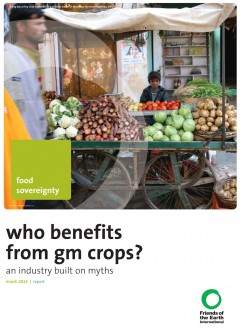
Who benefits from GM crops? An industry built on myths

28 MARCH 2014
Our relationship with food and the way in which we farm is under increasing pressure. Extreme weather events, a changing climate and a growing population are putting the food sovereignty of communities at risk. At the same time health experts have raised serious questions about our modern diet.
The way we farm and feed the world needs fundamental change. The biotech industry is claiming to offer exactly that. But this report examines the reality of GM crop production worldwide, and drawing evidence from the experiences of small farmers and the communities who live with GM, separates facts from fiction.

Etiquetas: ,

domingo, abril 07, 2013

STOP THE CROP

http://stopthecrop.org/


Europe is faced with a new wave of GM-crops that could drastically change the way we produce food in Europe – including extensive pesticide spraying. These GM-crops are unnecessary, risky and profit large multinational companies at the expense of small scale and sustainable farming. 
This website and film present some of the dangers of GM-crops, and calls for people across Europe and beyond to take action to stop them. We need a future of food and farming that benefits people and planet, and not the pockets of big business. We need to stop GM-crops from spreading across Europe.

Etiquetas: , ,

jueves, marzo 21, 2013

GM crops a failure in developing countries, says Friends of the Earth

jueves, mayo 03, 2012

Friends of the Earth takes on the "bioeconomy"

http://www.foe.org/news/blog/2012-04-bioeconomy-blueprint-or-biotechnology-boost

Bioeconomy Blueprint or biotechnology boost?

Posted Apr. 27, 2012 / Posted by: Eric hoffman
Yesterday morning the White House released its National Bioeconomy Blueprint  which “outlines steps that agencies will take to drive the bioeconomy—economic activity powered by research and innovation in the biosciences—and details ongoing efforts across the Federal government to realize this goal.”
Unfortunately, this new bioeconomy is not as green as the Obama administration is making it out to be. The so-called bioeconomy is dependent primarily on the risky, unregulated field of synthetic biology and the use of unsustainably produced biomass to feed synthetic organisms created by these technologies. The National Bioeconomy Blueprint, while offering little in new substantive policy, causes more harm than good by giving the green light to the growth and profit of the synthetic biology industry without making any real effort to protect people and the environment from the novel risks posed by this emerging technology.
Synthetic biology is an extreme form of genetic engineering involving the writing and rewriting of genetic code and biological systems in order to create novel organisms that have never existed before in nature. Novel organisms created through synthetic biology could escape from the lab and become a new class of invasive species or pump out oil into local waterways. Biotech workers at put at risk if organisms are improperly contained and these synthetic bugs get inside their bodies or are carried home with them on their clothes. Check out our issue brief, Synthetic Biology 101, for more information on what exactly these technologies are and the risks synthetic biology pose.
According to Andrew Pollack at the New York Times, “much of what is in the 43-page-report…is a list of government programs that are already under way. So it is not clear what concrete changes, if any, will result.” But while no new major policy initiatives were announced, the Blueprint appears to be a nod of approval for moving full speed ahead for an unregulated and rapidly developing synthetic biology industry.  
You may recall that last month, 113 organizations from around the world called for the proper oversight and regulation of synthetic biology in the Principles for the Oversight of Synthetic Biology. This global coalition demanded that the Precautionary Principle be applied to the governance of synthetic biology and that a moratorium be placed on the environmental release and commercial use of synthetic organisms until proper national and international laws have been established to ensure synthetic biology does not harm people or the environment.
Unfortunately, the Obama White House is moving in the exact opposite direction with this new initiative. The National Bioeconomy Blueprint calls for expanded development of “essential bioeconomy technologies” such as synthetic biology and identify points to reduce regulatory barriers for the biotechnology industry. One of the White House’s main strategic objectives is to “unlock the promise of synthetic biology” by making strategic investments in synthetic biology that “have the potential to move the bioeconomy forward in all sectors.”
The Blueprint quotes  President Obama’s Bioethics Commission, which recommended back in 2010, that federal actions be taken “to ensure that America reaps the benefits of synthetic biology while identifying appropriate ethical boundaries and minimizing identified risks” of synthetic biology.  Unfortunately those recommendations, which were publically criticized by Friends of the Earth and 57 other organizations from around the world, looked to self-regulation to guide developments in synthetic biology instead of developing actual laws and regulations that are specifically tailored to the novel risks posed by synthetic biology.
The claim that the government will “minimize identified risks” from synthetic biology sounds great but so far they have failed to even look at these risks. According to a report from the Woodrow Wilson International Center for Scholars, of the $430 million spent by the federal government on synthetic biology between 2005 and 2010, zero projects were identified that focused on risk assessments related to the accidental or intentional release of synthetic organisms from the lab. Instead of truly balancing the potential benefits and risks of synthetic biology, the Bioeconomy Blueprint gives the industry the green light to rush ahead while turning a blind eye to the risks.
The bioeconomy also carries serious socio-economic risks. As the ETC Group highlighted in its brilliant report, The New Biomassters: Synthetic B iology and the Next Assault on Biodiversity and Livelihoods, the new bioeconomy is not as green as it seems. The bioeconomy is, in fact, “a red-hot resource grab of the lands, livelihoods, knowledge and resources of peoples in the global South, where most of that biomass is located.” As the report points out, 86 percent of global biomass is located in the tropics and subtropics, and a push for a new bioeconomy, enabled by synthetic biology, will only “accelerate the pace of forest destruction and land acquisition in the South in order to feed the economies of the North.” Biomass, or land on which it is grown, is not an unlimited resource, as the Blueprint seems to assume.
And just yesterday, a new report was released by the Global Forest Coalition titled Bio-economy Versus Biodiversity, which argues how the so-called bioeconomy will have “serious negative impacts…on forests, forest-dependent peoples, and biodiversity.” According to Simone Lovera, Executive Director of the Global Forest Coalition, “the bioeconomy is a massive effort to privatize nature for corporate profit…high-risk technologies like synthetic biology, nanotechnology, and genetically engineered trees will only drive the planetary ecosystem further into crisis.” This report concludes by challenging the Obama administration and other global leaders to “abandon the green sheen of biotechnology and market-based conservation schemes, and to affirm the kinds of biocultural approaches demonstrated by Indigenous Peoples and social movements in the Global South that eschew infinite economic growth for sustainable livelihoods, local living economies, and integration with the natural world.”
The Obama administration had a chance to take the driver’s seat and ensure that synthetic biology does not cause more harm than good. Instead, the White House is sitting in the passenger’s seat while the biotechnology industry speeds ahead without proper regulation, safety assessment, or oversight.
In the end the National Bioeconomy Blueprint feels more like an attempt for President Obama to claim he is creating jobs. What we really need is a serious discussion over how we should regulate new technologies and just what kind of future economy we want. If we are to have a truly sustainable economy moving forward, it cannot be based on risky, unregulated (and patented) technologies such as synthetic biology that pose serious harms to the environment and our health. The risks posed by synthetic biology and other biotechnologies must be studied before we rush forward with this new bioeconomy in which industry stands to make large profits while the risks are spread to the public.

Etiquetas: , ,

viernes, marzo 18, 2011

Biotech industry myths exposed by FoE

“Farmers and citizens in South America are bearing the burden of ten years of GM crops with widespread health disasters and rising costs. The myths on which the biotech industry is built are crumbling. The havoc wreaked across South America shows that this technology is not compatible with sustainable farming. It is a wake up call for the rest of the world to move towards more ecological methods of farming.”
www.foei.org

AMSTERDAM / BRUSSELS / MONTEVIDEO / BENIN CITY, - Governments are being forced to protect farmers and citizens from genetically modified crops (GM crops) to combat biotech corporations’ stranglehold over farmers, and health scares from escalating pesticide use, according to a new re

Etiquetas: ,

World Against Monsanto: Anti-GMO Resistance

(From Organic Bytes, online newsletter of the Organic Consumers Association, issue #268)


"In South America, the Brazilian Government has launched a GM-free soy programme to help farmers access non-GM soy seeds. In Argentina new research has exposed that the herbicide Glyphosate, used on the majority of GM crops grown worldwide, could have severe negative impacts on human health... This has led to bans on spraying of the herbicide near people's homes. In Uruguay, local areas are declaring themselves GM-free...

"Widespread resistance to GM crops in the developing world and Europe means that they are only planted on a large scale in a handful of countries and that over 97% of global agricultural land is GM-free...

"GM crops continue to collapse in Europe. Less than 0.06 percent of European fields are planted with GM crops. Seven EU countries have banned Monsanto's GM maize because of growing evidence of its negative environmental impacts. Three countries banned BASF's GM potato due to health concerns immediately after its authorisation in spring 2010, and for the first time five member states have sued the European Commission over the authorisation of a GM crop. "

-Friends of the Earth International, "Cracks Widen in Biotech Industry Myths," press release announcing the 2011 report, "Who Benefits from GM Crops?"

Read More

Etiquetas: , ,

miércoles, febrero 16, 2011

USDA Approves Use of Genetically Engineered Corn for Ethanol

For Immediate Release
February 11, 2010

Contact:
Nick Berning, 202-222-0748, nberning@foe.org
Kelly Trout, 202-222-0722, ktrout@foe.org

USDA Approves Use of Genetically Engineered Corn for Ethanol

Decision risks contamination of human food supply and threatens environment

Obama administration criticized for reckless boosting of dirty corn ethanol industry

WASHINGTON, D.C.--The U.S. Department of Agriculture announced today that it has approved a form of genetically engineered corn created by the biotechnology corporation Syngenta Seeds, Inc. for use in ethanol production.

The USDA deregulated the crop, meaning it is not subject to a comprehensive Environmental Impact Statement or any restrictions on where and how it can be planted.

Eric Hoffman, biotechnology policy campaigner at Friends of the Earth, criticized the USDA’s decision as “an irresponsible move that puts the interests of the biotechnology and polluting corn ethanol industries above public health and our environment.”

Hoffman warned, “This new strain of genetically engineered corn is not meant for human consumption, but, as we learned in the StarLink corn fiasco, contamination is bound to happen. The USDA decision threatens the safety of our food supply and the biodiversity of American agriculture.”

Eleven years ago, Friends of the Earth discovered that StarLink corn, which was not approved for human consumption, had contaminated the U.S. food supply. This discovery resulted in the recall of tens of millions of supermarket items. In 2003, a group of farmers was awarded a $110 million settlement due to the loss of foreign markets because of StarLink contamination.

Syngenta engineered its corn variety to more easily break down corn starch for ethanol production.

Kate McMahon, biofuels campaign coordinator at Friends of the Earth, noted, “This type of genetically engineered corn would have no reason to exist if it were not for the massive mandate for biofuels consumption passed by Congress in 2007.”

The Renewable Fuel Standard, the law passed by Congress in 2007, requires the consumption of 36 billion gallons of ethanol by 2022, 15 billion gallons of which is projected to be met with corn ethanol. The Environmental Protection Agency recently released a report detailing the harmful impacts that this law continues to have on water, soil and air quality.

McMahon concluded, “The Obama administration is giving the green light to dirty and dangerous forms of corn ethanol despite significant health, food security and environmental concerns. Instead of continuing to risk the health of people and the planet, we should reexamine the existence of the biofuel mandate.”

###
Friends of the Earth and our network of grassroots groups in 76 countries fight to create a more healthy, just world. Our current campaigns focus on clean energy and solutions to climate change, keeping toxic and risky technologies out of the food we eat and products we use, and protecting marine ecosystems and the people who live and work near them.

Etiquetas: , , , , ,

miércoles, noviembre 17, 2010

Nanotechnology’s true climate and energy cost exposed

Tuesday, November 16, 2010

For Immediate Release

Contact:
Sarah Mier, 202-222-0751, smier@foe.org;

Ian Illuminato, 250-478-7135, iilluminato@foe.org

Nanotechnology’s true climate and energy cost exposed

Report reveals large net energy cost and other environmental threats posed by nanotechnology

Washington, D.C.—Friends of the Earth groups around the world today released the report, Nanotechnology, climate and energy: Over-heated promises and hot air, debunking the promises made by the nanotechnology industry about its ability to increase energy efficiency and alleviate climate change.

The report delves into the complex issues raised by nanotechnology and concludes that nanotechnology fails to exhibit much potential as a solution to global warming, resource depletion or pollution.

“Despite claims that nanotechnology can limit climate change and promote energy efficiency, we’ve found that the use of nanotechnology actually comes at a large environmental cost,” said Ian Illuminato of Friends of the Earth U.S., a coauthor of the report. “Rather than substantively reducing our environmental footprint, it instead allows people to continue with ‘business as usual’ and avoid serious improvements in energy efficiency and behavioral changes.”

“Worse, the report reveals that the world’s biggest petrochemical companies have established a joint, U.S.-based, consortium to use nanotechnology to find and extract more oil and gas, which would have extremely adverse environmental impacts.”

According to the report, nanotechnology has the potential to transform the way we harness, use and store energy. However, the manufacture of nanotechnology products requires large amounts of energy, and the products may not deliver promised energy. The report also highlights how the technology is primarily used in products that do not provide energy savings, such as clothing, cosmetics and sporting goods.

In response to the report, 350.org founder Bill McKibben said, “Very few people have looked beyond the shiny promise of nanotechnology to try and understand how this far-reaching new technique is actually developing. This report is an excellent glimpse inside, and it offers a judicious and balanced account of a subject we need very much to be thinking about.”

“Nanotechnology has been the focus of considerable ‘greenwash’ and industry has promoted it as is a solution to environmental concerns. It is important the public understands that many nanotechnology applications actually come at a high environmental cost. Worse, at a time when we need to reduce our reliance on fossil fuels, there is growing investment in nanotechnology to find and extract more oil and gas,” said report coauthor Georgia Miller, of Friends of the Earth Australia.

The report can be viewed at: www.foe.org/nano-climate

###

Friends of the Earth and our network of grassroots groups in 83 countries fight to create a more healthy, just world. Our current campaigns focus on clean energy and solutions to global warming, protecting people from toxic and new, potentially harmful technologies, and promoting smarter, low-pollution transportation alternatives.

Etiquetas: , ,

lunes, octubre 18, 2010

New Report Concludes Synthetic Biofuels Won’t Help Solve the Climate Crisis

FOR IMMEDIATE RELEASE
September 30, 2010
1:00 PM

CONTACT: Friends of the Earth
Sarah Mier, 202-222-0751, smier@foe.org
Eric Hoffman, 202-222-0747, ehoffman@foe.org


New report examines the dangers of synthetic biology in biofuels production

WASHINGTON - September 30 - The environmental watchdog group Friends of the Earth released a report today warning policymakers of the dangers of misguided attempts by the biotechnology industry to apply synthetic biology to the climate crisis, including the production of synthetic biofuels.

The report, titled “Synthetic Solutions to the Climate Crisis: The Dangers of Synthetic Biology for Biofuels Production,” concludes that synthetic biology projects including the creation of algae with synthetic DNA to produce fuels or synthetic yeast to break down biomass could have potentially devastating results if these organisms were released into the environment. For example, synthetic algae released into the ocean could grow rapidly, depleting oxygen levels, choking other life, and creating large dead zones.

Friends of the Earth Biotechnology Policy Campaigner Eric Hoffman had the following comment:

“This is uncharted territory, but we know that in the past, Monsanto and other corporations have promised that genetically modified crops would not spread and cross pollinate, and these claims proved false. We are now being asked to believe a similar promise, but the stakes are even higher. Synthetic microbes have no natural predators, and if they escape they may disrupt ecosystems and harm public health. Our report concludes thatthe federal government should put a complete moratorium on the release and commercial use of synthetic organisms. All possible implications of this synthetic biology research, including environmental, economic, social, and public health risks, must be reviewed by regulators.”

“In addition, we have found that despite the industry’s claims, synthetic biofuels will not be a solution to the climate crisis. Any efficiency gains in the production process are likely to be offset by the fact that synthetic biology would lead to more materials being turned into biofuels. This would increase the environmental damage—including deforestation and emissions of heat-trapping gases—and social ills caused by biofuel crop cultivation.”

The report can be viewed at http://www.foe.org/healthy-people/synthetic-biology.

###

Friends of the Earth is the U.S. voice of the world's largest grassroots environmental network, with member groups in 77 countries. Since 1969, Friends of the Earth has fought to create a more healthy, just world.

Etiquetas: , , , ,

jueves, julio 15, 2010

Controversial Extreme Genetic Engineering Project Announced by Exxon and Prominent Scientist

July 14, 2010

Contact:

Kim Huynh, khuynh@foe.org, 202-222-0723
Nick Berning, nberning@foe.org, 202-222-0748


A leading scientist in the controversial field of synthetic biology and oil giant Exxon Mobil announced today that they are opening a greenhouse in San Diego, California, to grow synthetic algae to produce fuel.


The scientist, Craig Venter, and his firm, Synthetic Genomics, plan to work with Exxon Mobil to employ synthetic biology, an extreme form of genetic engineering, in the new greenhouse. In synthetic biology, novel genetic material is designed on computers and then manufactured. This material is then inserted into living organisms to reconfigure them or is used to build completely new species from scratch. Venter and Exxon plan to use this approach to create algae that produce petroleum-like fuel from sunlight and carbon dioxide.


The deal announced today represents one of the largest efforts yet to produce fuel using synthetic biology, and poses substantial environmental and ethical risks, said Eric Hoffman, a genetic technology policy campaigner for Friends of the Earth.


“This announcement shows that Big Oil is deeply involved in the dangerous field of synthetic biology," Hoffman said. "We should heed lessons learned from the Exxon Valdez and Deepwater Horizon disasters and stop allowing oil companies that have repeatedly harmed our environment to continue taking excessive risks that endanger the public. But that is exactly what they’re doing by deploying this risky and underregulated technology. Algae form the basis of many food chains. If synthetic algae were to escape, they could out-compete natural forms of algae and disrupt food chains that depend on them, damaging ecosystems and the economy.”


Friends of the Earth has called on the government to put a moratorium on the environmental release and commercial use of synthetic organisms. More information can be found at http://www.foe.org/healthy-people/biofuels-synthetic-biology.

Etiquetas: , , ,

sábado, mayo 08, 2010

Friends of the Earth Reacts to Exxon-Synthetic Genomics Deal to Develop Novel Algae Biofuel

http://www.foe.org/friends-earth-reacts-exxon-synthetic-genomics-deal-develop-novel-algae-biofuel

The $600M investment by Exxon into Synthetic Genomics, J. Craig Venter's synthetic biology company, is just the latest in a string of controversial and what should be eyebrow-raising investment deals between the oil industry and synthetic biology research ventures. The BP-Berkeley deal was the first major investment by Big Oil into synthetic biology research, in which BP invested $500M over 10 years to fund researching synthetic biology for the development of new biofuels in 2007. Since then, almost all major oil companies have invested, steeply, in synthetic biology research for biofuels. Here is a report from ETC Group outlining all of these investments.

Friends of the Earth is concerned with synthetic biology because it is an extreme form of genetic engineering where engineers are using biology to re-design and design from scratch life using its most basic component -- DNA. Scientists are making DNA from scratch in an attempt to create new, streamlined life that will do things they want. While this particular science is fascinating, it also potentially presents a vast array of harms and ethical concerns, such as environmental safety, emergence of new disease, control and ownership of life, bioweapons, and sustainable energy development. Although we only hear about the potential promises of synthetic biology, we also must think of the potential dangers. One scenario is that these super microorganisms could mutate to overcome the genetic control switch that is supposed to prevent it from surviving in nature and started digesting all cellulosic material. Until we have strict oversight to protect human health and the environment, we do not think this technology should be commercialized.

In general, while it is promising to see the oil industry investigate alternative sources of energy production, investing in biofuels is not necessarily sustainable or "green." Biofuels, if anything, are a short-term way to transition us from using fossil fuels to more long-term, truly sustainable sources of energy like wind and solar power. The oil industry invests heavily in these new types of biofuels because it is the easiest way for them to stay in business and guarantee their place in the energy market. Many of these oil companies are making steep investments in synthetic biology because they can literally own the very microorganisms that aim to produce fuel because of the current patentability of DNA. If synthetic biology proves successful, Big Oil will not only own the fuel itself, but own the very life form that produces it.

The biofuel industry is currently facing a shift from conventional, first-generation biofuels to so-called advanced biofuels as it becomes more clear that corn-based ethanol and soybean biodiesel are neither ecologically, socially or economically sustainable. Advanced biofuels -- algae, synthetic biology, cellulosic -- are still being researched, and it is still uncertain whether many of these potential fuels will be sustainable. However, each of these types of biofuel will require a massive amount of plant material. This means that some sort of plant will have to be mass produced and harvested, which corporate agribusiness has demonstrated is unsustainable, and even then it is estimated that we cannot produce enough biomass to meet current fuel demand projections.

Exxon is one of the dirtiest companies that exist today. It is amazing that they were the biggest global warming deniers, yet today they are the latest Big Oil company to be investing in alternative energy technologies. We need to see if this is purely a public relations stunt -- will they spend the same amount of money advertising this investment as the investment itself? Are they investing in any truly "green" technology such as wind or solar? The jury is out.

In summary, biofuels, even these super so-called advanced biofuels, are not a solution to our climate and energy problems. Today's biofuels can create far more global warming pollution than gasoline, and it is unclear whether tomorrow's biofuels will be any better. Instead of investing in biofuels in order to wean ourselves from oil and gasoline, we should be looking at our transportation sector in a holistic way. We must invest in truly sustainable sources of energy, such as wind and solar. And we must electrify our transportation sector to no longer run off of liquid fuels and instead be energized from a green and clean electrical grid. Additionally, we must look critically on the demand for transportation energy and make investments in green transportation infrastructure that give people affordable transportation options, such as high-speed passenger rail, public transportation, transit, and infrastructure for biking and walking. We should not be wasting money and time on these unsustainable and potentially dangerous technologies.

For more information, see Friends of the Earth's position on synthetic biology.

CNN article quoting Friends of the Earth on Exxon-Synthetic Genomics Deal

Also, see

Woodrow Wilson Center's Synthetic Biology Project

ETC Group's website on synthetic biology

Open Letter from NGOs on synthetic biology

Etiquetas: , , , ,

lunes, marzo 02, 2009

Right to national GMO bans upheld: European Commission defeated

Friends of the Earth Europe press release, 2 March 2009.

Brussels - Today, the European Commission was defeated in its latest attempt to force two countries to drop bans on controversial genetically modified maize [1]. It was the second and third time that Hungary and Austria respectively had come under attack by the European Commission for refusing to grow GM maize. Friends of the Earth has welcomed the vote.

Helen Holder, European GMO campaign coordinator at Friends of the Earth Europe said:

"The European Commission has once again failed to force countries to lift their national GMO bans. Today's vote is a clear message that European countries will not be bullied into taking unsound decisions regarding their environment, their farming and their citizens' health."

"The Commission must now abandon its unpopular proposals once and for all and get down to the real work of improving GMO risk assessments in the EU, as Ministers have requested."

Under EU GMO laws, countries are allowed to ban individual GM crops for environmental and health reasons [2]. There are a number of reasons why these bans should not be lifted:

• The effects of Monsanto's genetically modified maize MON 810, which is engineered to produce a toxin to kill insects, are uncertain and controversial [3]

• European Environment Ministers [4] concluded last December that GMO risk assessment in the EU is not fulfilling legal requirements, that long term impacts are not been assessed, and that crops such as those being voted on today should also be assessed under EU pesticide laws because of the toxin they release. The European Commission's proposal to lift the bans completely disregarded this recent agreement.

• MON810 is currently being re-assessed at EU level as required under EU law. No national bans should be lifted under a full, independent and good quality review [5]

Pressure has been building in the EU for GM crops to be grown. Biotech companies launched legal action in order to get more GM crops put to the vote in the EU for cultivation [6], whilst the pro-GMO commission president, JosÈ Manuel Barroso set up a high level group on GMOs last summer to push member states to vote in favour of GM crops [7].

Contact:

Helen Holder, Coordinator of tthe Friends of the Earth Europe GMOs campaign:
Tel: +32 2542 6182 and +32 474 857638 (Belgian mobile), helen.holder@foeeurope.org

Notes:

[1] The GM crops banned in the two countries are Monsanto's genetically modified maize MON810. Austria has also banned Bayer Crops Science maize T25. It is the third time that the Commission has tried to force Austria to drop its bans, and the second time for Hungary In practice, only Monsanto's GM maize MON810 is authorised for cultivation in the EU. The other maize, T25 that Austria has also banned is no longer authorised for cultivation. Bayer CropScience have a new request for cultivation in the EU pipeline which is why the ban is still "on the table"

[2] Called the "Safeguard Clause" under Directive 2001/18

[3] Peer reviewed research has demonstrated negative effects on non-target organisms, on soil health and on aquatic ecosystems in rivers. 'Bt crops' also cause insect resistance to the toxin they produce thus potentially posing problems for farmers.

References:

Baumgarte, S. & Tebbe, C.C. 2005. Field studies on the environmental fate of the Cry1Ab Bt-toxin produced by transgenic maize (MON810) and its effect on bacterial communities in the maize rhizosphere. Molecular Ecology 14: 2539-2551.

Stotzky, G. 2004. Persistence and biological activity in soil of the insecticidal proteins from Bacillus thuringiensis, especially from transgenic plants. Plant and Soil 266: 77-89.

Zwahlen, C. Hilbeck, A. Gugerli, P. & Nentwig, W. 2003. Degradation of the Cry1Ab protein within transgenic Bacillus thuringiensis corn tissue in the field. Molecular Ecology 12: 765-775.

Rosi-Marshall, E.J., Tank, J.L., Royer, T.V., Whiles, M.R., Evans-White, M., Chambers, C., Griffiths, N.A., Pokelsek, J. & Stephen, M.L. 2007. Toxins in transgenic crop byproducts may affect headwater stream ecosystems. Proceedings National Academy of Sciences of the USA 41: 16204-16208.

B¯hn, T., Primicerio, R., Hessen, D.O. & Traavik, T. 2008. Reduced fitness of Daphnia magna fed a Bt-transgenic maize variety. Archives of Environmental Contamination and Toxicology DOI 10.1007/s00244-008-9150-5.

Prasifka, P.L., Hellmich, R.L., Prasifka, J.R. & Lewis, L.C. 2007. Effects of Cry1Ab-expressing corn anthers on the movement of monarch butterfly larvae. Environmental Entomology 36:228-233.

Andow, D.A. and A. Hilbeck. 2004. Science-based risk assessment for non-target effects of transgenic crops. Bioscience 54: 637-649.

Obrist, L.B., Dutton, A., Romeis, J. & Bigler, F. 2006. Biological activity of Cry1Ab toxin expressed by Bt maize following ingestion by herbivorous arthropods and exposure of the predator Chrysoperla carnea. BioControl 51: 31-48.

[4] Council Conclusions on Genetically Modified Organisms (GMOs), 2912th Environment Council meeting, Brussels, 4 December 2008 http://www.consilium.europa.eu/ueDocs/cms_Data/docs/pressData/en/envir/104509.pdf

[5] Under EU GMO laws, after a GMO has been on the market for 10 years, a re-approval must be carried out in order to re-assess environmental and health impacts.

[6] Legal action has been brought against the Commission by Pioneer which produced genetically modified maize 1507 that it wants to be grown in the EU, and by BASF that produces a GM potato that it also wants to get grown in the EU

[7] http://www.foeeurope.org/GMOs/GMOs_highlevel_discussion.html and http://www.foeeurope.org/GMOs/sherpas/Sherpa_meeting_10oct_conclusions.pdf

Etiquetas: , , ,

viernes, febrero 13, 2009

Undoing the ISAAA Myths on GM Crops

Media Briefing by GM Freeze and Friends of the Earth Europe


11 February 2009

This afternoon, the industry-sponsored International Service for the Acquisition of Agri-biotech Applications (ISAAA) group launches its annual report on genetically modified crops around the world. As usual, the report aims to show GM crops in a positive light through inflated and massaged figures.

Pete Riley, Director of the UK's GM Freeze said: "Once again ISAAA have massaged the data on GM crops to making a struggling industry look impressive. The vast majority of hundreds of millions farmers in the world use conventional seeds to produce food and this is where we need
to concentrate research rather than on a technology that has delivered very little."

Helen Holder, GMO campaign coordinator at Friends of the Earth Europe said: "A tiny proportion of farmers in the world are growing GM crops on a very small fraction of the world's agricultural land. The biotech industry is inflating the figures in an attempt to convince the media and politicians that GM crops are a success. The latest industry figures for Europe are highly unreliable which indicates that this is probably the case for other regions as well."

Below, (see also www.gmfreeze.org/page.asp?id=365&iType=1079 and
www.foeeurope.org/GMOs/position_papers/ISAAA_media_briefing.pdf ) GM Freeze and Friends of the Earth Europe respond to some of the ISAAA statements in this year's report "Brief 39, Global Status of Commercialized Biotech/GM Crops: 2008, Clive James, ISAAA".


1. GM crops are grown by very few farmers
ISAAA says: "Number of biotech crop farmers increased by 1.3 million in 2008, reaching 13.3 million globally in 25 countries – notably 90%, or 12.3 million were small and resource-poor farmers in developing countries." (page xiv executive summary)

Even assuming that the ISAAA numbers are reliable, the UN's International Fund for Agricultural Development estimates that there are 450 million small and medium sized farmers in the world
(www.twnside.org.sg/title2/susagri/susagri068.htm).

The International Labour Organisation (ILO) has estimated the number of farm workers to be 1.3 billion worldwide. [1] The 13.3 million farmers that the ISAAA claims are growing GM crops would therefore only account for about 1%.

So GM crops are grown by a tiny 2.7% of small or medium scale farmers worldwide, at the most, and less than 1% of farmers globally.


2. 2008: Few countries, little land
ISAAA says: "Number of countries planting biotech crops soars to 25 – a historical milestone." (page IX executive summary)

In 2008, two new countries grew GM crops compared to 2007. The 2.4% of global agricultural land under GM crop cultivation in 2007 has risen 0.2% to 2.6%. Calling this an "historical milestone" is a little overstated to say the least.


3. Inflated figures for the EU, massaged figures globally

3.1 ISAAA says: "All seven EU countries increased their Bt maize hectarage in 2008, resulting in an overall increase of 21% to reach over 100,000 hectares." (page xvii, executive summary)

The ISAAA has inflated the figures by almost a quarter and has claimed that GM crop cultivation in the EU in 2008 showed "a 21% increase over 2007" [2] when in fact there has been a 2% DECREASE. The group erased the latest country to have banned growing GM crops – France – from its calculations. By doing this, it could mask the real figures and claim an increase for 2008. [3]

3.2 ISAAA says: "Global hectarage of biotech crops continued its strong growth in 2008 for the thirteenth consecutive year – a 9.4%, or 10.7 million hectare increase, reaching 125 million hectares, or more precisely, 166 million 'trait hectares', equivalent to a 15% growth or a 22 million 'trait hectare' increase." (page v and xi executive summary)

In order to make the area under GM crop cultivation sound better than it is, the ISAAA is reporting a 33% greater increase than is actually the case. The industry-sponsored group does this by multiplying the actual surface area by the number of GM traits in the crops. So, for a field of one hectare growing a GM crop which is tolerant to two herbicides and secretes insecticide toxin (three traits) suddenly becomes three fields, and ISAAA therefore triples its figures for the area under GM crop cultivation.

This is a rather desperate and nonsensical approach to try and make the industry appear more successful.

Three countries that the ISAAA are likely to emphasize are India, China and South Africa as these represent developing countries where GM crops are grown. The table below calculates the percentage of agricultural land in each country that GM crops actually represent:

Country Agricultutal Land Million ha GM crop land Million ha % GM
India 180.18 7.6 4.2
China 554.851 3.8 0.7
South Africa 99.6400 1.8 1.8


4. Who are ISAAA?
ISAAA claims [4] "to contribute to poverty alleviation, by increasing crop productivity and income generation, particularly for resource-poor farmers, and to bring about a safer environment and more sustainable agricultural development". A glance at their financial supporters – all major biotech corporations including Monsanto, Bayer, Syngenta and Du Pont - suggests that the interests of private sector links in the North are at the heart of ISAAA's activities.

The sources of data used in the global status report are unclear. For instance, the on-line PowerPoint presentation of the 2007 Global Status Report cites the source as "Clive James 2007" [CJ is the director of ISAAA]. Aside from the US, very few governments record the area of GM and non-GM crops separately, so data are collected per crop, ie maize areas include GM and non-GM crops. Thus ISAAA must generally rely on industry data for seed sales to calculate how many hectares were planted. China poses more difficult problems because the seeds come from several public institutions. [5]

*****

For more information, please contact:

Pete Riley, GM Freeze UK
Tel: +44 845 217 8992 or +44 7903 341 065 (UK mobile)

Helen Holder, Coordinator of the Friends of the Earth Europe GMOs campaign
Tel: +32 2542 6182 and +32 474 857638 (Belgian mobile)

*****

NOTES

[1] See www.ilo.org/public/english/employment/strat/wer2004.htm

[2] See www.europabio.org/articles/GBE/EuropaBio%20Press%20Release%20cultivation%20figures%202008_290908.pdf

[3] France banned the one GMO authorised for cultivation in the EU, Monsanto's MON 810, in 2008 on environmental and health grounds, as allowed under EU law. Until it joined the EU in 2004, Romania grew GM soy that is not authorised in the EU. Therefore on joining the EU it stopped growing GM soy.

[4] See www.isaaa.org/inbrief/default.html

[5] See www.gmfreeze.org/uploads/ISAAA_Q&A_2009.pdf

Etiquetas: ,

jueves, febrero 12, 2009

Genetically Modified Crops Feed Biotech Giants,

Not the Poor

Biotech Companies Exploit Food Crisis by Raising GM Seed and Pesticide Prices, Record Profits Projected

Biotech Propaganda Distracts Attention from Real Solutions for Small Farmers

Washington D.C., February 11, 2009 – A new report released today by the Center for Food Safety and Friends of the Earth International warned that genetically modified (GM) crops are benefiting biotech food giants instead of the world's hungry population, which is projected to increase to 1.2 billion by the year 2025 due to the global food crisis.

The report explains how biotech firms like Monsanto are exploiting the dramatic rise in world grain prices that are responsible for the global food crisis by sharply increasing the prices of GM seeds and chemicals they sell to farmers, even as hundreds of millions go hungry.

The findings of the report support a comprehensive United Nations' assessment of world agriculture – the International Assessment of Agricultural Knowledge, Science and Technology for Development (IAASTD) – which in 2008 concluded that GM crops have little potential to alleviate poverty and hunger in the world. IAASTD experts recommended instead low-cost, low-input agroecological farming methods.

"GM crops are all about feeding the biotech giants, not the world's poor," said Nnimmo Bassey, executive director of Friends of the Earth Nigeria and chair of Friends of the Earth International.

"GM seeds and the pesticides used with them are much too expensive for Africa's small farmers. Those who promote this technology in developing countries are completely out of touch with reality," he added.

"U.S. farmers are facing dramatic increases in the price of GM seeds and the chemicals used with them," said Bill Freese, science policy analyst at the US-based Center for Food Safety and co-author of the report. "Farmers in any developing country that welcomes Monsanto and other biotech companies can expect the same fate – sharply rising seed and pesticide costs, and a radical decline in the availability of conventional seeds," he added.

GM seeds cost from two to over four times as much as conventional, non-GM seeds, and the price disparity is increasing. From 80% to over 90% of the soybean, corn and cotton seeds planted in the U.S. are GM varieties. Thanks to GM trait fee increases, average U.S. seed prices for these crops have risen by over 50% in just the past two to three years.

Exploitation of the food crisis has been extremely profitable for Monsanto, by far the dominant player in GM seeds. Goldman Sachs recently projected that Monsanto's net income (after taxes) would triple from $984 million to $2.96 billion from 2007 to 2010.

The exorbitant cost of GM seeds is not the only problem. The vast majority of GM crops are not grown by or destined for the world's poor, but instead are soybeans and corn used to feed animals, generate biofuels, or produce highly processed food products consumed mostly in rich countries.

The report documents that nearly 90% of the global area planted GM crops in 2008 was found in just 6 countries with highly industrialized, export-oriented agricultural sectors in North and South America, with the U.S., Argentina and Brazil responsible for 80% of GM crops. The United States alone produced 50% of the world's GM crops in 2008.

Despite more than a decade of hype, the biotechnology industry has not introduced a single GM crop with increased yield, enhanced nutrition, drought-tolerance or salt-tolerance. In fact, the biotechnology industry's own figures show that 85% of all GM crop acreage worldwide in 2008 was planted with herbicide-tolerant crops. Herbicide-tolerant GM crops – chiefly Monsanto's Roundup Ready varieties used with Monsanto's Roundup herbicide – have increased overall use of chemical weed killers. Roundup prices in the U.S. have more than doubled in the past two years.

Meanwhile, biotech propaganda has obscured the huge potential of low-cost agroecological and organic techniques to increase food production and alleviate hunger in developing countries. The report mentions several such projects, such as push-pull maize farming, practiced by 10,000 farmers in east Africa. The enormously successful push-pull system controls weed and insect pests without chemicals, increases maize production, and raises the income of smallholder farmers.

The report 'Who benefits from GM crops 2009' is available online at:

http://www.foei.org/en/publications/pdfs/gmcrops2009full.pdf

An executive summary is online at: http://www.foei.org/en/publications/pdfs/gmcrops2009exec.pdf

The Center for Food Safety is national, non-profit, membership organization founded in 1997 to protect human health and the environment by curbing the use of harmful food production technologies and by promoting organic and other forms of sustainable agriculture. On the web at: http://www.centerforfoodsafety.org

Friends of the Earth International is the world's largest grassroots environmental network, with 77 national member groups, some 5,000 local activist groups on every continent, and over 2 million members and supporters around the world. www.foei.org

Etiquetas: ,

jueves, febrero 14, 2008

Friends of the Earth report

GENETICALLY MODIFIED (GM) CROPS INCREASE PESTICIDE USE AND FAIL TO ALLEVIATE POVERTY, REVEALS NEW REPORT
GM Crops Have Not Reduced World Hunger, Study Concludes
Washington D.C., February 13, 2008 – Genetically modified (GM) crops have led to a large increase in pesticide use and have failed to increase yield or tackle world hunger and poverty, a new report by Friends of the Earth and Center for Food Safety reveals today. The report coincides with the annual release of biotech industry figures on GM crop cultivation around the world.
"The biotech industry tells Africans that we need GM crops to tackle the food needs of our population. But the majority of GM crops are used to feed animals in rich countries, to produce damaging agrofuels, and don't even yield more than conventional crops," said Nnimmo Bassey, Friends of the Earth International's GMO coordinator in Nigeria.
"For years, the biotech industry has been trumpeting the benefits of GM crops, but this report shows the true emerging picture," added Andrew Kimbrell, Executive Director of the Center for Food Safety. "These crops really promote greater use of pesticides, and cause direct harm to the environment and small farmers. More and more, foundations and international aid and development organizations are recognizing the dead end that GM crops represent."
The report, "Who Benefits from GM Crops?: The Rise in Pesticide Use," finds that:
GM crops do not tackle hunger or poverty
· The vast majority of GM crops are used to feed animals in rich countries rather than people in poorer nations. South America's expanding GM soybean plantations produce soy meal for Europe's livestock industry, and have reduced food security by displacing poor farmers and reducing land area planted to food crops like corn and beans for local consumption.
· Industry claims that genetically-modified cotton (Bt cotton) has boosted cotton yields and increased small farmers' income. However, close examination reveals that cotton yield gains are attributable more to favorable weather conditions (India, the U.S) and a shift to irrigation (South Africa) than to the biotech trait.
· In South Africa's Makhatini Flats, portrayed internationally as the "success story" demonstrating the benefits of GM cotton, the number of small cotton growers has plummeted from 3229 in 2001/02 to just 853 in 2006/07.
· Not a single GM crop on the market is engineered for enhanced nutrition, increased yield potential, drought-tolerance, or other attractive traits touted by the biotech industry.
GM crops increase pesticide use and foster spread of resistant "superweeds"
· Four of every five acres of GM crops worldwide are Monsanto's Roundup Ready varieties, designed specifically for use with glyphosate, the weed-killing chemical that Monsanto sells under the name of Roundup. Weed-killers, or herbicides, are the largest class of pesticides.
· U.S. government data reveal a huge 15-fold increase in the use of glyphosate on soybeans, corn and cotton in the U.S. from 1994 to 2005, driven by adoption of Roundup Ready versions of these crops.
· Rising glyphosate use has spawned a growing epidemic of weeds resistant to the chemical in the U.S., Argentina and Brazil. Weed scientists have reported glyphosate-resistant weeds infesting 2.4 million acres in the U.S. alone.
· Increasing weed resistance to glyphosate has led to rising use of other toxic chemicals. In the U.S., the amount of 2,4-D applied to soybeans more than doubled from 2002 to 2006. 2,4-D was a component of the Vietnam War defoliant, Agent Orange. In Argentina, it is projected that 25 million liters of herbicides other than glyphosate will be needed to tackle glyphosate-resistant Johnsongrass.
Overall, GM crops do not yield more and often yield less than other crops
· Roundup Ready soybeans, the world's most widely planted GM crop, have 6% lower yield than conventional soy, according to University of Nebraska researchers
· Even the U.S. Dept. of Agriculture admits that no GM crop on the market has been modified to increase yield. The main factors influencing crop yield are weather, irrigation, soil fertility, and conventional (non-biotech) breeding for increased yield.
GM crops benefit the biotech industry and some large growers, not small farmers
· Biotech companies benefit by selling more herbicides, charging more for GM seeds, and by seed patents, which make seed-saving illegal and thereby increase seed sales.
· Some large-scale growers in North and South America benefit from a "convenience effect" – reduced labor needs and increased flexibility in the timing of herbicide applications, though resistant weeds are beginning to erode these benefits.
· Thousands of U.S. farmers have been forced to pay Monsanto tens of millions of dollars for the "crime" of (allegedly) saving and replanting the company's patented seed.
The executive summary of "Who Benefits from GM Crops?" is available online at:

The full report is available online at:
A Question & Answer document showing that GM crops do not help meet the United Nation's Millennium Development Goals of halving hunger and poverty by 2015 is available at: http://www.foeeurope.org/GMOs/Who_Benefits/QA_FINAL_FEB08.pdf

Etiquetas: