domingo, noviembre 30, 2014

GRAIN report: How does the Gates Foundation spend its money to feed the world?

http://www.grain.org/article/entries/5064-how-does-the-gates-
foundation-spend-its-money-to-feed-the-world

GRAIN | 04 November 2014 | Against the grain
Listening to farmers and addressing their specific needs. We talk to farmers about the crops they want to grow and eat, as well as the unique challenges they face. We partner with organizations that understand and are equipped to address these challenges, and we invest in research to identify relevant and affordable solutions that farmers want and will use.”
First guiding principle of the Gates Foundation's work on agriculture.1
At some point in June this year, the total amount given as grants to food and agriculture projects by the Bill and Melinda Gates Foundation surpassed the US$3 billion mark. It marked quite a milestone. From nowhere on the agricultural scene less than a decade ago, the Gates Foundation has emerged as one of the world's major donors to agricultural research and development.
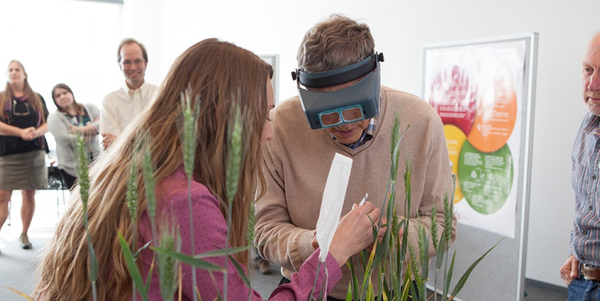
Bill Gates at Cornell University, trying to cross-pollinate wheat. (Photo: Cornell University)
The Gates Foundation is arguably the biggest philanthropic venture ever. It currently holds a $40 billion endowment, made up mostly of contributions from Gates and his billionaire friend Warren Buffet. The foundation has over 1,200 staff, and has given over $30 billion in grants since its inception in 2000, $3.6 billion in 2013 alone.2 Most of the grants go to global health programmes and educational work in the US, traditionally the foundation's priority areas. But in 2006-2007, the foundation massively expanded its funding for agriculture, with the launch of the Alliance for a Green Revolution in Africa (AGRA) and a series of large grants to the international agricultural research system (CGIAR). In 2007, it spent over half a billion dollars on agricultural projects and has maintained funding at around this level. The vast majority of the foundation's agricultural grants focus on Africa.


******

We could find no evidence of any support from the Gates Foundation for programmes of research or technology development carried out by farmers or based on farmers' knowledge, despite the multitude of such initiatives that exist across the continent. (African farmers, after all, do continue to supply an estimated 90% of the seed used on the continent!) The foundation has consistently chosen to put its money into top down structures of knowledge generation and flow, where farmers' are mere recipients of the technologies developed in labs and sold to them by companies.

Etiquetas: , , , ,

domingo, septiembre 08, 2013

AGRA: helping agribusiness conquer African agriculture?

http://www.greenpeace.org/international/en/news/Blogs/makingwaves/agra-agribusiness-africa-agriculture/blog/46511/

Blogpost by Iza Kruszewska and Glen Tyler - September 6, 2013

Finally, we have confirmation of what we have long suspected: AGRA, the Alliance for a Green Revolution in Africa, has been created to facilitate the corporate takeover of African agriculture, not support African smallholder farmers with real solutions.
AGRA’s African Agriculture Status Report 2013 released two days ago confirms the organisation’s Green Revolution agenda, despite the legacy of soil degradation and water depletion left by the Green Revolution in Asia.
AGRA, founded by the Gates and Rockefeller Foundations in 2006, claims that it is spurring a “uniquely African Green Revolution”, but there’s little original thinking here. Instead, it seems to be more of the same agenda that locks farmers into a spiral of corporate control, making them dependent on seeds and fertilisers from transnational corporations which dictate price and product delivery times.
Farming In Kenya

Etiquetas: , , ,

martes, noviembre 03, 2009

Worldwatch cozies up to the Gates Foundation and AGRA

Danielle with Argent Chuula, a program officer in the Soil Health Program at AGRA

Danielle with Argent Chuula, a program officer in the Soil Health Program at AGRA

This is the first of a three-part series about our visit to the Alliance for a Green Revolution in Africa (AGRA) and AGRA grantees in Kenya.

We visited the headquarters of the Alliance for a Green Revolution in Africa (AGRA) in Nairobi, Kenya, this week. The organization, which began in 2006 with a $150 million grant from both the Rockefeller Foundation and the Bill & Melinda Gates Foundation (which is one of the organizations supporting our Nourishing the Planet project), has some pretty ambitious—and controversial—goals for agriculture in Africa.

As we walked into the building, I couldn’t help but think to myself that many of my friends and colleagues in the sustainable agriculture community would think that I was walking into the belly of the beast, so to speak. Try googling AGRA—and in addition to the organization’s website, you’ll find pages and pages of criticism about them from groups like GRAIN, Food First, and The Oakland Institute. But as part of our research for State of the World 2011, we thought we had to see—and hear—for ourselves what AGRA program representatives had to say about their work.

LINK: http://blogs.worldwatch.org/nourishingtheplanet/looking-for-a-greener-revolution-visit-to-agra/

Etiquetas: , ,

martes, junio 09, 2009

File:Vegetation Africa.png


Mount Kenya Declaration on the Global Crisis and Africa’s Responsibility

Statement from the African Biodiversity Network

From 23 - 31 May 2009, the African Biodiversity Network (ABN) have gathered together near Mount Kenya, 25 organisations from 10 countries that work with farmers and local communities on the issues of biodiversity, food sovereignty, livelihoods, climate change, traditional knowledge, culture and community rights in Africa.

We are deeply aware that the planet is facing multiple interconnected crises which will have an even bigger impact on Africa, even though Africa is not responsible for these crises. On the one hand, there is the stark and devastating impact of the food and financial crises, which will be compounded by the impact of climate change.

We are very concerned about the devastating impact that the food and financial crises and climate change is having on the people of Africa and their environment. People are losing their livelihoods, houses, jobs at an alarming rate and at the same time, farmers, pastoralists and local communities have to cope with unpredictable changes in their environment. We concur with the Indigenous Peoples11 Anchorage Declaration of April 2009, that the Earth is no longer in a period of climate change but in a climate crisis.

We are outraged at the financial crisis which was caused by global financial institutions accumulating unimaginable wealth while speculating with ordinary people’s hard-earned savings. This economic meltdown is now pushing many countries over the brink and is adding another estimated 104 million people to the 1 billion permanently hungry people in the world.

We are also aware that the food crisis and recurring famines in Africa are not something new but is caused by basic structural injustices entrenched over decades, now reaching new levels of deprivation because of the speculative trading of food on international markets.

We find the current scale of ”crisis capitalism” intolerable and strongly reject the cynical attempts of corporates that target Africa for further exploitation of the food and climate crises by turning it into economic opportunities rather than trying to solve it.

We see the underlying cause of the crises as the globalisation of the industrial system which inevitably results in the concentration of capital and power in the hands of a few, generating ever growing poverty and ecological destruction resulting in global climate change. Now the same thinking that created these numerous toxic debts is promoting many“False Solutions” that are exacerbating the crises. There is an intensified scramble for Africa’s land and ecological wealth facilitated by governments who continue to be dominated by corporate interests.
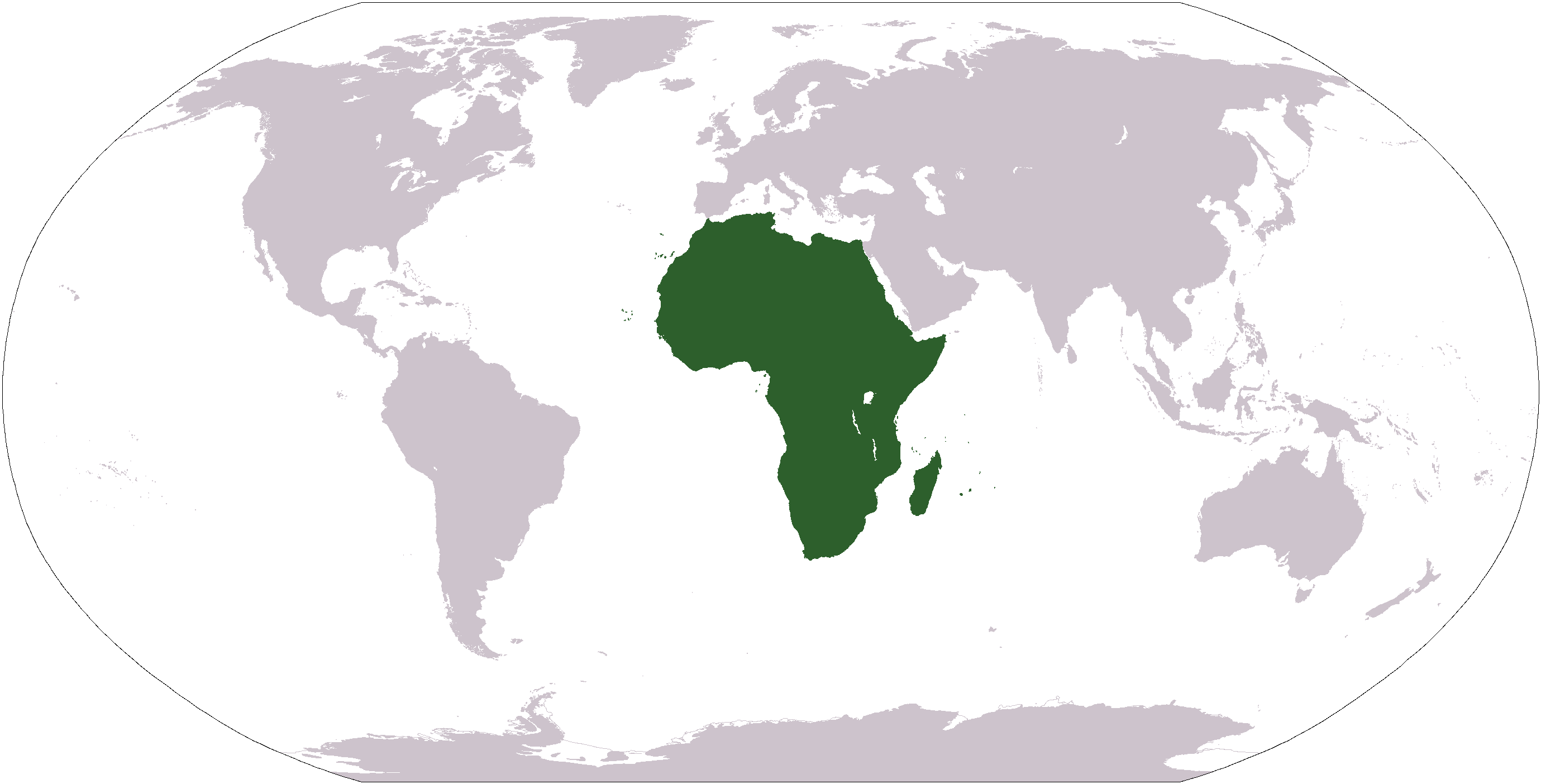
File:LocationAfrica.png


We reject these False Solutions which include:
  • Genetically Modified Organisms (GMOs), which, we are told will solve hunger and climate change, but have instead caused widespread contamination of farmers’ crops and our food while increasing the use of pesticides which destroy biodiversity and health. The ultimate aim of GMO companies is control over our seed and thus food system through the patenting of all forms of life. These crops require highly industrialised farming conditions, which release huge amounts of carbon into the atmosphere, thus a major contributing factor to climate change. In spite of this, GMO proponents are now claiming that they can find GMO fixes for both the climate change and the food crisis.
  • AGRA – A New Green Revolution is imposed on Africa by a collaborative effort between amongst others, the Bill and Melinda Gates and Rockefeller Foundations, the World Bank, and agro-industries to replace Africa’s seeds, crops and knowledge with hybrids, GMOs, fertilisers and pesticides. Because this industrial system needs large tracts of land, AGRA is also funding the push to change land tenure systems, privatise land and so facilitating the rapid change of land from community custodianship to just another commodity in the pockets of investors. The sheer amount of money and political influence the Green Revolution push has behind it, is now dominating the debate on agriculture, pushing for stricter intellectual property rights on seeds, weak biosafety legislation, in the process narrowing Africa’s options for food sovereignty both on country and local level.
  • Agrofuels (or biofuels) are promoted in Northern countries as the solution to climate change, as providing an alternative to fossil fuels. But they are driving an unprecedented land grab across Africa, and leading to forced evictions, deforestation, and rising food prices. We challenge the myth spread by corporations and corrupt governments that there is plenty of free land, going spare in Africa. We in Africa know of the challenges and conflicts we already face from the competition for land and water. A number of other solutions to climate change are also turning out to be little more than business opportunities, including biochar, carbon trading, geo-engineering.

It is clear that these proposed solutions by corporate interests are based on acquiring large tracts of land and cheap labour for industrial scale production, serving to maintain the lifestyle of societies of over-consumption thereby exacerbating the crises both in the North and the South. All of these developments claim that they bring progress to Africa. But not only will they fail to address hunger and climate change, they will make them worse. These false solutions are cynical attempts by the corporations to reach new markets, and to make a business out of a crisis

ABN’s Position

ABN believes that the solutions to climate change and hunger are the same: healthy resilient communities depend on healthy resilient ecosystems and biodiversity.

We are certain that the role of healthy, biodiverse ecosystems in maintaining a stable climate is critical, and that it is completely underestimated in most predictions and discussions about climate change. When dealing with climate change, we must both reduce carbon emissions and enhance biodiversity as equally important. Healthy soils built up by ecological agriculture and livelihood systems sink carbon as well as having more capacity to hold water in times of drought or flood.

Food sovereignty at local and national level requires locally adapted crop and livestock diversity and land tenure systems that will enable communities to produce and market food in a way that really feeds people, promote equity and at the same time deal with climate instability.

We also believe that local and indigenous ecological knowledge and governance systems must be urgently revived and enhanced to maximise Africa’s capacity to read, anticipate and adapt to climate change.

The time has come for national governments to prioritise the regeneration of ecosystems, self-reliant communities and diversified local economies over export oriented policies, free trade agreements and the current wave of expansion of the food system.

Africa needs to have the courage to free itself from its colonial legacy and build on its rich heritage through reviving the wisdom of its people as a responsibility to past and future generations. Based on this wealth, it has the capacity to take a lead in finding true solutions by disengaging from the very thinking that has created the crises in the first place.

Here, as the birthplace of the human species, African communities have adapted and evolved over 1000’s of years, without destroying their life support system. Africa needs to reclaim its responsibility and legacy as a basis from which to build a viable future for all.


Elfrieda Pschorn-Strauss
GRAIN

Etiquetas: ,

miércoles, mayo 20, 2009

www.oaklandinstit/3F6DE3FE.png

The Oakland Institute Reporter


Tell Congress Not to Force GE Crops on Other Countries


An Action Alert from Center for Food Safety (www.centerforfoodsafety.org)


A Note from the Oakland Institute


The 2008 food crisis and growing hunger, which threatens nearly one billion people worldwide, has been framed as a crisis of demand and supply. Thus the solutions offered primarily focus on boosting agricultural production through technological solutions like genetic engineering (GE).


A big player promoting GE as the panacea to world hunger is the United States. During the G-8 Summit, U.S. Secretary of Agriculture Tom Vilsack warned that failure to take immediate steps to reduce hunger will cause fresh social unrest. He thus urged the G8 to back the use of science in agriculture, including genetically modified organisms, to boost productivity. (Financial Times, 2009) On his return from Italy, much to the delight of biotech companies such as Pioneer Hi-Bred and Monsanto, he pledged to bring a "more comprehensive and integrated" approach to promoting agricultural biotech overseas. (Des Moines Register, 2009).


Similarly in a joint essay, former Executive Director of the UN World Food Program, Catherine Bertini, and former U.S. Secretary of Agriculture, Dan Glickman, hailed plans for a new Green Revolution that includes biotechnology, as holding "great promise." They advocated for prioritizing food and agriculture in the U.S. foreign aid. Recognizing that their plans might generate resistance, the authors wrote, "Although there is the potential for conflict over a hunger initiative on the issue of introducing more GM crops, this conflict is more likely to be with Europeans than with Africans or Asians, both of whom are increasingly inclined to accept the technology." (Bertini & Glickman, 2009)


This thinking, that developing countries can be arm twisted into accepting GE crops, is reflected in a new multi-billion dollar U.S. aid bill. Global Food Security Act (SB 384), also known as the Lugar-Casey Act, revises the 1961 Federal Assistance Act to direct more money towards GE research as part of U.S. foreign aid programs. (PANNA, 2009) The bill is now before the Senate after passing the Senate Foreign Relations Committee in March 2009 on the basis of hastily conducted, industry-friendly research that was funded by the Gates Foundation. A similar bill is expected soon in the House of Representatives.


A recent report from the Oakland Institute, Voices from Africa: African Farmers & Environmentalists Speak Out Against a New Green Revolution in Africa, clearly outlines African resistance to plans for a technological agricultural revolution in Africa, particularly the misguided philanthropic efforts of the Gates Foundation's Alliance for a New Green Revolution in Africa (AGRA), and presents African solutions rooted in first-hand knowledge of what Africans need. To learn more, download a copy of the report at www.oaklandinstitute.org.


Also visit and join today, Voices From Africa at www.oaklandinstitute.org/voicesfromafrica, a new online clearinghouse to share information on and promote alternatives to the New Green Revolution in Africa.


It is time that we demand the U.S. government stops bullying other countries and that they hav policy space to develop agriculture as they deem fit for their environment, farmers, and national needs.


Send a letter to the following decision maker(s):


Tell Congress Not to Force GE Crops on Other Countries


An Action Alert from Center for Food Safety (www.centerforfoodsafety.org)


An effort to fight global poverty and hunger may become a Trojan horse to force genetically engineered crops on countries and farmers that do not want them. In the Senate, Senators Bob Casey (D-Penn.) and Dick Lugar (R-Ind.) introduced the Global Food Security Act, which increases funding for agricultural research in the developing world, and a companion bill in the House of Representatives is expected to be introduced soon. While the bill recognizes the desperate need to increase funding for agricultural development and food security, it also requires that foreign agricultural development aid include investment in genetically engineered (GE) crops.


Most developing countries, especially in Africa, do not allow genetically engineered crops to be commercially grown, but that's changing with international pressure. Biotech companies have mounted a misinformation campaign to sell themselves and their products as "humanitarian." But, genetically engineered crops are not a solution to world hunger. To date, not a single GE crop released for commercial growing has increased yield potential or elevated nutritional levels. In reality, fully 85% of all GE crops globally are engineered to survive spraying with chemical weedkillers. These chemical-dependent GE crops have sharply increased overall use of pesticides and are best-suited to large growers seeking to reduce labor needs for weed control, not poor farmers anxious to produce more to feed their families.


A recent report by the Center for Food Safety and Friends of the Earth found that agricultural biotechnology feeds the profits of biotech companies - not the poor. The report's findings support the United Nations' assessment of world agriculture released in a report in 2008, which concluded that GE crops have little potential to alleviate poverty and hunger in the world, and instead recommended low-cost, low-input agroecological farming methods.


The solutions for food security through agricultural development lie in promoting agroecological practices that not only increase agricultural productivity, but are affordable and accessible to small-scale developing world farmers. As Ben Burkett, an African American farmer from Mississippi and President of the National Family Farm Coalition who has visited Africa many times, said in a recent article, "More expensive genetically modified seeds, pesticides and chemical-intensive practices won't help the hungry and will only allow more profits and control for seed companies like Monsanto and Syngenta."


Food aid and development assistance should never be pre-conditioned on accepting unwanted and ineffective genetically engineered crops. Tell Congress to keep genetic engineering out of any food aid and agricultural research legislation.


Send a letter to the following decision maker(s):


Your Senators


Below is the sample letter:


Subject: Keep genetic engineering out of food aid and agricultural research legislation


Dear [decision maker name automatically inserted here],


I urge you to oppose any food aid or agricultural development aid legislation that promotes genetic engineering, or that mandates its development or use, such as the Global Food Security Act of 2009 (S. 384), Section 202, subsection number 4. This provision would require that agricultural research include "research on biotechnological advances, including genetically modified technology."


The food crisis makes clear how vital it is that we increase our foreign assistance funding to help the world's poor - primarily small farmers - become more productive and capable of feeding their families and communities. However, as Congress examines the ways to do so, genetically modified (GM) crops should not be mandated as part of that funding. Thus far, GM crops have failed to offer food security or agricultural development assistance in developing countries throughout the world. Currently 85% of all GM crops are engineered for pesticide tolerance. These chemical-dependent crops have sharply increased overall use of pesticides and are best-suited to large growers seeking to reduce labor needs for weed control, not poor farmers striving to produce more to feed their families. In addition, GM seeds are two to four-fold more expensive than conventional seeds, well beyond the means of many developing country farmers. Not a single GM crop commercially available offe rs nutritional benefits, enhanced yield potential, drought-tolerance, or other attractive sounding traits often touted in the media. Thus, it is not surprising that many developing countries do not allow the commercial growing of GM crops, particularly in Africa, where only two countries allow them.


Fortunately, much more effective and affordable solutions already exist - only they desperately require additional funding to spread their benefits to more farmers. In fact, a comprehensive assessment sponsored by the United Nations and the World Bank concluded in 2008 that while such agroecological techniques hold tremendous promise, GM crops have little potential to alleviate poverty and hunger in the world.


Farmers and governments in the developing world have the right to make their own choices about GM crops. Food aid and development assistance should never be pre-conditioned on acceptance of unwanted, expensive, and ineffective technology. Instead, our legislative efforts to increase food security and agricultural development assistance should be based on the proven agroecological methods already being promoted by the international community and the United Nations.


Please oppose Section 202, subsection number 4 of the Global Food Security Act (S. 384) which would force genetically engineered crops on the developing world.


Sincerely,


###


Support the Oakland Institute

The Oakland Institute is an independent policy think tank working to increase public participation and to promote fair debate
on critical social, economic, and environmental issues.


-OR-
Make your check payable to our fiscal sponsors, the International Forum on Globalization and note that it is for The Oakland Institute.
Please mail your checks to:
The Oakland Institute
P.O. Box 18978
Oakland, CA 94619

Etiquetas: ,

viernes, mayo 08, 2009

Ignacio Chapela on Pollan and the Gates Foundation

Berkeley, April 1
To: Jim Thomas et al.
From: Ignacio Chapela
Re: Gates' Grant to Berkeley's Journalism School

In coincidence with Jim's friends at Berkeley (but independently of any of them), I composed an email to Michael Pollan, which I sent earlier today with copies to people I thought would be directly interested. Since this seems in fact to be taking a deservedly higher magnitude of interest, I am enclosing the text of that email for your information below.

I cannot pretend not to be concerned about these developments, even with Michael's reassurances as reported by Jim. As the corporate capture of all aspects of public life noose-knots tighter and faster, I think this is a very unfortunate step. Berkeley is, as we have shown multiple times over the decades, the weathervane for developments in the corporatization of public spaces and this, modest and independent as it seems, looks to me as a very important one. It was Berkeley, not least thanks to Michael's deft leadership and brilliant writing, which catalyzed the very successful and inspiring inroads of the organic and slow food movements in the last few years, developments which have had resonance around the world. And it is because of this influence that Berkeley continues to be a target of all kinds of discredited parties who want to gain credibility, not least BP, Novartis, the hordes of biotech boosters and now Gates.

Gates' move on Berkeley is interesting because it comes from a "charity", an organization which could be naïvely believed to be free of vested interests and because it targets an institutional player who is not clearly identified with direct interventionist goals as a technical research lab would be. So it is not the usual "BP Pays Energy Researchers to do its Work" kind of headline (as it is, no regular news outlet seems to have picked up the story, but that is another story), and Gates is as free to claim independence from vested interests as the J School is free to claim freedom to research. Naively, then, we should pack this conversation and move on to another (for example, watch the nice video at one my ex student's comment on youth bloggers against clean coal here: http://solveclimate.com/blog/20090331/media-savvy-youth-are-blogging-coal-death ). But the reality is not so simple, not these days of Government by Monsanto, BP, Lockheed and Goldman Sachs.

As Jim probably pointed out to Michael, Gates is bereft of ideas on what to do with their billions as they seek to save the poor (from whom?), and they have -naively or not, I don't know- loaded their ship with well-known agents of the capsizing nave of agricultural biotech. If there is anything in which the Gates people seem to believe, it is the unavoidability nay the morality of technical solutions to all problems, and the one tired thing left in the magician's hat of technology for environmental interventions is transgenesis, or at least they seem to believe so. Most importantly, Gates' dominant voice and policy enforcer continues to be one of the most notorious activists for the transgenization of Africa, Robert Horsch (a UC R alumnus and Monsanto's main strategist on the very matter). Given the dismal record of transgenic agriculture in general, and in particular in Africa, can we possibly believe that Gates would want to attract real, probing journalism to their (basically, Monsanto's) agricultural works in the troubled continent? Horsch must know very well what Burston-Marsteller was telling Monsanto already in 1998, namely that the battle over GMOs was not technical, but one of PR dominance. I use the word "Monsanto" here because of Dr Horsch, but also to refer to this particularly interesting beast of the 21st Century corporate state as much as to a metonymy for the rest of the known list of commercial, environmental transgenecists such as Syngenta, Amyris or LS9.

Ever since, and despite all signs of financial, ecological and public rejection of their plans, Monsanto and allies have continued a campaign to enforce the use of GMOs wherever possible. "Africa" has been in their designs at least since their catastrophic collapse of 2000 (largely unreported as such), mostly as a strategic -and mostly rhetorical- location. It appears that Gates may have naively run into its role as the new, new lease on life to Monsanto's designs after the evaporation first of real industrial money (1999), then of venture capital (2002) and now of governmental subsidies. Along this long trek of failures, it has been interesting to note also the move on Monsanto's part from trying to support their own scientists (early 1990s) to getting hired, subsidized ones (in academia and government mid- to late 1990s), to altogether giving up on them and dedicating themselves to two main things: PR and litigation.

I am sure I would offend many at the J School by even suggesting that they could possibly be participating in anyone's PR campaign, but I cannot avoid the conclusion that this grant is intended to weigh the academic balance in that direction. Nevertheless, we the Academic Senate of the Berkeley campus re-wrote the meaning of Academic Freedom in 2007, on the occasion of the BP half-billion cannonade, to mean the freedom to receive money from any source we wish without being questioned about it, so it may be close to impossible (and for me even a breach of basic academic rules) to even ask questions about it. Gates must be well advised about this nice, business-friendly novelty at the Berkeley campus, since the chair of the Senate at the time and a fierce promoter of the idea was the Journalism School's locally influential William Drummond.

Whether Michael (Pollan) takes money from them or not is in fact a consideration, but one that in the dumb light of PR campaigns represents a minor one in comparison with the brightness of the well-honed power of our campus' PR machine and of course those of Gates and their subjacent interested parties. Already in the press release about the grant, Michael is the subject of about 1/6 of the text, certainly the only one with anything to say about how this makes any sense, and there is definitely the impression that he is a central player in the grant. This image is irretrievable. Did he mean to play this role? Apparently not, but this subtlety will remain hidden from the outsider.

By staying on as a faculty member on the Berkeley campus of BP, I am myself confronted with the very same quandary, knowing that the very work I may do on my side of the biotech debates is always prone to be used as a demonstration of the "balance" and even "radicalism" of the campus, no matter how marginal my position may be. It is a sad National situation when I have to be proud that there are no quotes of me on the campus' news website (the ugly mugs with one of my quotes in the Free Speech Movement Café are also gone), or that my Chair would have called me in to tell me that I was tarnishing the image of the Department by my statements. I do not wish this status on Michael, who had managed to keep -together with some of his colleagues- a notably sane environment in the J School, and wish him well on managing what I believe to be unmanageable.

After all, what are the options? In my case, and now it appears in Michael's, too, the alternative doors are closing for the moment. For me the prospect of receiving funds from BP or Monsanto is untenable, but even looking elsewhere the panorama is not much broader for the critical thinker: I do not seem able to find a federally-funded program that has even two degrees of separation from BP's Department of Energy, Monsanto's Department of Agriculture, Lilly's NIH and so on. It is not a coincidence that Gates itself would have hit a brilliant, $48 million strategic alliance with the last uninfected (perhaps) agency, the NSF: not two days ago, the announcement was made that Gates was pouring $24 million into the perversely named BREAD initiative, whereby NSF will administer Gates' money to entice scientists to perform promotional work in ag biotech. In a world where journalism has passed from the kneeling to the supine position, the Seattle Times appears to be the only independent source of this news and far from implying any interest in influencing scientist's attention, the homie reporter highlights Gates' generosity in "sharing" the decision: "Staff from NSF and the Gates Foundation will jointly make the final cut." I would have called that jaw-dropping arrogance, glaring censorship and meddling in the work of science. And of course I can easily imagine the fate of one of my proposals to this generous program.

No doubt, we must keep the feet of the J School and the Gates Foundation on the fire of critical thinking and analysis, and I am thankful that there are so many out there who are paying attention. Please keep pushing, please keep questioning.

With all best from a Berkeley buffeted by a long tide of corporate cooptation that does not relent,

Ignacio


Dear Michael,

I just read news about the big Gates grant to the Journalism School to draw your attention and efforts to Africa's agriculture: What a great idea, what a scary reality! I just want to wish you luck in dealing with this, loaded as it is with the intervention of Gates, Henry and Zilberman (those few I could figure out from the PR on the press release at http://journalism.berkeley.edu/press/africa_reporting/, among the many chefs that I imagine will be wanting to help with the menu); I can see there will be involvement of the Beahrs Poverty Center, too.

I hear from good sources that Gates may be honest about trying to find out the consequences of their extremely clumsy moves on Africa, and they will have to conclude sooner or later that they have been acting like an ignorant goat in a concert hall. But will they be so open as to allow serious journalism being done about themselves? No doubt AGRA will have to be part of any English-language reporting on Africa's agricultures, perhaps the most important part, and it is hard not to conclude from all they do in their "Fourth Generation" AGRA program that Gates are clear in a propagandistic intent.

How to avoid the conclusion that the J School is now burdened with as heavy a conflict of interest as there can be in the field? Not even Monsanto has such a desperate need for inspired and credible propagandizing (check out their Monsanto blog, which they present as if it was their maiden trip into internet-driven opinion-shaping, as if nobody knew about their millions invested over the many years in every possible PR strategy, including the questionable "viral marketing" from its earliest days) - and Gates has in fact much more financial muscle to push their weight around than Monsanto. Gates (and AGRA) cannot claim independence from Monsanto, with whom they have strategic alliances, at least through Monsanto's Danforth Center. Perhaps it will be useful to hear what Paul Rabinow has to say about such deals since he has gained experience trying to infuse the BP deal with a streak of Bioethics, a similar quandary as the one you are presented today.

I do look forward to the internationalization of the food-related work and the J School, and keep my fingers crossed.

With all best,

Ignacio

Etiquetas: , , , , ,

martes, abril 21, 2009

Africa's Green Revolution rolls out the Gene Revolution

African Centre for Biosafety produces another Briefing paper, titled: "Africa's Green Revolution rolls out the Gene Revolution" by Mariam Mayet.

"The 'New Green Revolution in Africa', touted since the 1990s, was given renewed impetus two and a half years ago, when the Rockefeller and Bill and Melinda Gates Foundations launched the Alliance for a Green Revolution in Africa (AGRA). Although AGRA itself does not incorporate genetically modified (GM) crops in its projects, the ominous presence of GM companies and GM technologies hovers over the Green Revolution push like a bad dream.
Millions of dollars have been poured into the coffers of a host of carefully selected role players, to lay the groundwork for the industrialisation of African agriculture and creation of markets for agribusiness giants. These AGRA players include US groups such as Citizens Network for Foreign Affairs (CNFA) and the International Fertiliser Development Centre (IFDC). Both these groups are successfully enmeshing the corporate interests of Syngenta Crop Protection, Dow AgroSciences, Bayer CropScience, Du Pont Crop Protection and Monsanto within AGRA projects in select African countries.
It is also becoming extremely important to link the huge amounts of cash flowing into 'Green Revolution' coffers, to the enormous cash injections flowing from the Gates Foundation into biosafety projects in Africa. The beneficiaries of huge Gates Foundation biosafety grants are all linked directly with, or are funded by, the biotechnology industry. These projects strategically avoid the promotion of GM crops that are in commercial production and instead focus on 'pie in the sky' nutritionally enhanced GM 'biofortified' and 'climate-friendly' drought-tolerant crops. This is done to win over the hearts and minds of reluctant Africans, while paving the path for the gene giants to gain a firmer and more respectable foothold in Africa."
To download the whole document, please log on to:
http://www.biosafetyafrica.org.za/images/stories/dmdocuments/gene_revolution_brief.pdf
This paper has been published in the Third World Resurgence, April edition.

SOURCE:
http://www.oaklandinstitute.org/voicesfromafrica/node/15

Etiquetas: , ,

lunes, marzo 09, 2009

Oakland Institute Report Challenges Western-led Plans for a Genetically Engineered Revolution in African Agriculture


Voices From Africa


African Farmers & Environmentalists Speak Out Against a New Green Revolution in Africa


Oakland, CA: A new report from the Oakland Institute, Voices from Africa: African Farmers & Environmentalists Speak Out Against a New Green Revolution in Africa, issues a direct challenge to Western-led plans for a genetically engineered revolution in African agriculture, particularly the recent misguided philanthropic efforts of the Gates Foundation's Alliance for a New Green Revolution in Africa (AGRA), and presents African resistance and solutions rooted in first-hand knowledge of what Africans need.

The report finds a lack of accountability, transparency, and stakeholder involvement in philanthropic efforts such as AGRA. "Despite the Gates Foundation's rhetoric of inclusion and the claim that their investment in agricultural development benefits the growing majority of the world's poor who rely on agriculture, a leaked Gates Foundation confidential report on their Agricultural Development Strategy for 2008-2011 actually emphasizes moving people out of the agricultural sector," said Anuradha Mittal, Executive Director of the Oakland Institute and the editor of the report. "Their intention is to reduce dependency on agriculture, but their strategy report does not specify where or how this new 'land mobile' population is to be reemployed," she continued.

AGRA claims to be an "African-led Green Revolution," and features Kofi Annan at the helm as its chairman; however, African civil society has rejected the idea that one man can speak on behalf of over 50 countries and 680 million people. It is also not apparent from the foundation's Agricultural Development Strategy report whether--or how--the Gates Foundation consulted with African farmers before launching their multi-million dollar development strategy for the continent. Some of the foundation's external advisors have long partnered with biotech companies: for example, Ruth Oniang'o is featured on Monsanto's website claiming that there is an urgent need for food biotechnology in Africa, and Gates Foundation potential grantee Calestous Juma has urged the G8 to put biotechnology on the agenda for for Africa and discard the application of the precautionary principle because it interferes with the development of new technologies.

"Africa does not need dumping of food aid by rich countries that destroys local efforts to produce. Not the imposition of industrial-style agriculture based on chemicals and 'high-yielding' seeds, with the paradoxical outcome of greater production of a few food crops accompanied by even worse hunger and environmental degradation," said Diamantino Nhampossa, a contributor to the report and Executive Coordinator of the União Nacional de Camponeses (National Peasants Union) in Mozambique and member of the Via Campesina's International Coordinating Committee for the Africa Region.

The battle over genetic engineering is being fought across the world, between those who champion farmers' rights to seeds, livelihood, and land, and those who seek to privatize these. While promotional campaigns for technological solutions to hunger regularly feature a handful of African spokespeople who drown out the genuine voices of farmers, researchers, and civil society groups, there is widespread opposition to genetic engineering and plans for a New Green Revolution for Africa. Voices From Africa is based on the essays and statements of leading African farmers, environmentalists, and civil society groups, and brings to light the real African perspectives on technological solutions to hunger and poverty on the continent--and the solutions that the people on the ground believe would bring true development.

The increase in hunger resulting from 2008's steep increase in food prices has been used to make a case for increasing agricultural production through technical solutions such as genetically engineered crops. This "poor washing"--the spurious claim that technology will address the needs of the hungry--and "green washing"--the claim that this technology will help address the threat of climate change--conveys a false sense of need. Voices from Africa clarifies how solutions to hunger and environmental degradation require a paradigm shift that values local and traditional knowledge and biodiversity, opens policy space for developing countries to craft their own solutions, and allows for agriculture and trade policies that protect local and regional markets for small farmers, pastorlists, and fisherfolk. "The way to fight poverty in Africa is to embrace the proposal of food sovereignty that comes from the movement of peasants, indigenous peoples, migrants, women, and rural communities," said Mr. Nhampossa. "Food sovereignty puts those who produce, distribute, and consume food at the heart of food systems and policies, rather than the demands of markets and corporations."

Other voices featured in the report include: Mariam Mayet, African Center of Biodiversity, South Africa; Nnimo Bassey, Environmental Rights Action, Nigeria; David Fig, BioWatch, South Africa; Mukoma Wa Ngugi, BBC Focus on Africa Magazine; Makhathe Moahloli, Katleho Moho Association (KMA), Lesotho; Zachary Makanya, Participatory Ecological Land Use Management Association (PELUM), Kenya; and Gertrude Kenyangi Kabusimbi, Support for Women in Agriculture and Environment (SWAGEN), Uganda.

Voices from Africa:African Farmers & Environmentalists Speak Out Against a New Green Revolution in Africa is a publication of the Oakland Institute (www.oaklandinstitute.org), a think tank for research, analysis, and action whose mission is to increase public participation and promote fair debate on critical social, economic, and environmental issues in both national and international forums.

Download a copy of the report at http://www.oaklandinstitute.org/voicesfromafrica/pdfs/voicesfromafrica_full.pdf

Download the Introduction of the Report at http://www.oaklandinstitute.org/voicesfromafrica/pdfs/voicesfromafrica_intro.pdf

Meet the Authors at http://www.oaklandinstitute.org/?q=node/view/501

Read other reports and policy briefs on the global food crisis at http://www.oaklandinstitute.org/?q=node/view/489

Etiquetas: , ,

martes, octubre 14, 2008

Food First Policy Brief No.12

October 2006

Ten Reasons Why the Rockefeller and the Bill and Melinda Gates Foundations’ Alliance for Another Green Revolution Will Not Solve the Problems of Poverty and Hunger in Sub-Saharan Africa

By Eric Holt-Gimenez, Ph.D., Miguel A. Altieri, Ph.D., and Peter Rosset, Ph.D.

Food First/Institute for Food and Development Policy
October 2006

The Rockefeller Foundation and the Bill & Melinda Gates Foundation recently announced a joint $150 million Alliance for a Green Revolution in Africa (AGRA), provoking immediate criticisms that the proposal fails to take into account the failures of the original Green Revolution. The creators of AGRA claim the initiative will bring benefits to the African continent’s impoverished farmers who—they assert—until now have been bypassed by the first Green Revolution. A day later, probably in an orchestrated move, Jacques Diouf, Director General of UN’s Food and Agriculture Organization (FAO), called for support for a “second Green Revolution” to feed the world’s growing population. UN boss Kofi Annan also weighed in to support the initiative.

The AGRA plan is remarkable given that, according to a World Bank evaluation, over the last twenty-five years the CGIAR—which brings together the key Green Revolution research institutions—has invested 40-45% of their $350 million/yr budget in Africa (The World Bank 2004). If these public funds were not invested in a Green Revolution for Africa, then where were they spent? If they were spent on the Green Revolution, then why does Africa need another one? Either the Green Revolution’s institutions don’t work, or the Green Revolution itself doesn’t work—or both. The Green Revolution did not “bypass” Africa. It failed. Because this new philanthropic effort ignores, misinterprets, and misrepresents the harsh lessons of the first Green Revolution’s multiple failures, it will likely worsen the problem.


Download in PDF

Etiquetas: , , ,

jueves, septiembre 25, 2008

A letter to Scientific American

In regards to your article "Food Shortage Aid Should Start with Lessons in Agriculture." [Aug 2008], isn't it time that groups in wealthy developed countries stopped professing to know "the solution" to hunger in Africa? If Scientific American is concerned about "putting African bread on African tables," maybe you should be reporting on, and supporting, the many agroecological projects on that continent and elsewhere that have increased productivity using means more readily available to Global South farmers. [For example, the NY Times has reported that just intercropping of rice strains can double yields (Carol Kaesuk Yoon, "Simple Method Found to Increase Crop Yields Vastly," August 22, 2000)].

Many farming organizations in Africa have, with comparatively little international support behind them, achieved amazing agricultural successes through endogenous innovation, biointensive farming, and other organic farming methods, without the use of genetically engineered seeds.

We disagree with your support of Green Revolution technologies as a solution for African farmers. Green Revolution packages of hybrid seed, mechanical instruments, and chemical inputs were previously introduced in much of Africa, and for the most part, they failed due to their incompatibility with place-specific agricultural production patterns. Elsewhere in the world, they have led to significant negative consequences --consolidation of farms, massive debt for smallholders, and subsequent suicide epidemics. They did not reduce global hunger.

High tech inputs may be suitable for large mechanized industrial farms (although even here they present significant problems), but they are completely inconsistent with the needs of smallholders in the Global South. For example, while these technologies benefited those large farmers who were well-connected, they failed to address the politics of class. Patented GE seeds can not be legally replanted, shared with neighbors, or crossed with other varieties-the techniques that enabled these people to feed themselves for millennia.

The recent report of the International Assessment of Agricultural Knowledge, Science and Technology for Development, prepared by the World Bank and the UN, refused to support the further industrialization and globalization of agriculture and, in particular, reliance on genetically engineered plants, because the analysis shows that this route is unlikely to achieve the goal of feeding a hungry world.

GE issues are intensely political, as are agricultural issues in general-hunger in Africa and elsewhere is at least partly attributable to problems with unequal global distribution of food, political instability, and international trade regimes. However, your article leaves out the various political and economic aspects of the problem; these will not be fixed by technological improvements in agriculture.

Given our concern with the global state of agriculture and food security, we encourage Scientific American to consider all factors contributing to world hunger and to feature non-genetically engineered approaches that combine agricultural science with social, political, and economic non-technological solutions in your pages.

Sincerely,

Prof. Philip L. Bereano and Ashley Fent
on behalf of AGRA Watch, Seattle

Etiquetas: , ,

martes, septiembre 23, 2008


Mariam Mayet

Centro Africano para la Bioseguridad

mariammayet@mweb.co.za, http://www.biosafetyafrica.net/portal/


Introducción

Un reciente informe del Banco Mundial dio que hablar en todo el mundo porque atribuye la culpa de la escalada mundial del precio de los alimentos a la producción de agrocombustibles en Estados Unidos y Europa, al comercio especulativo y a las prohibiciones de exportación, y concluye que dichos factores provocaron un alza de los precios de entre 70 y 75% (1). Sin embargo, el informe no hace sino arañar la superficie de lo que realmente está detrás de la actual crisis alimentaria. Se requiere un estudio mucho más riguroso para analizar el “colapso estructural” provocado por políticas como la Revolución Verde, que transformaron algo tan sagrado como los alimentos en simples objetos de regateo y especulación (2). Si han proliferado los motines callejeros es debido al descontento y la frustración de tantos pobres del mundo ante los daños “colaterales” provocados por las fuerzas globalizadoras del capital. Ahora, esas mismas fuerzas se aprestan a acelerar el desarrollo agrícola en Asia y América Latina, y a resucitar el sector agrario de África. Ellas son el motor de la “nueva” Revolución Verde en África.

Cuando los líderes mundiales se reunieron apresuradamente en la Conferencia de Alto Nivel de la Organización para la Alimentación y la Agricultura (FAO) para buscar respuesta a la crisis alimentaria mundial, salieron con una declaración lamentable (3) que, como de costumbre, prescribía las habituales soluciones económicas y técnicas, en este caso el avance de una “nueva” revolución verde en África. Durante la conferencia, las tres instituciones de las Naciones Unidas con sede en Roma, es decir la FAO, el Fondo Internacional de Desarrollo Agrícola (FIDA) y el Programa Mundial de Alimentos (PMA), firmaron un Memorando de Entendimiento con las fundaciones Gates y Rockefeller para la Alianza para una Revolución Verde en África (AGRA), y de esa forma dar un fuerte envión a dicho proyecto.

Detrás de la promoción de la Revolución Verde está la tendencia a considerar la escasez de alimentos como una consecuencia de la insuficiencia de los alimentos disponibles, y no como un fenómeno más complejo que requiere un enfoque más amplio y holístico de las razones por las cuales la gente pasa hambre.

La Revolución Verde dirigida por el AGRA es una amenaza para la riqueza de la agricultura tradicional africana, y contrasta claramente con las muchas alternativas exitosas que ofrece este continente en materia de agricultura orgánica, agricultura sustentable, agro-silvicultura, pastoralismo, control integrado de plagas, obtención de variedades vegetales por parte de los agricultores, gestión sostenible de cuencas y tantos otros enfoques agroecológicos.

Fundamentalmente, la Revolución Verde socava los sistemas alimentarios y la soberanía alimentaria de África: el derecho de las personas a disponer de alimentos sanos y culturalmente apropiados, producidos por métodos ecológicamente sensatos y sostenibles, y su derecho a definir sus propios sistemas alimentarios y agrícolas.

La Revolución Verde

La Revolución Verde se refiere al desarrollo de variedades de alto rendimiento (VAR), obtenidas para que respondan a los fertilizantes inorgánicos y otros insumos químicos. Estas VAR forman parte de un paquete tecnológico compuesto por fertilizantes inorgánicos, plaguicidas y otros productos químicos, y se alega que han mejorado mucho la producción agrícola mundial, contribuyendo así a la existencia de excedentes de productos agrícolas y a la eliminación del hambre (4).

El desarrollo de semillas híbridas estériles para reemplazar las semillas producidas naturalmente por los productores fue uno de los pasos clave en el proceso de acumulación capitalista dentro del sector agrícola. Mientras las semillas se reprodujeran por sí mismas, iba a ser muy difícil que el capitalismo pudiera controlar el principal componente de este sector. Cuando se logró quitar a los agricultores la obtención de semillas y la posibilidad de que éstas se reprodujeran por sí mismas, el capitalismo completó el ciclo para controlar el sector agrícola y las semillas se convirtieron en el principal componente del proceso de acumulación. Este control se vio acentuado por la producción de organismos genéticamente modificados y el establecimiento de un régimen más riguroso para las patentes y los derechos de propiedad intelectual.

Así, la Revolución Verde de los años 1960 y 1970 facilitó la integración de un sistema agrícola mundial, con el pretexto de “resolver el problema de la seguridad alimentaria nacional” (5).

Los problemas asociados a la agricultura convencional e industrial, de la cual la Revolución Verde es el mejor ejemplo, incluyen los siguientes: (6)

La agricultura ha terminado por obtener de fuentes más alejadas, tanto espacialmente como sectorialmente, los insumos que utiliza, por obtener de fuentes no renovables una proporción cada vez mayor de la energía que consume, por depender de una base genética cada vez más reducida y por tener cada vez mayor impacto ambiental. Esto se refleja particularmente en su gran dependencia de los fertilizantes y plaguicidas químicos, en su necesidad de subsidios y medidas para mantener los precios, y en los costos externos que implica, como la amenaza a otras especies, la contaminación ambiental, la destrucción del hábitat y los riesgos para la salud y el bienestar humanos.

El paquete de la Revolución Verde requiere gran cantidad de energía, directamente para el transporte y la maquinaria, e indirectamente para la producción de fertilizantes y otros insumos. La aplicación continua y cada vez mayor de un modelo de agricultura de gran intensidad energética no sólo aumentará los costos de la producción de alimentos sino que contribuirá a agravar el cambio climático.

La Revolución Verde en África

La “nueva” Revolución Verde para África es una “revolución de base científica”, que apunta a transformar una agricultura “atrasada” e “ineficiente” según una nueva visión de la modernidad. El 12 de setiembre de 2006, la Fundación Rockefeller y la Fundación Bill y Melinda Gates (7) (la “Fundación Gates”) se asociaron en la llamada Alianza para una Revolución Verde en África (AGRA). Con sede en Nairiobi, Kenia, el AGRA está diseñada para ayudar a millones de pequeños agricultores a salir de la pobreza y el hambre, dando un gran empuje a la productividad agrícola gracias a tecnologías similares a las de la Revolución Verde (8). Para este fin, la Fundación Gates se comprometió a dar 100 millones de dólares y la Fundación Rockefeller 50 millones durante los próximos cinco años. (9)

El AGRA apunta principalmente a la selección de productos agrícolas. A este respecto, se ha fijado la ambiciosa meta de desarrollar en cinco años 100 nuevas variedades de los principales productos, como el maíz, la mandioca, el sorgo y el mijo. El AGRA ha sido inscripta en Estados Unidos como organización de beneficencia, y funciona como órgano administrativo, proveyendo apoyo en materia de políticas y de movilización de recursos, principalmente en lo referente al desembolso del fondo inicial de 150 millones de dólares.

En junio de 2007, el ex Secretario General de la ONU, Kofi Annan, fue nombrado presidente del AGRA. Se prevé que una de sus funciones principales consistirá en usar sus numerosos lazos políticos, sus muchos contactos y su influencia en general para promover medidas mundiales, regionales y nacionales en apoyo del AGRA y sus programas. Ya tuvo ocasión de solicitar el apoyo directo de las tres agencias de la ONU con sede en Roma, la FAO, el FIDA y el PMA. En lo que respecta al Memorando anteriormente mencionado, serán designadas zonas específicas en determinados países africanos para intensificar allí la producción agrícola.

El AGRA de Kofi Annan no es más que el buque insignia filantrópico de una gran red de compañías de semillas y fertilizantes y de instituciones que pretenden industrializar la agricultura africana. La fuerte campaña del AGRA por una nueva Revolución Verde tiene por objetivo atraer inversiones privadas, reclutar a los gobiernos africanos y convencer a los agricultores africanos de que compren las nuevas semillas y los nuevos fertilizantes. El AGRA está preparando a los investigadores, las instituciones y los agricultores africanos para la introducción de productos transgénicos, no sólo arroz, trigo y maíz, sino también mandioca, plátano y otros productos agrícolas africanos. La ideología sobre la que se basa el AGRA en su conjunto pretende abrir el camino a la industrialización de los cultivos africanos para que las grandes agroindustrias puedan penetrar en el sistema agrícola del continente y dominarlo.

La soberanía alimentaria

El concepto de soberanía alimentaria fue desarrollado por La Vía Campesina, un movimiento campesino mundial, e introducido en el debate público durante la Cumbre Mundial de la Alimentación que tuvo lugar en Italia en 1996, como marco alternativo para la alimentación y la agricultura. Según Vía Campesina, el mundo se enfrenta a un conflicto histórico entre dos modelos de desarrollo económico, social y cultural para el mundo rural: un modelo agroindustrial, dentro del cual se inserta la Revolución Verde, y un modelo alternativo llamado soberanía alimentaria, que parte del concepto de los derechos económicos y sociales del ser humano, entre los cuales figura el derecho a la alimentación (10). La soberanía alimentaria trata de los derechos políticos y económicos de los agricultores como condición previa para lograr la seguridad alimentaria.

El concepto está obteniendo más y más apoyo como modelo político alternativo para la alimentación, la agricultura, las pesquerías y el pastoralismo. En febrero de 2007, más de 500 personas provenientes de más de 80 países, que representaban a organizaciones de campesinos o agricultores familiares, pescadores artesanales, pueblos indígenas, campesinos sin tierra, trabajadores rurales, emigrantes, pastores, comunidades del bosque, mujeres, jóvenes, consumidores, movimientos urbanos y de consumidores, se reunieron en Nyéléni, ciudad de Sélingué, en Malí, para fortalecer el movimiento mundial por la soberanía alimentaria. A finales de 2007, otro encuentro de más de 150 representantes de agricultores, pastores, organizaciones ambientalistas, de mujeres, de jóvenes y de desarrollo de 25 países africanos y 10 países de otros continentes tuvo lugar en Nyéléni con el fin de buscar alternativas africanas a la campaña del AGRA por una nueva Revolución Verde, alternativas de raíces locales, basadas en los sistemas agro-ecológicos y las luchas por la soberanía alimentaria (11).

Mucho queda por hacer a nivel nacional para hacer avanzar una campaña que proponga otras alternativas que la campaña del AGRA y de sus partidarios por una nueva Revolución Verde. Dichas alternativas deben estar basadas en los sistemas agroecológicos locales y las luchas por la soberanía alimentaria. Sus pilares fundamentales han de ser la investigación y el aprendizaje mutuo entre agricultores, las campañas de información a nivel popular, y las políticas de apoyo a la diversidad agrícola y biológica y a los derechos de los pastores, agricultoras y pequeños agricultores.


(1) “Biofuels, major driver of food price rise”, Banco Mundial, 28 de julio de 2008, Reuters. http://www.alertnet.org/thenews/newsdesk/N286150`6.htm. “Biofuels are prime cause of food crisis, says leaked report”, Aditya Chakrobortty, 3 de julio de 2008, http://www.guardian.co.uk/environment/2008/jul/03/biofuels.renewableenergy.

(2) GRAIN. El negocio de matar de hambre. Abril de 2008, http://www.grain.org/articles/?id=40

(3) Conferencia de Alto Nivel sobre la Seguridad Alimentaria Mundial: los Desafíos del Cambio Climático y la Bioenergía, Roma, 3-5 de junio de 2008. Declaración de la Conferencia de Alto Nivel sobre la Seguridad Alimentaria Mundial: los Desafíos del Cambio Climático y la Sociedad. (http://www.fao.org/foodclimate/hlc-home/es/). Ver también: Net Dano, “Food Security Declaration weak on substance”, www.twnside.org.sg, http://www.biosafety-info.net/.

(4) International Food Policy Institute (IFPRI), 2002. Sustainable options for ending hunger and poverty: Green Revolution Cure of Blessing. www.ifpri.org.

(5) McMichael, P. (2004), “Global Development and the Corporate Food Regime”. Simposio sobre las nuevas orientaciones de la sociología del desarrollo. 11º Congreso mundial de sociología rural. Trondheim.

(6) Rigby, D. y Brown, S. (2007), “Whatever Happened to Organic ? Food Nature and the market for ‘Sustainable’ Food. Capitalism, Nature, Socialism.” Vol. 18, nº 3.

(7) La Fundación Bill y Melinda Gates (BMGF) es una sociedad creada en 2000, con base en Seattle, gracias a la fusión de la Gates Learning Foundation y la William H. Gates Foundation. La BMGF es la fundación benéfica más grande del mundo. Información disponible en: http://www.gatesfoundation.org/MediaCenter/FactSheet/default.htm.

(8) Alliance for a Green Revolution in Africa. http://www.agra-alliance.org.

(9) OCDE. Africa Partnership Forum. www.oecd.org/dataoecd/37/1/39024069.pdf.

(10) La Vía Campesina (2002). Soberanía alimentaria. Folleto distribuido en la Cumbre Mundial de la Alimentación + 5, Roma, Italia.

(11) Conclusiones de la conferencia organizada en el centro Nyéléni de Sélingué, Malí, del 26 de noviembre al 2 de diciembre de 2007.

Puedes comentar este artículo en: http://wrmbulletin.wordpress.com/

Etiquetas: , ,

martes, julio 01, 2008

África: el AGRA pone en peligro la soberanía alimentaria

Movimiento Mundial por los Bosques Tropicales


La iniciativa de Alianza para la Revolución Verde en África (AGRA) de Gates y Rockefeller llegó a África anunciando que ayudará a los pequeños agricultores a transformarse en productores comerciales. ¿Pero, qué significa esto?

Detrás de los millonarios proyectos de financiación lo que se esconde es la promoción de la biotecnología en la agricultura. La agricultura africana dependerá más de los productos químicos, de los monocultivos de semillas híbridas y de los cultivos genéticamente modificados.

Según Mariam Mayet, del African Center for Biosafety (Centro Africano para la Bioseguridad), el AGRA es una “propuesta muy violenta porque introduce productos químicos tóxicos muy poderosos en África. Desplaza y destruye el conocimiento y las semillas locales. Favorece sólo a los agricultores que pueden acceder al sistema, a los más poderosos. Esto dividirá al campesinado africano. El AGRA también genera mucha dependencia y endeudamiento.” (1)

En la creciente tendencia a la privatización de la ayuda exterior y a la fusión del sector empresarial con los gobiernos, el AGRA se transforma en una herramienta útil para los intereses de las empresas privadas y los gobiernos occidentales ávidos de privatizar la tierra y el agua para los cultivos de exportación, los agrocombustibles y los sumideros de carbono.

Las estrategias foráneas como el AGRA se están apoderando de bosques que son también un espacio de soberanía alimentaria de las comunidades que habitan y dependen del bosque.

Los monocultivos para agrocombustibles – ya sea jatrofa en Ghana y Zambia, caña de azúcar en Uganda, Tanzania y Kenia o palma aceitera en Benin, Camerún, Costa de Marfil– invaden los bosques amenazando o incluso privando a las comunidades locales de sus medios de vida y provocando desplazamientos y miseria.

Si se privatiza la fuente de la riqueza de África, los países africanos podrían perder la posibilidad de decidir su propio futuro.

Delegados de organizaciones campesinas de diferentes países africanos que comparten la visión del movimiento campesino internacional La Via Campesina se reunieron en Madagascar en mayo de 2008 y declararon su oposición a la introducción de políticas destructivas que socavan la producción local de alimentos, forzando a los agricultores a producir cultivos comerciales para empresas transnacionales y a comprar sus propios víveres en el mercado mundial. “Los campesinos y los pequeños agricultores no obtenemos ningún beneficio del alza de los precios. Cultivamos alimentos pero en general la ganancia de la cosecha no queda en nuestras manos: demasiado a menudo ya está comprometida con el prestamista, las compañías de insumos agrícolas o directamente con el comerciante o la unidad procesadora.” (2)

La declaración final de los campesinos sobre la “Crisis Alimentaria Mundial” denuncia que “la constante apropiación de tierras por las transnacionales y otros especuladores expulsará a miles de campesinos de las zonas rurales. Terminarán viviendo en las mega ciudades donde se unirán a las crecientes filas de gente pobre y hambrienta en los barrios bajos.” El documento declara que “¡ha llegado el momento de la Soberanía Alimentaria!” y exige la aplicación de “un cambio fundamental en los criterios que rigen la producción de alimentos y los mercados agrícolas”, de “compromisos políticos a largo plazo para reconstruir las economías alimentarias nacionales”, absoluta prioridad a “la producción nacional de alimentos para disminuir la dependencia del mercado internacional”, un mecanismo de intervención que “estabilice los precios a un nivel razonable en los mercados internacionales”, así como “el derecho a implementar controles a las importaciones” para detener el dumping, y el respeto y el apoyo a nivel internacional de “programas para apoyar a los consumidores más pobres, implementar una reforma agraria e invertir en la producción nacional de alimentos por parte de los agricultores y campesinos”.

No solo los sistemas alimentarios y los bosques están en peligro; también lo están los sistemas sociales y la cultura africana toda.

Artículo basado en: (1) “AGRA – green revolution or philanthro-capitalism?”, Pambazuka News 361, http://www.pambazuka.org/en/issue/361; (2) “Global Food Crisis”, Conferencia regional de La Vía Campesina África, Madagascar, 14 al 17 de mayo de 2008, http://www.wrm.org.uy/countries/Africa/GlobalFoodCrisis.pdf


Boletín Mensual del Movimiento Mundial por los Bosques

Este boletín también está disponible en inglés, francés y portugués

Editor: Ricardo Carrere

Movimiento Mundial por los Bosques

Maldonado 1858 - 11200 Montevideo - Uruguay
tel: 598 2 413 2989 / fax: 598 2 410 0985
wrm@wrm.org.uy -
http://www.wrm.org.uy

Etiquetas: , , ,