Este es un blog bilingüe fundado en mayo de 2004, dedicado a proveer perspectivas críticas sobre biotecnología y bioseguridad … This is a bilingual blog, founded in May 2004, dedicated to providing critical perspectives on biotechnology and biosafety. Contact: ruiz@tutanota.com.
lunes, julio 11, 2016
Don’t Eat the Yellow Rice: The Danger of Deploying Vitamin A Golden Rice
Researchers in Bangladesh also are in the early stages of confined field trials of Golden Rice, but it is doubtful that these efforts will progress any quicker than in the Philippines. Even if genetic modification succeeds in creating a strain of rice productive enough for poor farmers to grow successfully, it’s unclear how much impact the rice will have on children’s health. As Stone and Glover point out, it is still unknown if the beta carotene in Golden Rice can even be converted to Vitamin A in the bodies of badly undernourished children. There also has been little research on how well the beta carotene in Golden Rice will hold up when stored for long periods between harvest seasons, or when cooked using traditional methods common in remote rural locations, they argue. Meanwhile, as the development of Golden Rice creeps along, the Philippines has managed to slash the incidence of Vitamin A deficiency by non-GMO methods, Stone said.
It has generally been assumed that, because rice is largely a self-pollinated crop and dispersal of its pollen by wind is limited, there is low risk of gene flow between cultivated GM rice plants and other cultivated or wild rice. Few studies have, however, paid attention to the impact of insect pollination on gene flow in rice. A large-scale study conducted in China has found that over 510 insect species visited rice flowers and several of these carried away large amounts of pollen, some up to 500 metres away. In a field-cage experiment with GM and non-GM rice, using honeybees as pollinators, the screening of over 1-5 million germinated offspring seeds over three years revealed that honeybees increased transgene flow in rice significantly. The researchers concluded that “the potential exists for long-distance gene escape due to the abundance of insects that carry rice pollen”. They stressed that this factor must form part of the ecological risk assessment for GM rice as well as for other GM crops.
The summary of the research report published in the Journal of Applied Ecology is reproduced below.
To subscribe to other TWN information services: www.twnnews.net
FLOWER-VISITING INSECTS AND THEIR POTENTIAL IMPACT ON TRANSGENE FLOW IN RICE
Journal of Applied Ecology 2014 doi: 10.1111/1365-2664.12299
1. Rice is one of the most important crops in the world. Several transgenic varieties of rice have been developed, and some have recently entered pre-production trials. One concern with genetically modified (GM) crops is transgene escape, but prior studies suggest this risk is low for rice because it is self-pollinated and the dispersal of pollen by wind is limited. 2. Little is known about the impact of pollen transport by insects. We characterized the insects visiting rice plants during anthesis and considered the effects of insect pollination on gene flow. 3. We conducted a 2-year nationwide survey in China and identified more than 510 insect species that visited rice flowers. Honeybees, hoverflies and several other species carried large amounts of pollen. The European honeybee Apis mellifera visited rice flowers regularly with daily foraging activity peaking between 12.00 and 13.00 h. 4. We monitored 20 European honeybee colonies located 100–1000 metres away from rice fields in mixed agricultural landscapes and found the honeybees carried viable pollen at least 500 m away from the rice pollen source. 5. We used four GM rice lines as pollen donors, their non-GM parental varieties as pollen recipients and the European honeybee as the pollinator in field-cage experiments to assess whether honeybees increase the frequency of gene flow in rice. Results from screening over 1-5 million germinated offspring seeds over a 3-year study period showed that honeybees significantly increase transgene flow in rice. 6. Synthesis and applications. Our results indicate that a remarkably high diversity of insects visit rice flowers in China and that hundreds of species including honeybees carry large amounts of rice pollen. European honeybees carry viable pollen over long distances, forage on rice flowers regularly and increase the frequency of transgene flow. Insects mediate gene flow in rice more than previously assumed, and this should be taken into consideration during the ecological risk assessment of transgene flow in self-pollinated and/or anemophilous crops.
Title: Unresolved Questions Around Golden Rice Publication date: March 11, 2014 Posting date: March 11, 2014
THIRD WORLD NETWORK BIOSAFETY INFORMATION SERVICE
Dear Friends and Colleagues
Re: Unresolved Questions Around Golden Rice
An article published by The Ecologist exposes the tangled web of unanswered questions around Golden Rice, genetically engineered to supposedly cure Vitamin A deficiency (VAD) amongst the poor.
Agri-business giant, Syngenta, has reserved its commercial rights over Golden Rice and improvements to the technology, but has granted "humanitarian use" of it (through a sub-licensing agreement) to resource-poor farmers in developing countries, through the Golden Rice Humanitarian Board. The article points out that on the face of it, such terms appear straightforward but give rise to a multitude of concerns. It questions the full implications and hidden costs of such a ‘gift’ which countries would do well to consider beforehand.
Golden Rice is not a realistic solution to the problem of malnutrition and could well create further serious problems for the people who grow and eat it.
Golden Rice (GR) is genetically engineered to contain increased levels of beta-carotene, a precursor of vitamin A (also known as provitamin A). The rice is claimed to help cure blindness and other illnesses caused by vitamin A deficiency in the Third World. It is also claimed that opposition to GR by environmentalists and anti-GMO activists has caused millions to die or go blind in the developing world.
However, the claims made for and about GR are factually incorrect and unscientific.
Rice is the Philippines’ main staple and is also consumed by more than half of the world’s population every day. The diversity of our rice is a valuable resource for developing new varieties with improved yields and can withstand diseases and environmental conditions without compromising human health and the environment. However this resource is now being threatened by plans to release and commercialize Golden Rice to address Vitamin A deficiency (VAD) in the country.
However, these should be our concern:
► Golden rice is a genetically engineered crop, that can have irreversible damage to health, food security, environment, culture, farmers and communities. More than 60 countries have imposed moratoria or outright bans on GMOs to adopt the precautionary principle.
► The Philippines does not have a biosafety law nor the capacity and resources to conduct robust risk assessments for GMOs intended for field testing, food, feed and propagation. The current regulatory process for GMOs is flawed and is only based on risk assessments conducted by the company who owns these GMOs.
► Any deliberate release of GMOs can contaminate conventional crops. This also means that the more than 80 GMOs allowed for importation for food, feed and processing and 8 GMO corn varieties allowed for commercial propagation in the country actually challenge the integrity of the 2010 National Organic Agriculture Act.
► Covered by expensive patents, Golden Rice and other GMOs can deprive farmer’s access, control and stewardship over plant genetic resources which have been nurtured, exchanged and shared across communities for generations.
► The incidence of VAD have been significantly reduced to 15% for children as of 2008 and there are already solutions in place to address VAD and other micronutrient deficiencies. The funds that are being wasted on Golden Rice research and development should instead be used on solutions that are already working which include fortification of foods and Vitamin A supplementation capsules. Having a diverse diet is still the best solution to VAD.
Say no to Golden Rice! Let us demand access to safe, healthy, nutritious and sufficient food that is produced through ecological agriculture.
THIRD WORLD NETWORK BIOSAFETY INFORMATION SERVICE Dear Friends and Colleagues Re: Golden Rice and the Children of the Poor The debate on Golden Rice continues to rage since it was first proposed as a solution to vitamin A deficiency more than a decade ago. Golden Rice is genetically engineered to produce betacarotene, a precursor to vitamin A. While the promise of this long-term experiment appears exciting, there remain serious questions regarding the efficacy and risks of Golden Rice, which have not been highlighted nor addressed by its creators and proponents. We are pleased to share the article below by a TWN Associate in the Philippines, which provides a developing country perspective on the issue. Among the issues discussed are the biosafety institutional weaknesses that leave communities and the environment vulnerable while not providing adequate safeguards in the light of the power relations at play; the successes and remaining challenges of the vitamin A supplementation programme in the Philippines, which can be an efficient and sound alternative; the need to promote diverse diets, for which the country has an abundant resource of green and leafy vegetables; and the need to rethink quick techno-fixes that sidestep more deep-seated and structural concerns such as poverty, gender inequality, landlessness and limited social protection. With best wishes, Third World Network 131 Jalan Macalister 10400 Penang Malaysia
To subscribe to other TWN information services: www.twnnews.net
--------------------------------------------------------------------------------------------------------------------------------------- (Com)promised Charity: Golden Rice and the Children of the Poor By Nina Somera (Third World Network Associate in the Philippines) To read the article: http://www.biosafety-info.net/article.php?aid=1008
Groups in Asia support Filipino farmers' uprooting of Golden Rice
PRESS RELEASE August 29, 2013
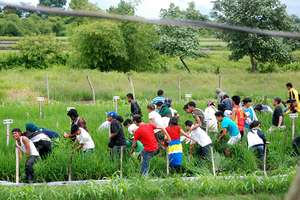
On August 8, 2013 more than 400 farmers, church people, students, academics and consumers uprooted a field trial of genetically modified (GM) rice that was nearly ready for harvest in Pili, Camarines Sur, Philippines. This courageous action undertaken by the Peasant Movement of Bicol and the Sikwal-GMO alliance was necessary to prevent the contamination of Asia's most important food crop by GMOs.
A new study in China has found that a weedy rice cross-bred with a genetically modified (GM) variety made resistant to the herbicide glyphosate (commonly sold as Roundup) has demonstrated unexpected improved fitness. Second-generation hybrids had higher rates of photosynthesis, grew more shoots and flowers, and produced 48–125% more seeds per plant than non-transgenic hybrids, all in the absence of glyphosate.
This finding raises concerns as it is contrary to scientific expectation that such a hybrid would actually be less competitive. Should such a transgene pass on to weedy or wild relatives, this could create risks to the environment. Having weedy rice that is more competietive will exacerbate the problems the it causes farmers while a more competitive wild rice species could out-compete normal wild species, threatenening genetic diversity.
Farmers, scientists and advocates believe that golden rice is but a “simplistic, techno-fix solution” to the prevalence of Vitamin A deficiency and there are other sustainable measures that have no negative impact on human health and the environment.
La contaminación transgénica es un hecho real. Solo pregúntenle a los agricultores de arroz de EEUU, cuyos cultivos fueron invadidos por el arroz transgénico Liberty Link de la multinacional alemana Bayer.
A Bayer AG unit will pay $750 million to settle claims with about 11,000 U.S. farmers who said a strain of the company’s genetically modified rice tainted crops and ruined their export value.
JONESBORO - Three Northeast Arkansas rice farmers say that despite nearly five years that have gone by since the Liberty Link genes were found in commercially-grown long-grain rice in several states in August 2006, they are still feeling the effects.
"It has affected us economically," said Clover Bend farmer Stan Jones. "We lost our markets and our reputation in the world of producing desirable, high quality long grain rice."
Their reputations as producers were damaged by something that they had no control over, Jones, along with Greg Gill and Ray Stone, also Lawrence County rice growers, said Wednesday.
They also said several of their friends and fellow rice growers literally lost everything when rice markets collapsed and crops could not be sold in the aftermath of the discovery of genetically modified traits in commercial rice in the south.
"Here we are four years later and still having to have our rice certified as being free of genetically modified traits," Stone said. "This is something that happened to us, and we had no control over it whatsoever. We're still feeling the effects of it."
The big effect, the farmers said, was not just their reputations and those of other rice growers in the south, but there was a stiff price to pay economically in lost markets and lower prices for all rice that resulted from the fallout of the tainted rice situation involving the Liberty Link experiments by Bayer CropScience that apparently went awry.
The European Union said no longer accepts U.S. rice. The market in Japan for American rice has also been hurt by discovery of the genetically modified traits in commercial rice.
Rice saved for seed has to be certified as free of genetically modified traits, and that certification has to be done at the cost of the farmer.
"It is the farmer that has to pay to have that done," Stone pointed out, adding that it was not the farmer's fault that the traits became spread through other varieties and ended up in commercial rice.
The announcement of the discovery of the stray traits was made by the U.S. Department of Agriculture in August 2006 that Bayer's LibertyLink traits had been found in commercially-grown long-grain rice in Arkansas, Louisiana, Mississippi, Texas and Missouri. Five days later the European Union rejected rice grown by U.S. rice farmers and announced that a ban on U.S. imports would be instituted.
It has taken a long time - 8 years to be precise. In 2002 Bayer first applied for approval for Brazilian farmers to be allowed to grow their genetically engineered (GE) rice. The only problem with their plan is that Brazilian rice farmers and producers don’t want GE rice. Bayer has finally gotten the message, and yesterday they finally withdrew their application.
Bayer is saying publically that they have withdrawn their application “to broaden the dialogue with key members in the production of rice in Brazil”. I would think 8 years would be more than enough time to broaden the debate on how GE crops are becoming less effective in the face of weeds that are resistant to herbicides, how rice producers have lost financially due to GE rice and how we continue to see unexpected side effects from GE crops.
It might have been more than just the Brazilian’s rejection of GE rice that made Bayer act. They are also currently taking a pounding in the US courts, having to pay out tens of millions of dollars to rice producers affected by their contamination of the US rice supply in 2006.
Despite this, the message from Brazilian rice producers is clear – GE rice is not wanted in Brazil. To broaden the debate Bayer will need to do some serious searching for other players in the Brazilian rice production chain, as already most of these players have voiced their opposition to GE rice. Amongst these groups is the Rice Federation of Rio Grande do Sul, the region which accounts for 60% of Brazilian rice production.
It’s time for governments everywhere to stand up for what people and producers want and stop GE rice.
On 12 April 2010, close to 1000 farmers from different parts of the Philippines, joined with representatives of farmers organisations from other Asian countries such as Cambodia, India, Malaysia, Nepal, Pakistan and Vietnam, to gather at the main gate of the International Rice Research Institute (IRRI) in Los Banos, Laguna (Philippines). Inside, IRRI celebrated its 50th anniversary, while outside these farmers were calling, once and for all, for IRRI's abolition. Another 2000 farmers in Bacolod City and North Cotabato, in central and southern Philippines respectively, did parallel rallies in solidarity with those in Los Banos. Through phone messaging, they shared with the protesters at the IRRI gate their firm resolve that IRRI's 50th year should be its last.
“What is golden with IRRI's golden anniversary? The Philippines is the world's top rice importer now,” according to Congressman Rafael Mariano, Anakpawis party list representative, who took the blazing afternoon sun to join the farmers.
As expected, none from IRRI's top management came out. Here was an Institute that claims to feed half of the world's population, yet it couldn't face these poor farmers who spoke about the three million people who have already died of hunger since the start of this year, while 1.23 billion suffer from malnutrition. Here was an Institute that proclaims to be the home of the Green Revolution in Asia, yet it couldn't afford to hear the real accounting of how its programmes have wreaked havoc on farmers' fields across the region. Here was an Institute that vows to improve the health of rice farmers and ensure that rice production is environmentally sustainable, yet it refuses to acknowledge the casualties of its chemically-laden rice research operations. Several former field workers of IRRI died over the years from their exposure to hazardous chemicals while others, who were in the protest, continue to suffer from pesticide-related symptoms. Had anyone from IRRI's management or trustees come out, they would have heard from several organisations in Asia that pesticide poisoning remains rampant among rice farmers who plant IRRI-developed varieties.
“The land that now houses IRRI were acquired from us farmers who were promised employment at IRRI, which has tenure that could be passed on to our children. What IRRI did however was terminate us even before we could get to our retirment. Some of us have already died from pesticide-related illnesses, and not one of our children could even find employment at IRRI. IRRI is a liar and we should get rid of it,” according to one former IRRI field-worker who were among those whose lands were acquired by the University of the Philippines (UP) for the use of IRRI back in the late 1950s.
“IRRI is like a broker for large TNCs (transnational corporations). It was used as an intrument to promote the notion that pesticides are necessary for farmers to grow rice. But as a result, this has caused many forms of illnesses on the liver, kidney, brain, among farmers, and even still births. We have to put a stop to this,” says Dr Romy Quijano, a toxicologist from UP.
“We do not believe that IRRI's rice research is for a better world. What IRRI is doing is rice science for a bitter world, for a corporate world, for TNCs world,” according to Anakpawis' Mariano.
IRRI should understand that the action in front of their gate was not merely about closing IRRI. The farmers had no illusions that IRRI would voluntarily heed their call. But April 12th was historic nonetheless. It was a day for farmers from across Asia to make it clear that, for them, IRRI has lost whatever legitimacy it once had in rice research and farming. As the farmers said very emphatically: 50 years is enough. It was not a gentle request for IRRI to close shop. It was an indictment on IRRI's future.
“IRRI is the enemy of the Asia's peasants. We want it out of the Philippines or anywhere in Asia. We want IRRI out now because it has done nothing for the people. IRRI is useless,” according to Erpan Faryadi of Alliance of Agrarian Reform Movement in Indonesia.
Thursday, April 15, 2010 by: David Gutierrez, staff writer
(NaturalNews) Drug and chemical giant Bayer AG has admitted that there is no way to stop the uncontrolled spread of its genetically modified crops.
******
Two Missouri farmers sued Bayer for contaminating their crop with modified genes from an experimental strain of rice engineered to be resistant to the company's Liberty-brand herbicide. The contamination occurred in 2006, during an open field test of the new rice, which was not approved for human consumption. According to the plaintiffs' lawyer, Don Downing, genetic material from the unapproved rice contaminated more than 30 percent of all rice cropland in the United States.
******
The plaintiffs alleged that in addition to contaminating their fields, Bayer further harmed them financially by undermining their export market. When the U.S. Department of Agriculture announced the widespread rice contamination, important export markets were closed to U.S. producers. A report from Greenpeace International estimates the financial damage of the contamination at between $741 million and $1.3 billion.
Bayer claimed that there was no possible way it could have prevented the contamination, insisting that it followed not only the law but also the best industry practices. The jury disagreed, finding Bayer guilty of carelessness in handling the genetically modified crops. The company was ordered to pay farmers Kenneth Bell and Johnny Hunter $2 million.
******
Bayer is still being sued by more than 1,000 other farmers from Missouri, Arkansas, Louisiana, Mississippi and Texas.
A Greenpeace activst holds rice cake with the message "IRRI GO GE- Free!" at the International Rice Research Institute (IRRI) as a security officer negotiates with activists during a Greenpeace activity at the International Rice Research Institute (IRRI). Greenpeace activists installed a 'historical' marker in the International Rice Research (IRRI).
Los Baños, Laguna, PHILIPPINES — Greenpeace activists today delivered puto (rice cake) to the International Rice Research Institute on its 50th birthday, carrying the message “IRRI GO GE-Free!” and installed a ‘historical’ marker at the premises, to call on the Philippine-based rice center to abandon the development of genetically-engineered (GE) rice varieties. The call came as IRRI unveiled its actual historical marker on the day of its 50th anniversary.
“Greenpeace is opposed to all GE rice research being undertaken by the IRRI. This rice cake and marker are meant to remind IRRI that its mission ‘to reduce poverty and hunger, improve the health of rice farmers and consumers and ensure that rice production is environmentally sustainable’ can never be achieved through GE rice,” said Natwipha Ewasakul, Greenpeace Southeast Asia Sustainable Agriculture campaigner.
“IRRI must realize that GE crops are part of an outdated industrial agriculture model that continues to use environmentally harmful chemicals, and fails to provide solutions for food crises and climate change,” she added.
IRRI currently devotes part of its resources to costly GE (or genetically modified) rice development, such as yellow rice and “C4” rice(1). GE crops, however, have already been debunked as a viable option to address the challenges of food security and climate change. In the first comprehensive global assessment of agricultural development presented by the UN’s International Assessment of Agricultural Knowledge, Science, and Technology (IAASTD) in 2008, 400 scientists who participated in the review concluded that GE crops are not a priority for feeding the world in 2050, and that business-as-usual is not an option for the future of agriculture.(2)
On the basis of IAASTD recommendations, Greenpeace is demanding that IRRI 1) stop field trials of GE rice; 2) stop GE rice research programs; 3) shift resources towards the development of conventional and new technologies (for example Marker Assisted Selection or MAS) within a framework of ecological rice farming that is resilient to the impacts of climate change; and 4) focus investment and research on improving the environmental and ecological aspects of rice production such as reducing use of synthetic fertilizers; phasing out pesticides and developing ecological state-of-the-art solutions to rice production.
“Technological solutions presented as silver bullets to solve hunger or malnutrition, such as GE crops, shift the focus away from the real solutions and hide the true causes of hunger which derive from social and environmental problems. On its 50th birthday, IRRI has a chance to change its direction away from the current unsustainable rice farming practices dependent on fossil fuels, toxic inputs and GE varieties. The future direction of IRRI should be toward ecological farming models,” said Natwipha.
Greenpeace is committed to ecological farming worldwide: farming that protects soil, water, the climate, promotes biological diversity and does not contaminate the environment with chemicals and GE-organisms.
International groups mark 50 as last year of IRRI, call for its abolition
The Year of Rice Action (YORA) 2009 – 2010, the international campaign composed of countries such as Philippines, Malaysia, India, Sri Lanka, Indonesia, Nepal, Laos PDR, Cambodia, Thailand, Bangladesh and Pakistan vowed anew to protect bio-diversed traditional and indigenous varieties of rice against the genetically-engineered promoted by the International Rice Research Institute (IRRI) and agro-chemical TNCs such as Monsanto, Syngenta, Bayer, Dow AgroSciences and BASF. The group also marked 50 as the last year of IRRI and called for its permanent abolition or dismantling, not simply a transfer out of the Philippines.
YORA is campaigned by Kilusang Magbubukid ng Pilipinas (KMP, Peasant Movement of the Philippines), Pesticide Action Network – Asia-Pacific (PAN-AP), Resistance and Solidarity against Agro-chem TNCs (RESIST) of the Philippines, Asian Peasant Coalition (APC), Alliansi Gerakan Reforma Agraria (AGRA) in Indonesia, All Nepal Peasants Federation (ANPFa), Tamil Nadu Women’s Forum in India, and Vikalpani in Sri Lanka.
“IRRI had enough existence and opportunities of exploiting farmers globally. It should be abolished immediately if we want to save bio-diversity of rice varieties and preserve the lives and health of farmers who have been exposed to deadly agro-chemicals it promotes, alongwith giant agro-chem TNCs,” said Wilfredo Marbella, Deputy Secretary-General of Philippine-based Kilusang Magbubukid ng Pilipinas (KMP).
“Entrusted with the world’s rice germplasm, IRRI is currently revising its Intellectual Property Right (IPR) policy to enable some give and take with its new clientele – the corporates. Two questions arise immediately: how are these changes going to sit with IRRI’s public mandate? And what impact would this have on small farmers?,” said Shalini Bhutani of Genetic Resources Action International (GRAIN).
“Its rice collection and the material it develops from it is IRRI’s biggest asset. At the heart of the redesign of its IPR policy is the question of how IRRI can raise financial resources from these materials? The business reality is that farmers’ material is industry’s raw material, and farmers themselves is the seed industry’s target market. So it makes sense for IRRI, in need of funding, and the private sector, wanting seeds to commercialise, and eager to take a greater piece of the potentially enormous rice seed market, to turn the situation around for their own benefit,” added Bhutani.
“All IRRI invented were the chain and shackles put to farmers, forcing them to use expensive and fatal agro-chemicals so that agro-chem TNCs could rake up super-profits,” added Marbella.
“IRRI should be held liable for the significant extinction of traditional rice varities across the world. While environmentalist are staking their lives to protect the environment and bio-diversity, IRRI, with all its multi-billion dollar funds, power and influence are consciously wiping-out natural genus of rice native to different countries. This is a ferocious crime against mother earth and against the future of mankind,” Erpan Faryadi of AGRA said.
“Pesticide poisonings (estimated at 25 million occurrences involving agricultural workers per year), environmental and health calamities, soil degradation and major pest outbreaks, such as brown plant hopper infestations, continue to haunt farming communities across Asia because of the increasing use of fertilizers and pesticides that IRRI’s modern rice varieties require,” remarked Clare Westwood of PAN AP.
The group vowed that they are to protest any promotion of genetically-modified varieties of IRRI and agro-chem TNCs. They have planned to march towards the office of IRRI at Los Baños, Laguna on April 12, where foreign delegates would be accompanied by hundreds of farmers from KMP Southern Tagalog regional chapter, KASAMA-TK. They will also hold a street conference at the gates of IRRI to further educate farmers of the ill-effects of agro-chemical farming methods.
KMP also said that it has pushed the use of traditional varieties developed by patriotic agriculturists from MASIPAG.
“Our regional chapters from Mindanao, Eastern Visayas, Panay, Southern Tagalog, Central and Northern Luzon are now using it. There would come a time that we would isolate the varieties that originated from IRRI and Filipino farmers would be free from the use of expensive and deadly agro-chemicals,” said Marbella.
The group said that the a world without IRRI is a world free of monopoly over rice varieties and deaths and diseases caused by agro-chemicals they promote. Foreign and local delegates continued to shout “50 years of IRRI is enough! IRRI should close down now!” #






 15 April 2010

