sábado, julio 09, 2016

Nobel Laureate Attack on Greenpeace Traced Back to Biotech PR Operators

jueves, junio 30, 2016

Financial Conflicts at National Academy Advisory Panel on the Future of GMO Regulation


https://www.independentsciencenews.org/news/conflicts-at-national-
academy-advisory-panel-on-gmo-regulation/

by Jonathan Latham, PhD

The National Academy of Sciences needs to urgently address its one-sided work on GMOs say public-interest groups, farmer organisations, and academics. In a letter sent to the Academy’s president today, dozens of stakeholders drew attention to what they called a “troubling trend” at the prestigious scientific institution and its work on agricultural biotechnology.


Etiquetas: , ,

miércoles, mayo 18, 2016

Unsafe at any Dose? Diagnosing Chemical Safety Failures, from DDT to BPA


https://www.independentsciencenews.org/health/unsafe-at-any-dose-
diagnosing-chemical-safety-failures-from-ddt-to-bpa/

By Jonathan Latham

Time and again, synthetic chemicals have been banned or withdrawn only to be replaced by others that are equally harmful, and sometimes are worse. Neonicotinoids, which the International Union for the Conservation of Nature (IUCN) credits with creating a global ecological catastrophe, are modern replacements for long-targeted organophosphate pesticides. Organophosphates had previously supplanted DDT and the other organochlorine pesticides from whose effects many bird species are only now recovering.

Etiquetas: ,

viernes, abril 29, 2016

God’s Red Pencil? CRISPR and The Three Myths of Precise Genome Editing

http://www.independentsciencenews.org/science-media/gods-red-
pencil-crispr-and-the-three-myths-of-precise-genome-editing/

By Jonathan Latham

For the benefit of those parts of the world where public acceptance of biotechnology is incomplete, a public relations blitz is at full tilt. It concerns an emerging set of methods for altering the DNA of living organisms. “Easy DNA Editing Will Remake the World. Buckle Up“; “We Have the Technology to Destroy All Zika Mosquitoes“; and “CRISPR: gene editing is just the beginning”. (CRISPR is short for CRISPR/cas9, which is short for Clustered Regularly-Interspaced Short Palindromic Repeats/CRISPR associated protein 9; Jinek et al., 2012. It is a combination of a guide RNA and a protein that can cut DNA.)
The hubris is alarming; but the more subtle element of the propaganda campaign is the biggest and most dangerous improbability of them all: that CRISPR and related technologies are “genome editing” (Fichtner et al., 2014). That is, they are capable of creating precise, accurate and specific alterations to DNA.

Etiquetas: , ,

jueves, noviembre 12, 2015

¿Transgénicos o ciencia?, por Silvia Ribeiro

La Jornada: ¿Transgénicos o ciencia? →


Jonathan Latham es biólogo, botánico, tiene maestría en genética vegetal y doctorado en virología. Acaba de publicar un texto titulado Growing Doubt: a Scientist’s Experience of GMOs(Dudas crecientes: la experiencia de un científico con los organismos modificados genéticamente), donde expresa importantes preocupaciones sobre los impactos de los transgénicos y nuevas técnicas de modificación genética. Se basa para ello en su experiencia como científico que desde la década de 1990 trabajó haciendo plantas transgénicas, como parte de sus actividades académicas.

Etiquetas: , , ,

miércoles, septiembre 23, 2015

From GM Watch: Critics of Alliance for Science gonged into silence

The Alliance for Science is a campaign of Cornell University that claims to want to "depolarise the charged debate" around GMOs. Supported by a $5.6 million grant from the Bill & Melinda Gates Foundation and with the GMO industry as its partners, the real aim of the campaign appears to be to promote GMOs and silence critical voices.

This became crystal clear on 10 September, when the Alliance hosted a panel discussion titled, "Ask Me Anything About GMOs", at the Unitarian Church in Ithaca, New York. Ithaca is also home to Cornell.

The Bioscience Resource Project has posted a video recording of the event, which appears to have been most memorable for being extraordinarily boring, thanks to all critical voices having been excluded from the panel. The Bioscience Resource Project has also chronicled some of the background to the Ithaca event.

Two highlights particularly stand out. At 29 minutes into the video, the pro-GMO scientist Kevin Folta, who was recently exposed as having received a $25,000 grant from Monsanto despite repeated claims of never having had a dime from the company, says, "I am one of the most fiercely independent people you will ever meet". Interestingly, emails between Folta and Monsanto, released by the New York Times, discuss setting up “Ask Me Anything" events at US universities with Folta on their panel, i.e. they set out the PR formula followed in Ithaca.

Then at 38 minutes, the director of the Bioscience Resource Project, DrJonathan Latham, questions the claims being made by the panel on pesticide use due to GMO crop adoption. Just as Dr Latham is getting into his stride, supporters of the Alliance for Science start banging a gong to drown him out!

Perhaps the event should have been titled, "Ask Me Anything About GMOs, As Long As It Doesn't Successfully Challenge Our Pro-GMO Claims".

This bizarre episode helped prompt a letter to the editor of the Ithaca Times from Trevor Pinch, reproduced below. Prof Pinch is not only a musician and author of The Golem: What You Should Know About Science; he is also the Goldwin Smith Professor of Science & Technology Studies at Cornell.
---

Letter: For whom the bell tolls

Etiquetas: , , , , ,

jueves, septiembre 10, 2015

Growing Doubt: a Scientist’s Experience of GMOs

http://www.independentsciencenews.org/health/growing-doubt-a-scientists-experience-of-gmos/

Jonathan R. Latham, PhD

By training, I am a plant biologist. In the early 1990s I was busy making genetically modified plants (often called GMOs for Genetically Modified Organisms) as part of the research that led to my PhD. Into these plants we were putting DNA from various foreign organisms, such as viruses and bacteria.

I was not, at the outset, concerned about the possible effects of GM plants on human health or the environment. One reason for this lack of concern was that I was still a very young scientist, feeling my way in the complex world of biology and of scientific research. Another reason was that we hardly imagined that GMOs like ours would be grown or eaten. So far as I was concerned, all GMOs were for research purposes only.

Gradually, however, it became clear that certain companies thought differently. Some of my older colleagues shared their skepticism with me that commercial interests were running far ahead of scientific knowledge. I listened carefully and I didn’t disagree. Today, over twenty years later, GMO crops, especially soybeans, corn, papaya, canola and cotton, are commercially grown in numerous parts of the world.

Etiquetas:

martes, septiembre 08, 2015

The Puppetmasters of Academia (or What the NY Times Left out)

http://www.independentsciencenews.org/science-media/the-puppetmasters-of-academia-ny-times-left-out/

by Jonathan Latham, PhD
“Reading the emails make(s) me want to throw up” tweeted the Food Babe after reading a lengthy series of them posted online by the NY Times on Sept 5th. The emails in question result from a Freedom of Information Act (FOIA) request and are posted in the side bars of a front-page article by Times reporter Eric Lipton (“Food Industry Enlisted Academics in G.M.O. Lobbying War, Emails Show”). The article is highly disturbing, but, as the Food Babe implied, the Timesburied the real story. The real scoop was not the perfidy and deceit of a handful of individual professors. Buried in the emails is proof positive of active collusion between the agribusiness and chemical industries, numerous and often prominent academics, PR companies, and key administrators of land grant universities for the purpose of promoting GMOs and pesticides.

Etiquetas: , , ,

jueves, enero 16, 2014

Fakethrough! GMOs and the Capitulation of Science Journalism


by Jonathan Latham, PhD


Synopsis: If the purpose of the press is to be a public interest watchdog then the science media is a uniquely unsuccessful institution. This is nowhere truer than in its coverage of the ag-biotech industry. Especially useful for anyone wanting to understand the relationship between this industry and the media are journalist descriptions of 'humanitarian' GMO breakthroughs. In these, biotech crops are proposed, in the words of Canada's National Post, to pull "the African continent out of decades of economic and social despair”. Such articles appear regularly in all of the specialist science media and well beyond, including the New York Times,Time magazine, the Toronto Globe and Mail, the Guardian, the Economist, Slate, New Scientist, Forbes and hundreds of others. The gusher of biotech good news stories originates mostly from a very limited number of GMO projects: edible vaccines, biofortified cassava, golden rice, and a virus resistant sweet potato.
Yet the scientific foundation of these breakthroughs is weak; they are invariably based on preliminary or unpublished research, or they have already failed. What they primarily showcase is the failure of the science press to fulfill the requirements of rigorous and sceptical journalism. The ag-biotech industry has taken full advantage of this to project an image of itself as ethical, innovative, and essential to a sustainable future that is virtually unrelated to reality.

Please share and enjoy.
yours sincerely
Jonathan Latham, PhD
Executive Director
The Bioscience Resource Projectwww.independentsciencenews.org
and
www.bioscienceresource.org
jrlatham@bioscienceresource.org
Skype: jonathanlatham2
Tel: 1-607-319-0279

Etiquetas: ,

miércoles, noviembre 13, 2013

Can the Scientific Reputation of Pamela Ronald, Public Face of GMOs, Be Salvaged?

http://www.independentsciencenews.org/news/can-the-scientific-reputation-of-pamela-ronald-public-face-of-gmos-be-salvaged/


November 12, 2013 Biotechnology, News, Science Media 7 Comments
by Jonathan Latham, PhD

Professor Pamela Ronald is probably the scientist most widely known for publicly defending genetically engineered (GE or GMO) crops. Her media persona, familiar to readers of the 
Boston Globe, the Wall Street Journal, the Economist, NPR, and many other global media outlets, is to take no prisoners.
After New York Times chief food writer Mark Bittman advocated GMO labelling, she called him “a scourge on science” who “couches his nutty views in reasonable-sounding verbiage”. His opinions were “almost fact- and science-free” continued Ronald. In 2011 she claimed in an interview with the US Ambassador to New Zealand: “After 14 years of cultivation and a cumulative total of two billion acres planted, GE crops have not caused a single instance of harm to human health or the environment.”
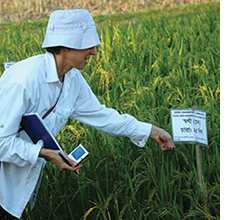
Pamela Ronald
PAMELA RONALD
This second career of Pamela Ronald’s, as advocate of GMOs (which also includes being a book author, and contributor to and board member of the blog Biofortified) is founded on her first career: at the University of California in Davis she is Professor in the Department of Plant Pathology, Director of the Laboratory for Crop Genetics Innovation, and Director of Grass Genetics at the Joint BioEnergy Institute, among other positions.
This background is relevant because Pamela Ronald is now also fighting on her home front. Her scientific research has become the central question in a controversy that may destroy both careers. In the last year Ronald’s laboratory at UC Davis has retracted two scientific papers (Lee et al. 2009 and Han et al 2011) and other researchers have raised questions about a third (Danna et al 2011). The two retracted papers form the core of her research programme into how rice plants detect specific bacterial pathogens (1).

Etiquetas: , , ,