domingo, febrero 07, 2016

Standing up for transparency: A letter to Nature Biotechnology


To the Editor:

I am writing to you as co-director of the consumer group US Right to Know (USRTK). Your editorial in the October issue entitled “Standing up for science” contained many indefensible statements. It falsely accused us of a “smear campaign” in investigating the food and agrichemical industries, their public relations firms and front groups, and the professors who speak for them.

Our aim is to expose the ties between the food and agrichemical industries and those who assist in their public relations efforts. The documents we obtained show that University of Florida Professor Kevin Folta accepted a $25,000 unrestricted grant from Monsanto (St. Louis). In accepting the grant, he promised Monsanto “a solid return on the investment.” Just a couple weeks later, he publicly claimed no association with Monsanto, and repeatedly denied ties to Monsanto. Although the grant was paid to the University of Florida Foundation, Monsanto's grant letter is addressed to Folta and specifically states that the funds could be used “at your discretion in support of your research and outreach projects.” The documents show that Folta's proposal to Monsanto was crafted to evade disclosure and conflict-of-interest reporting. As Folta notes in his proposal, the purpose was “to eliminate the potential concern of the funding organization influencing the messaging,” by placing the funds into an account that is “not publicly noted.”

Just because it is legal to lie and hide corporate contributions doesn't make it ethical. At one point, Folta even wrote to a Monsanto executive, “I'm glad to sign on to whatever you like, or write whatever you like.” This is not a shining example of integrity in science.

Your editorial neglects to mention that Folta used text that was ghostwritten by the public relations firm Ketchum (New York) for the website GMO Answers (https://gmoanswers.com/), and—incredibly—in a recent interview he defended this as an acceptable practice for scientists (http://www.buzzfeed.com/brookeborel/when-scientists-email-monsanto).

For the record, USRTK is not an anti-GMO group. We are a consumer group. We believe genetic engineering of crops may someday have benefits; however, it should proceed only with full transparency, as well as stringent health and environmental testing and safeguards.

We are working for transparency, accountability, the integrity of science and public institutions, and to improve our nation's food system. We are not out to 'get anyone'. Folta's main complaint is that his e-mails were cherry-picked; however, unlike WikiLeaks, we chose not to post thousands of pages of documents obtained through the US Freedom of Information Act exactly because they contain personal e-mails and other material that are not relevant to our investigation. We do release to journalists, or in some cases directly to the public, specific newsworthy documents about food and agrichemical industry PR and lobbying tactics that highlight what they do not want consumers to know about our food.

But a larger issue looms beyond the specifics of Folta's relationship with Monsanto; the incident highlights a wider problem in the systems we have for assuring transparency concerning disclosure of financial interests of academic scientists. Although drug and medical device manufacturers are required under the Physician Payments Sunshine Act to disclose payments to doctors and teaching hospitals, at this time, there is no similar requirement for food or agrichemical companies. USRTK believes there should be.

Collaboration between industry and academia can be beneficial as well as problematic; transparency must be the guiding principle for such relationships. Scientific journals, such as Nature Biotechnology, have an important role to play in advocating for transparency in funding, lobbying and public relations conducted by university scientists. We hope to hear more from your team on that topic.

We want to encourage scientists to communicate with the public to create a thriving science-based society. The problem comes when such communication is reduced to misleading PR talking points to promote commercial products and corporate profits.

- Stacy Malkan

Etiquetas: , , ,

lunes, febrero 01, 2016

Academia selling out

The True Inside Story of How a College Professor Sells Out to Monsanto 

E-mails released through Freedom of Information Act requests show that Chassy was an active member of a group of U.S. academics who have been quietly collaborating with Monsanto on strategies aimed at not just promoting biotech crop products, but also rolling back regulation of these products and fending off industry critics. The emails show money flowing into the university from Monsanto as Chassy collaborated on multiple projects with Monsanto to counter public concerns about genetically modified crops (GMOs) – all while representing himself as an independent academic for a public institution.
A New York Times article by Eric Lipton published last September laid bare the campaign crafted by Monsanto and other industry players to use the credibility of prominent academics to push the industry’s political agenda. That Times article focused primarily on University of Florida academic Kevin Folta, chairman of the university’s Horticultural Sciences Department, and Folta’s work on behalf of Monsanto. But an examination of recently released email exchanges between Monsanto and Chassy show new depths to the industry efforts.

Etiquetas: ,

jueves, enero 14, 2016

Folta, again

Kevin Folta accused of lying and hiding corporate contributions 

Nature Biotechnology has just published a powerful letter that demolishes the journal’s recent attempt to defend University of Florida scientist Kevin Folta. The letter says, “Just because it is legal to lie and hide corporate contributions doesn’t make it ethical.”

The author is Stacy Malkan, co-director of the consumer group US Right to Know (USRTK), which first exposed the controversial scientist’s close ties to the agrichemical industry.
Malkan points out that in its pro-Folta editorial, the journal had falsely accused USRTK of “a ‘smear campaign’ in investigating the food and agrichemical industries, their public relations firms and front groups, and the professors who speak for them.” Not so, says Malkan – all USRTK has been doing is bringing to light the largely undisclosed ties that the public has every right to know about.

Etiquetas: , ,

martes, noviembre 10, 2015

What a Masked Academic Crusader Says About GMO Journalism

https://www.foodandwaterwatch.org/insight/what-masked-academic-crusader-says-about-gmo-journalism

In what may be the weirdest GMO news of 2015, a new report documents how Kevin Folta, a University of Florida professor recently exposed for having undisclosed ties to the biotechnology industry, has been running a pro-GMO podcast under an assumed identity
Guests and listeners alike were deceived by the ruse, according to the story. Most bizarrely, Folta even interviewed himself, employing two different voices and identities, addressing at one point whether he had financial ties to the biotechnology industry. His version conflicts sharply with that of The New York Times, which documented how Folta had been collaborating with Monsanto on a $25,000 GMO advocacy campaign and had attached his name as the author to pro-GMO materials written by the biotechnology industry.
******
The writer of this expose, Brooke Borel, is by no means a critic of GMOs. Her previous work includes reporting sourced with quotes from well-known pro-GMO academics, many with industry ties that Borel does not disclose. Largely or entirely missing from her reporting are the voices of GMO critics, including the hundreds of expert scientists who have long noted that there are many unresolved safety issues with GMOs. Even her new article exposing Folta’s questionable behavior, though very thoughtful at times, openly defends Folta’s pro-GMO ideology, which she erroneously says reflects a scientific “mainstream” on the safety of GMOs and their importance in feeding the world.

Etiquetas: , ,

lunes, octubre 05, 2015

From GM Watch: How “the Biofortified boys” defended the pesticide industry’s secrets in Hawaii

http://gmwatch.org/news/latest-news/16432

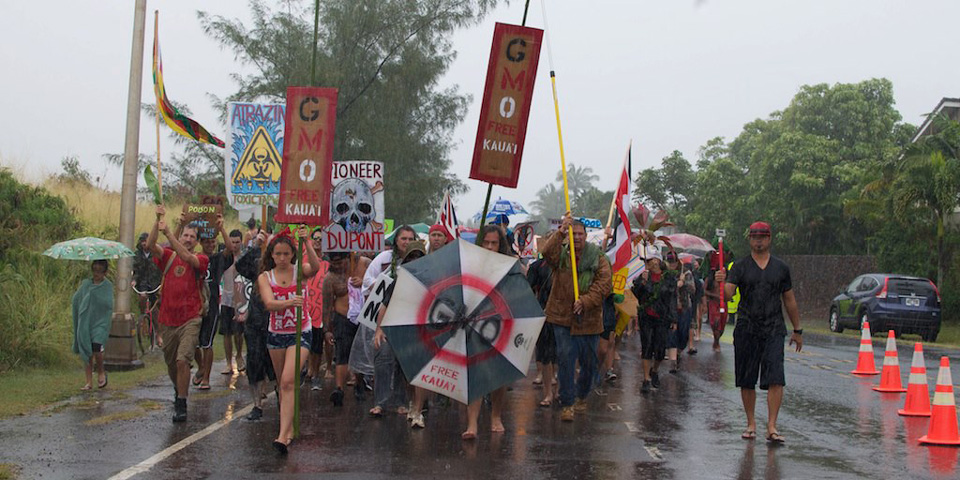
March in March to evict Monsanto from Kauai
Industry calls pro-GMO scientists “part of our overall public education strategy”
In 2013 in Kauai, Hawaii, Kauai County Councilman Gary Hooser proposed a bill to protect people from pesticide spraying on GMO crops. Bill 2491 would have enforced buffer zones between sprayed and public areas and required disclosure of the pesticides being sprayed. 

Reasonable demands, you might think – but the pesticide industry disagreed. It launched a massive PR and lobbying exercise to defeat the bill, as revealed by a recent New York Times’ investigation. The industry’s chosen mouthpieces for the Hawaii project were the pro-GMO scientist Kevin Folta and a group of other supposedly independent scientists, who travelled to Kauai to testify against the bill in Kauai County Council hearings.

Etiquetas: , , , ,

jueves, septiembre 17, 2015

Death threats, libel and lies – Part 2: Documented liar?


http://www.gmwatch.org/news/latest-news/16408

In the second part of this series, Jonathan Matthews examines Kevin Folta’s claims to have done “nothing wrong, said nothing false”

Etiquetas: , ,

martes, septiembre 08, 2015

The Puppetmasters of Academia (or What the NY Times Left out)

http://www.independentsciencenews.org/science-media/the-puppetmasters-of-academia-ny-times-left-out/

by Jonathan Latham, PhD
“Reading the emails make(s) me want to throw up” tweeted the Food Babe after reading a lengthy series of them posted online by the NY Times on Sept 5th. The emails in question result from a Freedom of Information Act (FOIA) request and are posted in the side bars of a front-page article by Times reporter Eric Lipton (“Food Industry Enlisted Academics in G.M.O. Lobbying War, Emails Show”). The article is highly disturbing, but, as the Food Babe implied, the Timesburied the real story. The real scoop was not the perfidy and deceit of a handful of individual professors. Buried in the emails is proof positive of active collusion between the agribusiness and chemical industries, numerous and often prominent academics, PR companies, and key administrators of land grant universities for the purpose of promoting GMOs and pesticides.

Etiquetas: , , ,

domingo, septiembre 06, 2015

From GM Watch: Folta affair exposed in the New York Times

Damning email stream shows Kevin Folta was in a cosy collaboration with Monsanto since early 2013
The New York Times has published a fascinating article on the Kevin Folta scandal. Folta was revealed by Freedom of Information Requests to have accepted $25,000 from Monsanto, even though he had repeatedly denied having any Monsanto funding.

A damning string of emails, released as a result of the Freedom of Information requests, have been posted online by the New York Times, with a commentary by the NYT editors. Many of the emails are between Kevin Folta and Monsanto or other industry and PR players.

The emails show Folta as an eager partner in a cosy relationship with Monsanto from as early as the spring of 2013.

In November 2013 Folta sent an email to employees of the PR firm Ketchum, which runs the pro-GMO website GMO Answers for its client the Council for Biotechnology. Regarding an upcoming meeting with the rest of the GMO Answers team, Folta wrote: ”Tell them I'm a friend of Ketchum”.

In 2014 Folta wrote to a Monsanto manager: “I’m glad to sign on to whatever you like, or write whatever you like.”

After Monsanto agreed to Folta’s funding bid for $25,000 for a pro-GMO communications programme, Folta wrote to a Monsanto executive, “I’m grateful for this opportunity and promise a solid return on the investment.”

Another Monsanto executive called the Folta deal “a great 3rd-party approach to developing the advocacy that we’re looking to develop [sic.]”.

The 3rd party PR technique is when industry places its messages in the mouths of supposedly independent third parties, such as scientists and doctors, because the public are more likely to trust them.

Folta claimed to be open about funding

Folta has repeatedly claimed that he was open about his funding arrangements. For example, early this year he wrote, "The bottom line is that my university operates under the Sunshine Law.  Emails are public information, just like my funding, my salary, my cholesterol levels, and everything else about me."

And in response to online speculation from critics about his funding sources, he wrote: “Hey guys, you know you could just reach out and ask… always glad to talk about such things. My research has been funded 100% by public sources, except for a small amount we get for strawberry research, mostly molecular marker development that helps our breeding program pyramid flavor-related genes via traditional breeding. No Monsanto.”

But while the $25,000 Folta got from Monsanto was for outreach and not research, he was anything but open about it. On page 104 of the newly released emails, you can see Folta apparently trying to hide Monsanto’s $25,000 grant so that it is not “publicly noted”.

GMO Answers

Among his outreach work for the GMO industry, Folta answered questions on GMOs for the Ketchum’s pro-GMO website GMO Answers. Ketchum provided canned answers for Folta to repeat for the reading public. Folta had previouslysaid of Ketchum’s pre-prepared points in an article published in Nature, “I don’t know if I used them, modified them or what…”

The email string published by the NYT remedies Folta’s memory failure. The NYT’s editors note: “Dr. Folta was encouraged to make any changes he wanted, but he largely stuck with the script.” Two examples, in which Folta regurgitated Ketchum’s responses, are provided.

Finally, it should be noted that while the NYT tries to draw an equivalence between Folta taking money from Monsanto and Dr Charles Benbrook being funded by the organic industry, the two are not comparable. Benbrook never denied being funded by, or having a relationship with, the organic industry. But Folta repeatedly denied his Monsanto links.

[Comment by Claire Robinson. Read this article online here.]

1. Food industry enlisted academics in GMO lobbying war, emails show
2. Our investigation of Big Food and its front groups

1. Food industry enlisted academics in GMO lobbying war, emails show

Etiquetas: , , , ,

domingo, agosto 09, 2015

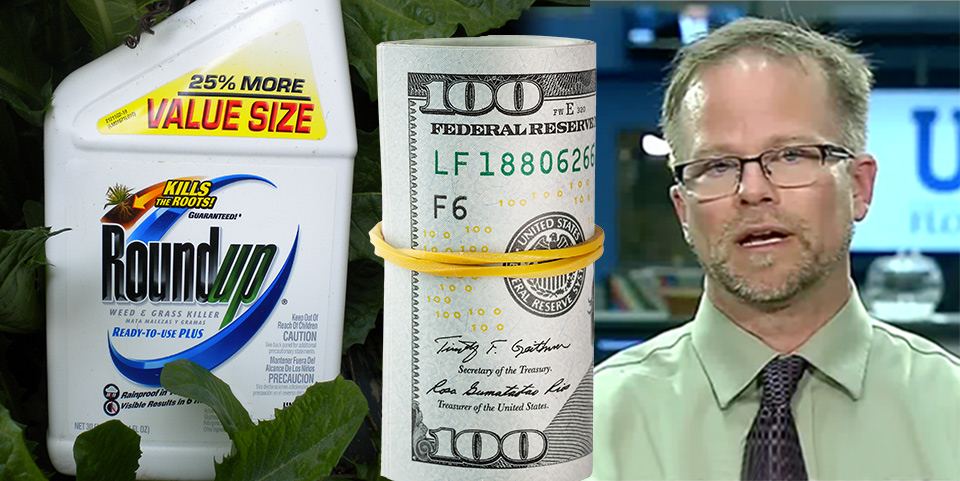
Kevin Folta received $25,000 from Monsanto


Roundup, Dollars and Kevin Folta

http://www.gmwatch.org/news/latest-news/16340-kevin-folta-received-25-000-from-monsanto

Investigation reveals damaging conflict of interest despite claims of no Monsanto funding. Report by Claire Robinson and Jonathan Matthews

Etiquetas: , , ,