domingo, octubre 23, 2011

THE GMO emperor has no clothes

http://www.foodfirst.org/en/failure+of+GMOs

THE GMO EMPEROR HAS NO CLOTHES

A Global Citizens Report on the State of GMOs - False Promises, Failed Technologies

October 2011
By Navdanya International in cooperation with numerous organizations around the world

People who point out the emptiness of the pretensions of powerful people and institutions are often compared to the child in Hans Christian Andersen's fable who says that the emperor has no .

The fable that GMOs are feeding the world has already led to large-scale destruction of biodiversity and farmers’ livelihoods. It is threatening the very basis of our freedom to know what we eat and to choose what we eat. Our biodiversity and our seed freedom are in peril. Our food freedom, food democracy and food sovereignty are at stake.

This report is a compilation of the many voices from around the globe speaking the truth about what is happening in their communities and countries and are exposing the illusion that genetically modified organisms (GMOs) are, as Wendell Berry writes, “the latest answer-to-everything”.

Actions recommended in this report include:
--Campaign to disinvest from Monsanto
--Boycott GMOs - Eat organic
--Demand labeling of GMOs
--Put your money to support local ecological/organic food projects and invest in the future
--Campaign to get your village/town/region/country GMO-free
--Help save seeds

Read this critical report.

Etiquetas: , ,

miércoles, septiembre 03, 2008

About Navdanya


A message from the founder

Vandana ShivaOver the past three decades I have tried to be change I want to see.

When I found that dominant science and technology served the interests of powerful, I left academics to found the Research Foundation for Science, Technology and Ecology, a participatory, public interest research organisation.

When I found global corporations wanted to patent seeds, crops or life forms, I started Navdanya to protect biodiversity, defend farmers' rights and promote organic farming.

Navdanya/RFSTE's journey over the past two decades has taken us into creating markets for farmers and promoting tasty, healthy, high quality food for consumers. We have connected the seed to the kitchen, biodiversity to gastronomy. And now we have joined hands with Slow Food to celebrate the quality and cultural diversity of our food.

The seed has inspired us to spread the message of sustainability through Bija Vidyapeeth, which I started with Satish Kumar as a sister institution of the Schumaker College in the UK.

My journey on the road to ecological sustainability started with the Chipko movement in the 1970s when women in the region of the Himalayas protected forests by hugging trees.

For me, ecology and feminism have been inseparable. And Diverse Women for Diversity is one expression of combining women's rights and nature's rights, celebrating our cultural diversity and biological diversity.

The defence of nature's rights and people's rights have come together for me in Earth Democracy - the democracy of all life on earth, a living democracy which supports and is supported by living culture and living economies.

I am happy you have visited us on the web. We look forward to your visit to our farm, our cafe, our school. Let us together build an earth family. Let us in our diversity create an earth democracy.

Etiquetas: ,

martes, junio 17, 2008


From the Deccan Chronicle
<http://www.deccan.com/

Continuing violence of Green Revolution

by Dr Vandana Shiva

A farmer called Sidhalingappa Choori was killed on June 10 when police opened fire on hundreds of farmers waiting for fertilisers at the Agricultural Produce Marketing Cooperative Centre in Karnataka's Haveri district. This was an entirely unnecessary tragedy.

However, fertiliser protests are not just taking place in Karnataka. Similar incidents have also occurred in the Vidharbha and Marathwada regions of Maharashtra. First, the Green Revolution got the Indian farmers addicted to chemical fertiliser and now, globalisation is forcing them to depend on imports.

Chemical agriculture has created the need for almost 4.8 million tonnes of synthetic diammonium phosphate or DAP in the country. About 1.9 million tonnes are produced domestically. The rest — nearly 2.9 million tonnes — has to be imported. In 2000-01, though the country did import a small quantity of DAP, it did not need to import any urea. Since then, import dependency has increased dramatically.

With rising oil prices, prices of fertilisers are going up and so is the burden of subsidy. Imported fertiliser costs approximately Rs 55,000 to Rs 60,000 per tonne. At the same time it is sold at Rs 9,350 a tonne. Government subsidies make up for the gap of Rs 45,000 a tonne.
However, even at such high prices, fertilisers do not reach the farmers on time. This is at the root of the farmers' protests as also Sidhalingappa Choori's tragic death. Choori's death is one more aspect of what can be termed the "violence of the Green Revolution."

Farmers do not need to wait for chemical fertilisers. The government does not need to pour a trillion dollars into subsides. There is an alternative — ecological agriculture and organic manuring — which can ensure better crops and higher output at very low costs.

Humus is the secret of soil's fertility. As Sir Albert Howard describes it in his classic The Agricultural Testament, humus is "the name given to a complex residue of partly oxidised vegetable and animal matter together with the substances synthesised by the fungi and bacteria which break down these wastes. If the soil is deficient in humus, the volume of the pore space is reduced; aeration of the soil is impeded; there is insufficient organic matter for the soil population; the machinery of the soil runs down; supply of oxygen, water, and dissolved salts needed by the roots is reduced; the synthesis of carbohydrates and proteins in the leaves proceeds at a lower tempo; and finally, growth is affected."

Soil micro-organisms maintain soil structure, contribute to the bio-degradation of dead plants and animals, fix nitrogen and increase soil fertility. Their destruction by chemicals can threaten our own survival and food security.

When scientists in Denmark scooped up a cubic metre of earth from a beech forest and took it into their laboratory, they found 50,000 small earthworms, 50,000 insects and mites, and 12 million roundworms. A gram of the same soil contained 30,000 protozoa, 50,000 algae, 4,00,000 fungi and billions of individual bacteria of 5,000 unknown species. It is this amazing bio-diversity which maintains and rejuvenates soil fertility. For feeding humanity we need to feed the soil and its millions of workers including the earthworms.

Soil treated with farmyard manure have from two to two-and-a-half times as many earthworms as untreated soil. Farmyard manure encourages the growth of earthworms by increasing their food supply. Earthworms contribute to soil fertility by maintaining soil structure and breaking down organic matter and incorporating it into the soil. It is estimated that they also increase soil-air volume by upto 30 per cent.

Farmers who have not been brainwashed into believing that fertilisers are mandatory for soil fertility do not need to wait for the government to provide them with expensive fertilisers at subsidised rates. They can turn to soil organisms, which renew soil fertility for free.

Chemical fertilisers, on which the Green Revolution is based, need fossil fuels. One kilogram of nitrogen fertiliser requires energy equivalent of two litres of diesel. With oil getting costlier, synthetic fertilisers are getting costlier too.

Chemical fertilisers also account for 38 per cent of the greenhouse gas emissions from agriculture. Chemical fertilisers emit nitrogen oxide which is 300 times more potent than carbon dioxide as a greenhouse gas. These pollutants are the cause of climate change. Getting rid of chemical fertilisers is the single most significant step in reducing emissions and also for adapting to climate change. Organic manuring reduces emissions and increases adaption to climate change while also ensuring food security for the community and the country.

Farming can only be sustained on the basis of ecological renewal of soil fertility. It is, therefore, irresponsible of the World Bank to use the present food crisis to dump more chemical fertilisers on the Third World as it did at the Food Summit in Rome in June 2008. Like the addiction to oil, the addiction to synthetic fertilisers only benefits giant corporations. The same corporations, which sell high-cost fertilisers to farmers like Choori and buy low-priced commodities from them. And while buying low-priced commodities from farmers, the corporationg are also driving up food prices and fertiliser costs through speculation.

Food security needs freedom from giant corporations and their toxic products — chemicals and GMOs. This has become even more necessary in the context of the climate chaos.

Dr Vandana Shiva is the executive director of the Navdanya Trust

Etiquetas: ,

viernes, marzo 07, 2008

http://www.navdanya.org/

The Organic Revolution

Chemical agriculture and genetic engineering are threatening public health and leading to nutrition decline. Costs of production, which includes hybrid and genetically engieered, seeds, chemicals and irrigation, are increasing with every season pushing farmers into the debt trap and also to suicides.

Thousands of farmers have given their life in India in the last two decades because of the debt. As an insurnace against such vulnerability, Navdanya pioneered the conservtion of biodiversity in India and built a movement for the protection of small farmers through promotion of ecological farming and fair trade to ensure the healthy, diverse and safe food. The movement is now spread throughout India through our partner organisaitons and farmer's networks.

Navdanya's pioneering reearch on the hazards of chemical farming, the costs of industrial agriculture and the risks of genetic engineering have led to a paradigm shift. Our research has proved that contrary to the dominant assumptions, ecological agriculture is highly productive and is the only lasting solution to hunger and poverty.

Navdanya have so far trained above 2,00,000 men and women farmers, students, government officials, representatives of national as well as international NGO's, Voluntary organisations on biodiversity conservation and organic farming. We have also trained several large groups like Yuvacharya of Art of Living, NGO led by Sri Sri Ravi Shankar. The group is presently working in about 5000 villages of India. Navdanya trained secretaries and Extension Officers of the Tibetan govt. in exile and now theri settlements across the country are in conversion to organic. Biodiversity based farming has changed the economic status of the member farmers across the country.

Organic agriculture is not just a source of safer, healthier, tastier food. It is an answer to rural poverty.

High cost corporate agriculture is having adverse impact on livelihood of farmers. The increasing cost of production and the falling price combined with the decline in farm credit is putting great burden on farmers, which is pushing him to suicide. Since 1997, more than 25,000 farmers from Andhra Pradesh, Karnataka, Maharashtra and Punjab have taken thier lives. Since then, RFSTE has been monitoring the impact of trade liberalisation policies on Indian farmer and Indian agriculture since the New Economic Policy (1991) and WTO rules of the agreement on agriculture (1995) came into force.

In celebration of non-violent organic agriculture, every year Navdanya organizes Albert Howard Memorial Lecture on 2nd October, initiated in the year 2000 to tribute to the two messiahs of sustainability and non-violence: Mahatma Gandhi and Sir Albert Howard.

Organic agriculture is saving the Earth and farmers' lives.


Navdanya: India’s Organic Pioneers

Over the last two decades, Navdanya has created a silent revolution transforming biodiversity and organic farming into an anti poverty strategy for small and marginal peasants. We have also brought biodiverse and unique organic foods into consumption patterns through direct marketing of our organic products.

Navdanya’s members include farmers as the producer members and consumers as consumer member, shaping the food system through their consumption choices.

Every producer member of Navdanya is a seed keeper and a water keeper committed to protecting the environment, food sovereignty and people’s health. [Read the pledge] Navdanya’s consumer members connect directly to the producer members through fair trade and direct marketing links.

Beginning with the year 2005, Navdanya has joined hands with Slow Food, an international good food movement, in spreading the movement for healthy, culturally diverse, high quality, nutritious and ecologically sustainable food. (See the Membership Form)

To complete the organic chain from seed-to-the-table, Navdanya has started organic outlets and cafeteria and is building a larger network.

Navdanya has connected biodiversity conservation with organic production and have challenged the standardization, uniformity and lack of quality, promoted by the industrial food system.

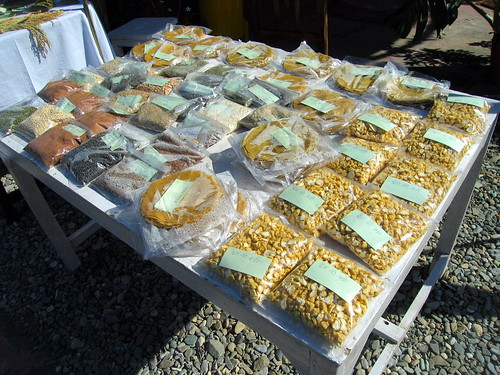
Please visit our organic products to see the biodiverse foods we bring to the consumer. Also visit our page on organic outlets.

Etiquetas: , ,

jueves, febrero 28, 2008

Semillas


Navdanya significa «nuevas semillas» , un nombre que evoca la riqueza de la diversidad y el deber de defenderla frente a la invasión de las biotecnologías y de los monocultivos de la agricultura industrial. Junto con las patentes que monopolizan los derechos de propiedad intelectual introducidos por la omc, por el Convenio de Diversidad Biológica y por otros acuerdos comerciales, las biotecnologías reducen la diversidad de las formas de vida al papel de materia prima para la industria y los beneficios. Las semillas genéticamente modificadas encierran a los pequeños agricultores en una jaula de deudas y mentiras. Por eso las llamo las “semillas del suicidio”. Se las hace estériles, a fin de que no puedan reproducirse y tengan que ser adquiridas cada año por los campesinos a precios elevados. Las patentes de las semillas son propiedad de transnacionales como Monsanto, que de esta forma se apropian de las fuentes de vida y de los derechos de dos terceras partes de la humanidad.

La desobediencia civil implica la opción por la no-violencia y por la no-cooperación pacífica. Yo creo que también hoy ésta es la vía a seguir, comenzando por la resistencia al patentamiento de las semillas. En India está en discusión una ley que podría traer consigo la prohibición del uso de semillas propias por parte de los campesinos. Semillas que durante miles de años han sido conservadas y transmitidas de generación en generación y de cosecha en cosecha, quedarían así desplazadas para dar lugar a la comercialización de semillas carísimas producidas en los laboratorios de las transnacionales. Nosotros sabemos que la variedad de las semillas indígenas, conservadas y seleccionadas localmente, representa nuestra garantía ecológica y económica, porque esas semillas diversas están en condiciones de adaptarse perfectamente a las condiciones climáticas y geológicas de las diversas regiones de India. No se puede criminalizar a centenares de millones de campesinos que no están dispuestos a someterse al modelo agrícola impuesto por las transnacionales. Para conquistar nuestra libertad económica y política es necesario volver a otra vez la mirada a Gandhi, a sus ideas de autogobierno y de autoproducción local.

- Vandana Shiva, entrevistada por Tommaso Rondinella y Duccio Zola,
Il Manifesto, 10 de octubre de 2006


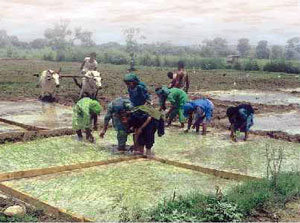
women in field

La solución propuesta por agra (Alliance for a Green Revolution in Africa), la alianza para llevar una Revolución Verde a África, es construir la infraestructura que facilite el desarrollo de compañías semilleras privadas, algo que la Fundación Rockefeller y el Banco Mundial han intentado por algún tiempo ya, pero con poco éxito. Uno de los primeros pasos de agra entonces sería el establecimiento de redes de “agrointermediarios” (“agrodealers”). que vendan semillas, pesticidas y fertilizantes. agra ya contrató a una ong estadounidense, Citizens’ Network for Foreign Affairs, para realizar este trabajo en Kenya, Tanzania y Malawi. Hasta ahora, la ong estadounidense ha recibido hasta 14 millones de dólares en donaciones… para abastecer a los intermediarios, los donantes de agra también financian a las compañías semilleras privadas. La Fundación Rockefeller es el principal inversionista en African Agricultural Capital, un proyecto con capital de riesgo que invierte en pequeñas compañías semilleras africanas y en parte las controla, compañías que a su vez reciben financiamiento de agra. Con toda seguridad intentan desarrollar mercados entre los campesinos, mercados que siguen siendo muy limitados por la empecinada resiliencia de los sistemas tradicionales de semillas que siempre han abastecido a los campesinos africanos con semillas de alta calidad, adaptada localmente, culturalmente aceptada y muy costeable.


- A new green revolution for Africa?, www.grain.org, diciembre de 2007

Etiquetas: , , , , ,

jueves, octubre 11, 2007

http://www.navdanya.org/news/08jun07.htm

From Seeds of Suicide to Seeds of Hope: Navdanya's Intervention to Stop Farmers' Suicides in Vidharbha

The increasing costs of production and the falling farm prices that go hand in hand with globalisation and corporate hijack of seed supply, combined with the decline in farm credit is putting an unbearable debt burden on farmers. The lure of huge profits linked with clever advertising strategies evolved by the seeds and chemical industries are forcing farmers into a chemical treadmill and a debt trap. It has been witnessed that across the country, farmers are taking the desperate step of ending their life. The pesticides, which had created debt, also became the source of ending indebted lives. More than 150,000 farmers have committed suicide in India due to
distortions introduced in agriculture as a result of trade liberalisation. More than 20,000 farmers have committed suicide in Andhra Pradesh alone. After the visit of Prime Minister Manmohan Singh in July 2006, the suicide has increased alarmingly, reaching more than 1400 with debt trap cotton farmers putting an end to their lives in Vidharbha region alone.
Navdanya has been monitoring the impact of trade liberalisation and seed monopoly by seed giants on Indian farmers and Indian agriculture. To stop the genocide of our farmers and reclaim our seed and food sovereignty, Navdanya launched the Bija Yatra on 9th of May 2006 to mark 150 years of our struggle for freedom. The Yatra started from Sevagram, Maharashtra, the place of Gandhiji's Ashram. The Yatra was concluded on 26th May in Bangalore. The Yatra covered Amravati,
Yavatmal,Nagpur in Vidharbha region of Maharashtra, Adilabad, Warangal, Karimnagar, Hyderabad in Andhra Pradesh, and Bidar, Gulbarga, Raichur, Hosepet, Chitradurg and Bangalore in Karnataka. These are the regions where farmers have become locked into dependence on corporate seeds supply for growing cash crops integrated to world markets, which is leading to a collapse in farm prices due to 400 billion dollars subsidies in rich countries.

Apart from providing guidance and help to the farmers for the revival of agriculture, Navdanya, under the "Asha ke Beej" (Seeds of Hope) program, distributed the indigenous variety of seeds to the farmers and encouraged them to shift to organic and sustainable agriculture. More than 6000 farmers were distributed indigenous seeds.

Navdanya also realized that one of the crisis farmers were facing was a seed famine created by Monsanto. Navdanya therefore started a seed bank in Kalaspur village. And on 2nd and 3rd June seeds were distributed from the seed bank in villages in Vidharbha.

Navdanya is committed to ending the vicious cycle of violence in agriculture, which is leading to farmers' suicides.

We are committed to strengthening the virtuous cycles of peace based on cooperation with nature and among communities to promote a sustainable and life enhancing food system. During the yatra, Navdanya took a pledge

To protect our freedom and our lives by defending seed sovereignty through chemical free and GMO free ecological and sustainable farming. More than 10,000 farmers have taken pledge to conserve, rejuvenate and protect their biodiversity.

To create GMO free, patent free, debt free and suicide free villages. As a result of Navdanya's joint initiative with Vidharbha Organic Farmers Association and Vidharbha Jan Andolan, Kolzari, Kalaspur and Goi villages have adopted to organic farming

To create Seed banks to conserve biodiversity and protect our indigenous seed varieties. Navdanya has set up a seed bank in the kalaspur village to provide the farmers with GM free heritage seeds.

To distribute seeds of life, seeds of freedom and seeds of hope: Navdanya has distributed seeds to more than 10,000 farmers and widows of suicide victims.

To create ecological, organic, just and fair trade. Navdanya has made a commitment to the Vidharbha farmers to create fair trade for their organic produce including cotton and helping the farmers to come out of the vicious circle of debt trap.

If you want to become part of the movement to stop farmers' suicides, Join Navdanya's campaign "adopt an acre: Stop farmers suicide" and help a farmer go organic. For more information, please contact us at vshiva@vsnl.com

Etiquetas: ,