sábado, diciembre 06, 2014

Trade deals criminalise farmers' seeds

http://www.grain.org/article/entries/5070-trade-deals-criminalise-farmers-seeds

GRAIN | 18 November 2014 | Against the grain
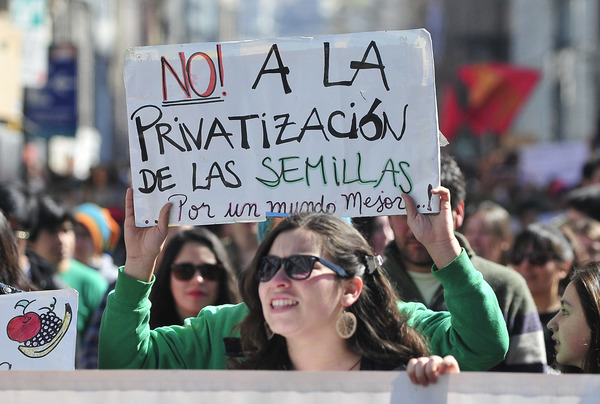
What could be more routine than saving seeds from one season to the next? After all, that is how we grow crops on our farms and in our gardens. Yet from Guatemala to Ghana, from Mozambique to Malaysia, this basic practice is being turned into a criminal offence, so that half a dozen large multinational corporations can turn seeds into private property and make money from them.
But people are fighting back and in several countries popular mobilisations are already forcing governments to put seed privatisation plans on hold.
GRAIN has produced an updated dataset
on how so-called free trade agreements are privatising seeds across the world.
Guatemala’s trade agreement with the US obliges it to adhere to the UPOV Convention. But popular resistance forced the government to repeal a national law passed for this purpose. (Photo: Raúl Zamora)


Trade agreements have become a tool of choice for governments, working with corporate lobbies, to push new rules to restrict farmers' rights to work with seeds. Until some years ago, the most important of these was the World Trade Organization's (WTO) agreement on Trade-Related Aspects of Intellectual Property Rights (TRIPS). Adopted in 1994, TRIPS was, and still is, the first international treaty to establish global standards for “intellectual property” rights over seeds.1The goal is to ensure that companies like Monsanto or Syngenta, which spend money on plant breeding and genetic engineering, can control what happens to the seeds they produce by preventing farmers from re-using them – in much the same way as Hollywood or Microsoft try to stop people from copying and sharing films or software by putting legal and technological locks on them.

Etiquetas: , ,

viernes, noviembre 21, 2014

Life or death over seeds – worldwide seed war rages

http://www.gmwatch.org/index.php/news/archive/2014/15762-
life-or-death-over-seeds-worldwide-seed-war-rages


 .

Over half the global seed market is controlled by 3 agrochemical corporations (Monsanto, DuPont, and Syngenta)
New legislation is threatening to criminalise the ability of farmers to freely save and exchange seeds (see item 1 below).
For example, Ghana is passing a new seed law because of pressure from rich governments, including that of the UK, and big corporations (see item 2 below).
The new law, if passed, will restrict small-scale farmers and food producers from freely saving, exchanging and selling seeds. This will sideline traditional varieties and push farmers towards buying seeds from big business like Monsanto year after year. And small-scale farmers could even face criminalisation for saving seeds that corporations lay claim to.
Take action (UK only): Write to your MP asking that the UK government cease pressuring Ghana to pass the new seed law:
http://action.wdm.org.uk/ea-action/action?ea.client.id=1784&ea.campaign.id=32583
Meanwhile in Europe, the TTIP free trade deal between the US and EU threatens to flood Europe with GMOs.
EXCERPT (item 1): Lobby[ing] from US large corporations has been intense and aimed at attacking those EU restrictions on imports of GM food, including the removal of EU requirement of labelling and traceability for GM crops and food. As a result thousands and thousands of citizens are mobilising throughout Europe and in the UK to say NO TTIP! Already the EU has had to halt part of the negotiations for three months to allow for proper democratic consultation.
1. Life or death over seeds – a worldwide seed war is now raging
2. The fight for seed sovereignty in Ghana

1. Life or death over seeds – a worldwide seed war is now raging

2. The fight for seed sovereignty in Ghana


Etiquetas: , ,

lunes, octubre 27, 2014

Patent industry selling out future of our food

http://no-patents-on-seeds.org/en/information/news/patent-industry-selling-out-future-our-food

New report published about patents on seeds and call for a public protest

23 October 2014 Munich

The international coalition of No Patents on Seeds! today published a report on patents on seeds. The report was prompted by the fact that the European Patent Office (EPO) has already granted several thousand patents on plants and seeds, with a steadily increasing number of patents on plants and seeds derived from conventional breeding. Around 2400 patents on plants and 1400 patents on animals have been granted in Europe since the 1980s. More than 7500 patent applications for plants and around 5000 patents for animals are pending. Amongst others, the EPO has already granted more than 120 patents on conventional breeding and about 1000 such patent applications are pending. The scope of many of the patents is extremely broad and very often covers the whole food chain from production to consumption.

Amongst the patents granted recently, are 'inventions' such as peppers bred from wild varieties originating from Jamaica, tomatoes that were developed through sourcing the international gene bank in Germany, sunflowers from random mutagenesis and a selection of wild relatives of soybeans found in Asia and Australia.

“Industry together with the EPO are the driving factors turning the patent system into an instrument for misappropriation of basic resources needed to produce our daily food. They are selling out future of our food”, warns Christoph Then, one of the authors of the report. “By restricting access to genetic resources, EPO patent practice is severely hampering innovation and breeding. Furthermore, it is endangering agro-biodiversity and adaptability in food production systems needed to react to the challenges of climate change. As a consequence, we are putting our global food security as well as regional food sovereignty at risk.”

According to European patent law, plant and animal varieties as well as processes for breeding plants and animals cannot be patented. Nevertheless, decision-making at the EPO has, in fact, intentionally created a situation full of legal absurdities that allows prohibitions to be circumvented, and serves the interests of multinationals such as Monsanto, Dupont and Syngenta, who already control around 50 percent of the international commercial seed market. Apart from the EPO, patent attorneys are amongst those that benefit financially from an increasing number of patents. In 2013, the EPO made a profit of 1.5 Billion € from patent and procedural fees.

The new report has been published just a few days ahead of a crucial hearing at the EPO on 27 October. Many observers expect the EPO to make a landmark decision on these cases within the next few months. However, as the report shows, it is highly unlikely that the EPO will stop patents on plants and animals, no matter how currently pending cases are decided. For this reason, the international coalition of No Patents on Seeds!, together with many other organisations, calls for a public demonstration outside the EPO on the day of the hearing, where it will demand that European governments take action to stop patents on plants and animals. Included in the coalition of No Patents on Seeds! are Bionext (Netherlands), The Berne Declaration (Switzerland), GeneWatch (UK), Greenpeace, Misereor (Germany), Development Fund (Norway), No Patents on Life (Germany), Red de Semillas (Spain), Rete Semi Rurali (Italy), Reseau Semences Paysannes (France) and Swissaid (Switzerland). No Patents on Seeds! is calling for a revision of European Patent Law to exclude breeding material, plants and animals and food derived thereof from patentability. The coalition is supported by several hundred other organisations.


Contacts:
Christoph Then, Tel 0049 151 54638040, info@no-patents-on-seeds.org
More information:
The Report

Etiquetas: , ,

domingo, septiembre 14, 2014

From Devon Peña's blog: Seed Savers Exchange Statement on Seed Libraries and the CRG Safe Seed Pledge

TO READ THE FULL ARTICLE:
http://ejfood.blogspot.com/2014/09/seed-sovereignty-seed-savers-exchange.html


Seeds. Jyoti Thomas. Source: absolutearts.com
Devon Peña’s Note: The Seed Savers Exchange has actively served the nation’s farmers, gardeners, plant breeders, and seed librarians since 1975 as a reliable source of non-GMO heirloom seed. The Seed Savers released a statement in support of seed libraries last week. I am reposting their eloquent declaration in defense of seed libraries; for the original, please visit the Seed Savers home page.

The statement makes a strong declaration of support for the principle tenet that seed saving is part of our deepest cultural heritage and people have been saving and sharing seeds for millennia. Moreover, “Despite what some institutions have suggested, seeds can be valuable, safe and healthy without laboratory germination tests or government licenses.”

Etiquetas: , , ,

viernes, septiembre 12, 2014

Seed Sovereignty | Grassroots seed savers and libraries organize

TO READ THE FULL ARTICLE:
http://ejfood.blogspot.com/2014/08/seed-sovereignty-grassroots-seed-savers.html


Seed libraries are one strategy to avoid the compression of seed
 biodiversity we have seen under the practices of commercial seed houses.
Seed Library Social Network calls for discourse
BIOPIRACY AND GMO BIOSAFETY MUST BE ADDRESSED

Devon G. Peña | Las Colonias de San Pablo, CO | August 31, 2014

On August 5, I reported on the closing down of a seed library in Pennsylvania by the state’s Department of Agriculture.  A week later, August 13, I posted an analysis and position paper on U.S. seed laws prepared by Sustainable Economies Law Center (SELC).

Continuing with this series on Seed Sovereignty in the U.S., I am posting this call for a discussion of a National Seed Library Protocol prepared by Leslie Goldman affiliated with the Seed Library Social Network (SLSN). The call was posted on August 27 on the SLSN homepage. I have re-posted Leslie Goldman’s announcement and call for discussion below (unedited). Goldman also reports on initial email correspondence with state officials in Pennsylvania.


Etiquetas: , , ,

sábado, septiembre 07, 2013

Farmers on strike in Colombia


From: GRAIN  


New from GRAIN | 4 September 2013

Colombia farmers' uprising puts the spotlight on seeds
On 19 August, Colombian farmers' organisations initiated a massive nationwide strike. They blocked roads, dumped milk on cars and basically stopped producing food for the cities.
The problem? They are being driven out of existence by the government's policies, which serve the interests of a wealthy elite minority. Recent free trade agreements (FTAs) with the US and the EU are undercutting Colombian producers, who can't compete with subsidised imports. The Colombian government has been actively promoting land grabbing by large corporations, many of them foreign (Monica Semillas from Brazil, Merhav from Israel, Cargill from the US), to promote export-oriented agribusiness at the expense of family farming oriented towards food sovereignty.
There is no question that Colombian farmers can feed the country very well, in a way that provides jobs, dignity and a healthy environment. But the government is too firmly attached to an economic model that caters to crony interests and holds no place for small-scale family farming. We should all support the popular agrarian struggle in Colombia to turn that model around. It's not too late.
We should all support the popular agrarian struggle in Colombia to turn that model around. It's not too late.
Read the article here: http://www.grain.org/e/4779

Etiquetas: , , ,

viernes, agosto 02, 2013

15 Seed Saving Initiatives Protecting Biodiversity for Future Generations

TO READ THE FULL ARTICLE:
http://foodtank.org/news/2013/07/fifteen-seed-saving-initiatives-protecting-biodiversity-for-future-generati


The entrance of the Svalbard Global Seed Vault in Svalbard, Norway.
(Mari Tefre / Global Crop Diversity Trust)

EXCERPT:

Roughly 100,000 global plant varieties are endangered today. Extreme weather events, over-exploitation of ecosystems, habitat loss, and a lack of public awareness threaten future plant biodiversity. Conservation techniques, such as the creation of seed banks and seed exchanges among farmers, gardeners, and even nations, play an important role in preserving ancient, heirloom varieties of important food crops.
Saving seeds doesn’t only help improve agricultural biodiversity, but helps farmers and researchers find varieties of crops that grow better in different regions, especially as the impacts of climate change become evident. Many farmers groups, non-profits, and governments are conserving crops in their own communities—there are currently more than 1,000 known seed banks, collaboratives, and exchanges around the world.
The Science & Environmental Health Network (SEHN) has been spearheading work on the Rights of Future Generations for the last decade. Future Generation Guardianship is the right and obligation of all people to protect the commonwealth of Earth—and one another—today for the prosperity of Future Generations. SEHN’s dedication and public advocacy to find legal channels for the application of Future Generation Guardianship provides the framework for preserving biodiversity for centuries to come.
Food Tank is honored to collaborate with SEHN by highlighting 15 important seed-saving projects across the globe that are helping preserve global agricultural biodiversity for Future Generations. 
Many of these seed banks are nonprofit organizations, but we would greatly appreciate your recommendations of more public and state-owned banks in the comments below. Many public seed banks are in danger of sale, contamination, and other threats. Because they are such a valuable part of the Commonwealth, the public should be aware of these assets so that they can work to protect the inheritance of Future Generations.

Etiquetas: , ,

miércoles, junio 26, 2013

Monsanto Bullies Small Farmers Over Planting Harvested GMO Seeds

TO READ THE WHOLE ARTICLE: http://www.corpwatch.org/article.php?id=15825


by Puck LoCorpWatch Blog
March 26th, 2013


"Seed Giants vs. U.S. Farmers." New report by Center for Food Safety.
Does Monsanto own all future generations of genetically modified seeds that it sells? The Missouri-based agribusiness giant wants farmers to pay a royalty to plant any seed that descended from a patented original. The legal decision has ramifications for other patented "inventions" that reproduce themselves like strands of DNA.

The U.S. Supreme Court appeared to side with Monsanto in oral arguments heard this past February in a lawsuit that the world's largest seed company has brought against Vernon Hugh Bowman, a 75 year old farmer in Indiana, who grows corn, soybeans and wheat on a small farm of 600 acres (242 hectares).

The impending court decision, which will probably come this June, has sparked alarm among consumer advocates.

"Judges don't understand agriculture," says Bill Freese, science policy analyst for the Center for Food Safety, a Washington DC based watchdog group. "The Monsantos of the world have everyone convinced through a massive misinformation campaigns that biotech crops are essential to feed the world, and patents are necessary for biotech crops. So there's this patina of virtuous innovation when in fact what biotechnology is really used for primarily is to develop pesticide-promoting crops."

Etiquetas: , , ,

sábado, marzo 30, 2013

New Report Exposes Devastating Impact of Monsanto Practices on U.S. Farmers

http://www.centerforfoodsafety.org/2013/02/12/cfs-save-our-seeds-release-new-report-seed-giants-vs-u-s-farmers/


WASHINGTON, D.C. –  – 
Center for Food Safety and Save Our Seeds Investigate Role of Seed Patents in Consolidating Corporate Control of Global Food Supply
Today, one week before the Supreme Court hears arguments in Bowman v. Monsanto Co., the Center for Food Safety (CFS) and Save our Seeds (SOS) – two legal and policy organizations dedicated to promoting safe, sustainable food and farming systems – will launch their new report, Seed Giants vs. U.S. Farmers.
The new report investigates how the current seed patent regime has led to a radical shift to consolidation and control of global seed supply and how these patents have abetted corporations, such as Monsanto, to sue U.S. farmers for alleged seed patent infringement.
Seed Giants vs. U.S. Farmers also examines broader socio-economic consequences of the present patent system including links to loss of seed innovation, rising seed prices, reduction of independent scientific inquiry, and environmental issues.
Debbie Barker, Program Director for Save Our Seeds and Senior Writer for the Report, said today:  “Corporations did not create seeds and many are challenging the existing patent system that allows private companies to assert ownership over a resource that is vital to survival, and that, historically, has been in the public domain.”
Among the report’s discoveries are several alarming statistics:
  • As of January 2013, Monsanto, alleging seed patent infringement, had filed 144 lawsuits involving 410 farmers and 56 small farm businesses in at least 27 different states.
  • Today, three corporations control 53 percent of the global commercial seed market.
  • Seed consolidation has led to market control resulting in dramatic increases in the price of seeds. From 1995-2011, the average cost to plant one acre of soybeans has risen 325 percent; for cotton prices spiked 516 percent and corn seed prices are up by 259 percent.
The report also disputes seed industry claims that present seed patent rules are necessary for seed innovation.  As Bill Freese, senior scientist at Center for Food Safety and one of the report’s contributors notes:  “Most major new crop varieties developed throughout the 20th century owe their origin to publicly funded agricultural research and breeding.”
Additionally, Seed Giants vs. U.S. Farmers reports a precipitous drop in seed diversity that has been cultivated for millennia. As the report notes:  86% of corn, 88% of cotton, and 93% of soybeans farmed in the U.S. are now genetically-engineered (GE) varieties, making the option of farming non-GE crops increasingly difficult.
While agrichemical corporations also claim that their patented seeds are leading to environmental improvements, the report notes that upward of 26 percent more chemicals per acre were used on GE crops than on non-GE crops, according to USDA data.
Further, in response to an epidemic of weed resistance to glyphosate, the primary herbicide used on GE crops, Dow AgroSciences is seeking USDA approval of “next generation” corn and soybeans resistant to 2,4-D, an active ingredient in Agent Orange.  Monsanto is seeking approval for GE dicamba-resistant soybeans, corn, and cotton.
At the launch of the report via teleconference today, experts from the Center for Food Safety and Save our Seeds were joined by Mr. Vernon Hugh Bowman, the 75-year-old Indiana soybean farmer who, next week, will come up against Monsanto in the Supreme Court Case.  When asked about the numerous comparisons being drawn between his case and the story of David and Goliath, Mr. Bowman responded, “I really don’t consider it as David and Goliath. I don’t think of it in those terms. I think of it in terms of right and wrong.”
In December of 2012, the Center for Food Safety, and Save Our Seeds submitted an amicus brief to the Supreme Court on behalf of Mr. Bowman, which supports the right of farmers to re-plant saved seed. Arguments in the case are scheduled for February 19th.
More information on the CFS and SOS can be found at: http://www.centerforfoodsafety.org

Etiquetas: , ,

domingo, septiembre 30, 2012

Act for Seed Freedom

martes, septiembre 25, 2012

TAKE ACTION FOR SEED FREEDOM! Oct 2012

 From 2nd October (Gandhi’s Birth Anniversary), to 16th October (World Food Day) the Global Alliance for Seed Freedom is planning intensive actions to create a global citizens’ response on the issue of Seed Freedom that we hope will act as a wake up call for citizens and the government http://seedfreedom.in/seed-freedom-fortnight/

Etiquetas: , , ,

jueves, abril 14, 2011

Kimbrell on seed saving and seed banks

http://www.centerforfoodsafety.org/campaign/save-our-seeds/seed-saving-and-seed-banks/

Seed Saving and Seed Banks

INTRODUCTION
By Andrew Kimbrell


My first experience with the perils of large scale seed banks was the scandal that erupted over the Fort Collins collection in the mid 1980s. Journalists had published stories dramatically detailing the grossly negligent manner in which deposits to the seed bank were treated. Numerous seed deposits were spilling out onto the floors of the facility, the facility was woefully understaffed, there was no testing of the seed and a virtually complete failure of required regeneration — in short a seed saving disaster. A legal petition by my organization to rectify the decision seemed to get the United States Department of Agriculture’s (USDA) attention. But when no real action resulted we litigated. I was a very active member of that legal team. As such I reviewed much of the material in the case that documented USDA’s complete disregard for the safety and integrity of the seeds under its care.

******

This has been one of the bases for CFS’ longstanding concerns about the Svalbard Global Seed Vault. Not surprisingly these fears have recently been justified. In December 2010 NordGen, the entity overseeing Svalbard, fired its Director Jessica Kathle. Some at NordGen believed that she was a “scapegoat” for the seed bank’s well known problems including continuing deficits, significant understaffing, and failure to do routine tests on the deposited seed to determine viability.

******

There is however yet another important concern about Svalbard. The Global Crop Diversity Trust (GCDT), which supports the operational costs of Svalbard, has received almost $30 million dollars in support from the Bill and Melinda Gates Foundation. (Global Diversity Trust, “Funding Status 1-1-2011.” http://www.croptrust.org/main/funds.php)This is by far the largest support of any non-governmental entity. As is well known, the Gates Foundation has very close working ties to Monsanto. The Gates Foundation invested $23 million in Monsanto in 2010 to help the company through some financial woes, and has been a determined supporter of spreading Monsanto’s genetically engineered crops throughout the developing world. In 2006 the Gates Foundation hired Rob Horsch, a former Monsanto Vice President and a key scientist involved in the creation of the company’s Round Up Ready crops in the 1980s, as their Senior Program Officer for their International Agriculture Development Program. This Monsanto connection to Svalbard is very troubling as the corporation owns almost a quarter of all the world’s commercial seeds and is the world’s leader in the genetic engineering of crops and the patenting of plant genetics (including plant genes, cells and seeds). Monsanto has also had a decade long history of persecuting and prosecuting thousands of farmers for saving seeds.

Etiquetas: , ,

viernes, octubre 08, 2010

This is not actually news, but it is a useful and informative article

Revealed: how seed market is controlled by Monsanto, Syngenta, Bayer, Dow & DuPont

Tom Levitt

7th October, 2010

Graphic illustrates how just five biotech giants have increased their control of the global seed market, promoting monoculture farming and making it harder for farmers to find alternative sources of seeds

Since the mid-1990s just five biotech giants - Monsanto, Syngenta, Bayer, Dow and DuPont - have bought up more than 200 other companies between them to dominate our access to seeds.

Philip Howard from Michigan State university, who has produced a unique visual to illustrate this growing concentration of power in the hands of a few companies, says the takeover of the seed market has been 'dramatic' and that it is getting harder for farmers to find alternatives.

In the US for example, where 90 per cent of the soybeans grown are genetically-modified varieties, many conventional farmers have had difficulty obtaining non-genetically modified seeds to plant.

Howard says the increasing power of these seed companies is 'incompatible' with renewable agricultural practices such as saving and replanting seeds. He says one solution to restricting their control would be through banning the practice of granting patents on seeds, plants and genes.

A patent gives a company exclusive rights to sell and develop a new invention. In the case of patents on plants and genes it grants them temporary monopolies and bans farmers from saving seeds, forcing them to buy new seeds from the company each year or pay a license to use patented seeds they have saved.

Howard and others argue that 'excessive seed patenting' by the biotech giants is allowing them to control a large number of seeds and leading to an increase in seed prices and a decrease of seed choices for farmers.

The groundbreaking IAASTD report in 2008, conducted by 400 scientists from around the world, criticised patents for driving up costs and restricting experimentation by farmers in developing countries.

A report, 'Future of seeds and food', published last year by a coalition of campaign groups, including Greenpeace, called for an end to patents on seeds to halt the domination of biotech giants like Syngenta. It says only bigger seed companies can afford to apply and enforce a patent.

'Patents exacerbate genetic erosion as they promote monoculture by hindering the development of new seed varieties. In sum, the possible, long term consequences of patents are control of the whole food chain by a few companies.

'What is needed most is a clear legal ruling that exempts seeds and farm animals from patent protection,' said the report.

Useful links
Visualizing Consolidation in the Global Seed Industry: 1996–2008


Etiquetas: ,

miércoles, junio 02, 2010

FOR IMMEDIATE RELEASE
June 1, 2010
Contacts:
· Matthew Dillon, Director of Advocacy, Organic Seed Alliance, 360-385-7192, matthew@seedalliance.org
· Kristina Hubbard, Advocacy Program Specialist, Organic Seed Alliance, 406-544-8946, kristina@seedalliance.org

Organizations and Businesses Ask Departments of Justice and Agriculture to Take Hard Look at Monsanto’s Comments Regarding Health of Seed Industry

Nearly 40 organizations and seed and food companies sent the Departments of Justice and Agriculture (DOJ-USDA) a simple reminder today: The seed industry demonstrates some of the most troubling concentration trends in agriculture and is in need of a serious examination.
The comments serve as a rebuttal to the Monsanto Company’s assertion that competition in the seed industry is alive and well.
“The rapid consolidation of the seed industry has led to less choice for farmers, especially organic and conventional growers,” says Kristina Hubbard of Organic Seed Alliance. “We are encouraged by the agencies’ efforts to investigate competition concerns as they relate to the seed industry and look forward to meaningful action.”
In addition to serving as a rebuttal to Monsanto’s comments to DOJ-USDA, the group’s letter and comments ask that the agencies broaden their investigation beyond the biotech trait disputes receiving much of the media attention. The signatories contend that farmers, seed companies and plant breeders in a variety of sectors are impacted by a host of other issues that warrant further examination, including the concentrated ownership of germplasm; increased consolidation in other crop sectors, such as sugarbeets and vegetables; and the effects patents have on facilitating market advantage for the largest firms and inhibiting important research in the private and public sector.
The letter also reminds DOJ-USDA that to return to a more competitive marketplace that serves the diverse needs of American agriculture there must be recognition and support for the contributions of public plant breeding programs. Once a competitor in the release of new varieties, the public sector has been negatively impacted by concentration in the seed industry, reliance on research funds from the largest seed firms, and the liberal usage of patents that restrict basic research.
“The seed industry has consolidated faster than most other agricultural sectors, and faster than any natural resource,” says Matthew Dillon of Organic Seed Alliance. “The Departments of Justice and Agriculture should host a workshop focused solely on seed industry concentration given the complex consequences farmers and independent seed companies are facing, and the role of this resource in food security.”
The group’s letter and comments can be downloaded at http://www.seedalliance.org/Advocacy.
Organic Seed Alliance is a nonprofit education and research organization that supports the ethical development and stewardship of seed.


--
Matthew Dillon
Director of Advocacy
Organic Seed Alliance
PO Box 772
Port Townsend, WA 98368
Office: 360.385.7192
Mobile: 360.301.0393
matthew@seedalliance.org
www.seedalliance.org

Etiquetas: , , ,

lunes, mayo 10, 2010

GMO free seed is a precondition for GMO free production

Study on economics of GMO free seed and its impact on the food sector launched by IFOAM EU Group

Author: Antje Kolling
9 May 2010 - Issue : 884


Within the EU, the option of establishing labelling thresholds for the adventitious presence (AP) of genetically engineered (GE) organisms in conventional and organic seed has been under discussion for several years. It can be expected that the Commission will come up with a legal proposal for a labelling regime between 2010 and 2014.
To contribute to the debate, the IFOAM EU Group has launched a study on the economic impacts of different labelling thresholds in an event hosted by MEP Corinne Lepage (ALDE Group) in the European Parliament on 26 April - which coincided with the day when new cases of GMO contamination in maize seed have become public in Germany. The authors Christoph Then, testbiotech, and Matthias Stolze, FibL presented the study, referring to the most recent case – Triffid Flax - where seed contamination caused tremendous costs for operators throughout the food chain.
The study presents data enriched by detailed case studies affording an overview of the costs associated with avoiding GE components in food production. The study clearly shows that the level of the labelling threshold will have profound impacts on the future of farming with respect to the possibility of co-existence and consumer choice: co-existence costs for farmers and the entire food chain will be influenced by the level of seed purity. A labelling threshold above zero would allow contamination with GE organisms to become permanently entrenched at the seed level, threatening existing EU food markets that rely on segregation, traceability and transparency. It would increase costs for maintaining co-existence and also bring about financial losses for farms and processors. Consumer choice would be narrowed, and in some market segments even completely eliminated. To some extent the tasks of the risk manager would be impacted.
The study concludes that, due to the fact that the area used for seed production is only a small fraction of total agricultural land, it may be assumed that overall segregation costs for the whole food production chain can be kept smaller if the strictest measures are applied to seed production, where they are comparatively low-cost. Pure seed is not only essential for the whole food sector, but also the basis for the European risk manager to withdraw a genetically modified organism in a reasonable period of time in the eventuality that new scientific evidence shows unexpected threats to human health and/or the environment. As these points are of societal relevance, seed protection mechanisms should be accompanied by an appropriate legal framework to protect seed producers from contamination; EU funding to support seed producers to keep seed free from GE seed could be considered.

Antje Kölling is Policy coordinator IFOAM EU Group

Etiquetas: , ,

domingo, abril 18, 2010

viernes, marzo 12, 2010

Hybrids and the Emergence of Seed Monopolies

viernes, junio 26, 2009

Information Graphics

SEED INDUSTRY STRUCTURE


Consolidation has increased in the international seed industry in recent decades. The chart below depicts changes in
ownership involving major seed companies and their subsidiaries, primarily occurring from 1996 to 2008.
1 The largest
firms are represented as circles, with size proportional to global commercial seed market share.2


NOTE: The PDF version allows you to zoom in so you can see the small text.


PDF version of Seed Industry Structure, 1996 - 2008


SOURCE:
https://www.msu.edu/~howardp/seedindustry.html

Etiquetas:

domingo, abril 26, 2009

International Seeds Day on April 2620 April 2009
TITLE: International Seeds Day on April 26 to advocate for patent-free seeds, biodiversity, farmers' rights and to challenge Order 81 AUTHOR: Institute of Near Eastern & African Studies PUBLICATION: press release DATE: 3 April 2009 URL:
http://www.ineas.org/20090426_PR.pdf
Institute of Near Eastern & African Studies 3 April 2009
INTERNATIONAL SEEDS DAY ON APRIL 26 TO ADVOCATE FOR PATENT-FREE SEEDS, BIODIVERSITY, FARMERS RIGHTS AND TO CHALLENGE ORDER 81
Cambridge, Massachusetts -- Organizations, activists, farmers and organic food advocates around the world have endorsed and will observe April 26 as International Seeds Day (ISD).
The purpose of the ISD is to educate the public and inform the media about:
- the importance of biodiversity and how to practice seed saving; - the dangers of genetically modified food and patent seeds; - Order 81 and how it had and will devastate the future of IRAQ's agriculture; and - how to resist the ability of giant agricultural corporations' to control seed resources.
Join us to educate about and advocate for patent-free seeds, farmers rights and mobilize to challenge the giant agricultural corporations and Order 81:
http://www.ineas.org/events.htm.
Historically, the Iraqi constitution prohibited ownership of biological resources. Farmers in Iraq have operated in a mostly free-to-little-regulated, informal seed supply system. Farm-saved seeds and the free exchange of planting materials among farmers have long been the basis of agricultural practice in Iraq. Yet all of this has become history. On April 26, 2004, Paul Bremer, the administrator of the Coalition Provisional Authority (CPA), issued and signed Order 81, which prohibits farmers from reusing seeds harvested from new varieties registered under the law. When ownership of a crop is claimed, seed saving will be banned and farmers will have to be pay royalties to the registered, so-called seed owner. A "Greedy, unjust law is meant to be disobeyed": http://www.youtube.com/watch?v=I-B1yU278zk
The Order arises from USAID program in Iraq, which confirms that foreign aid programs are mainly "commercial opportunity" programs designed to benefit companies in the USA and Europe. It fits perfectly into the US vision for the future of Iraqi agriculture following a system dependent on large corporations selling chemical inputs and seeds. The purpose of Order 81 is to facilitate the establishment of a new seed market in Iraq, one in which Iraqi farmers are forced to make their annual purchase of seeds, including those that are genetically modified, from transnational corporations.
The law awarded US Corporations complete control over farmers' seed for 20 years. Iraqi farmers had to sign an agreement to pay a "technology fee" plus an annual license fee. Plant Variety Protection (PVP) made seed reusing and saving illegal as well as "similar" seed plantings punishable by severe fines and imprisonment. Agribusiness wants the same rights everywhere, including in the USA. This will jeopardize the future of organic and independent farming.
Many developing countries in Africa and Asia particularly in Afghanistan, India and Iraq have been suffering from these unjust laws and the monopoly by the agricultural giants.
Therefore organizations, activists, organic food advocates, farm owners and farmers around the world are joining hand to advocate for patent-free seeds and biodiversity and to educate about the criminal practices by agricultural corporations and how their unjust laws have and will affect the future of agriculture.
More information:- Full text of Order 81:
http://www.trade.gov/static/iraq_memo81.pdf- People's rights to water and food: http://www.navdanya.org/organic/index.htm- GM Science Exposed: http://www.i-sis.org.uk/pdf/Papers_on_GM_Hazards.pdf- The agenda in Afghanistan & Iraq: http://www.grain.org/briefings/?id=217- International Seeds Day & Order 81: http://www.business-standard.com/india/news/lathajishnu-order-81the-plunderfarming/353518/- The US Green Party endorses International Seeds Day on April 26, asks for repeal of Order 81 which makes Iraqi farmers dependent on US firms: http://www.independentpoliticalreport.com/2009/04/the-green-party-endorses-international-seeds-day-on-april-26-repeal-of-order-81-making-iraqi-farmers-dependent-on-us-firms/- Merry Fitzgerald's speech at Third Iraqi Turkmen Media Council Conference in Istanbul on 10-12 April 2009. http://merryabla64.wordpress.com/2009/04/18/third-iraqi-turkmen-media-council-conference-in-istanbul/

http://www.grain.org/bio-ipr/?id=564

Etiquetas: ,