Spilling the Beans, September 2008
Subscribe to e-newsletter Spilling the Beans
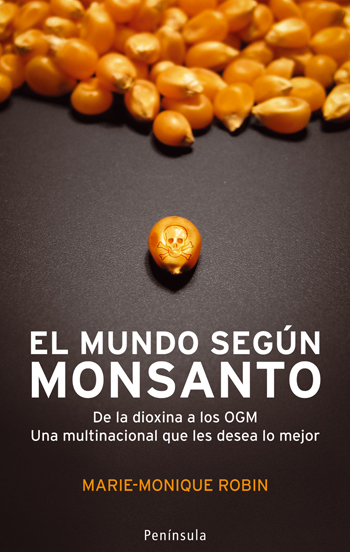
 The World According to Monsanto
The long awaited, blockbuster film The World According to Monsanto is now available in the United States. It is a powerful tool to motivate anyone to take up the cause against genetically modified foods. We urge you to hold house parties and sponsor free public showings of the film. Use our Film Showing Kit to help publicize the film and mobilize inspired audiences to take effective action to stop GMOs.
This month's Spilling the Beans is a review of the film. We also offer a shorter version of the review for websites and publications that are limited in space.
Update on bovine growth hormone (rBGH)
But first, great news! Monsanto just sold off their bovine growth hormone (rBGH/rBST) business to Ely Lilly's animal division, Elanco. Monsanto dumped this genetically engineered drug because snowballing consumer rejection of dairy products from cows treated with rBGH has already driven it out of Wal-Mart, Starbucks, Kroger, and 40 of the top 100 dairies.
Our Institute for Responsible Technology was one of many groups that helped bring about this victory by educating consumers about the potential health dangers (increased risks of cancer, higher fraternal twin rate, antibiotic resistant diseases, etc.). Informed people don't want anything to do with the drug. When the numbers of concerned, discerning shoppers hit the critical mass, a tipping point in the dairy industry ensued. For the inside scoop, view our new film on rBGH, Your Milk on Drugs—Just Say No!, at www.YourMilkonDrugs.com. Better yet, watch it as part of the bonus material on The World According to Monsanto DVD.
GMO Tipping Point Needs Your Help
Our Institute is now pursuing the same tipping point strategy to end the genetic engineering of the food supply. Our Campaign for Healthier Eating in America will inform receptive demographic groups in the US about GMO risks, and provide them with Non-GMO Shopping Guides. We expect to achieve the US tipping point before the end of 2009, which will leave companies scrambling to replace their suddenly unpopular GM ingredients.
To achieve our goals, we need to add some key staff positions immediately. Now would be a great time—actually a critical time—for you to donate to our Institute and invest in the health of our food supply and ecosystem. Please find an excuse to make a contribution today.
Film Review: The World According to Monsanto
Directed by Marie-Monique Robin
Reviewed by Jeffrey M. Smith
Distributed by Yes! Books, www.MonsantoFilm.com, $19.95
Includes bonus film and audio CD.
How much outrage can a single multinational corporation inspire? How much damage can they inflict? The breathtaking new film, The World According to Monsanto, features a company that sets the new standard. From Iowa to Paraguay, from England to India, Monsanto is uprooting our food supply and replacing it with their patented genetically engineered creations. And along the way, farmers, communities, and nature become collateral damage.
The Gazette says the movie "will freeze the blood in your veins." The Hour says it's a "horrifying enough picture" to warrant "fury." But most importantly, this critical film opens our eyes just in time.
The film is the work of celebrated award-winning French filmmaker Marie-Monique Robin, whose three years of work on four continents exposes why Monsanto has become the world's poster child for malignant corporate influence in government and technology. Combining secret documents with accounts by victims, scientists and policy makers, she guides us through a web of misleading reports, pressure tactics, collusion, and attempted corruption. And we learn how the company systematically tricked governments into allowing dangerous genetically modified (GM) foods into our diet—with Monsanto in charge of determining if they're safe.
Deception, Deception, Deception
The company's history with some of the most toxic chemicals ever produced, illustrates why they can't be trusted. Ask the folks of Anniston, Alabama, where Monsanto's PCB factory secretly poisoned the neighborhood for decades. PCBs are Monsanto's toxic oils used as coolants and lubricants for over 50 years and are now virtually omnipresent in the blood and tissues of humans and wildlife around the globe. But Anniston residents have levels hundreds or thousands of times the average. They all know their levels, which they carry as death sentences. David Baker, who lost his little brother and most of his friends to PCB-related diseases such as cancer, says Anniston kids used to run up to him, report their PCB level and ask, "How long you think I got?"
Ken Cook of the Environmental Working Group says that based on Monsanto documents made public during a trial, the company "knew the truth from the very beginning. They lied about it. They hid the truth from their neighbors." One Monsanto memo explains their justification: "We can't afford to lose one dollar of business."
Monsanto also produced the infamous Agent Orange, the cancer and birth-defect causing defoliant sprayed over Vietnam. It contaminated more than 3 million civilians and servicemen. But according to William Sanjour, who led the Toxic Waste Division of the Environmental Protection Agency, "thousands of veterans were disallowed benefits" because "Monsanto studies showed that dioxin [the main ingredient in Agent Orange] was not a human carcinogen." But his EPA colleague discovered that Monsanto had allegedly falsified the data in their studies. Sanjour says, "If they were done correctly, [the studies] would have reached just the opposite result."
Secret documents stolen from the FDA also reveal serious health effects from Monsanto's genetically engineered bovine growth hormone, called rBGH or rBST. In particular, the amount of a powerful hormone called IGF-1 is substantially increased in milk from treated cows. Samuel Epstein, Chairman of the Cancer Prevention Coalition, says that approximately 60 studies link IGF-1 to "breast, colon, and prostate cancers."
Cancer is also implicated in Monsanto's showcase herbicide, Roundup. According Professor Robert Bellé's research showing disrupted cell division, "Roundup provokes the first stages that lead to cancer." Bellé, who is with the National Center for Scientific Research and the Pierre and Marie Curie Institute in France, says, "The tested doses were well below those which people normally use."
Monsanto has promoted Roundup as harmless to both humans and the environment. But their advertised environmental claims, such as "biodegradable," "leaves the soil clean," and "respects the environment," were declared false and illegal by judges in both the US and France. In fact, Monsanto's own studies showed that 28 days after application, only 2% of the product had broken down. They were forced to remove "biodegradable" from the label.
Above the law
When Monsanto's transgressions are reported to authorities, somehow the company is magically let off the hook.
When Monsanto finally did share information on PCBs with the government, for example, Ken Cook says "instead of siding with the people who were being poisoned, [the government] sided with the company. . . . It was outrageous!" When William Sanjour's EPA colleague, Cate Jenkins, asked the agency to review Monsanto's flawed Agent Orange studies, Sanjour says, "there was no investigation of Monsanto. . . . What they investigated was Cate Jenkins, the whistleblower! They made her life a hell."
When Richard Burroughs of the FDA held up approval of rBGH by demanding more rigorous and relevant testing, he was fired. He says, "They figured: 'Well, if you're in the way, we'll get you out of the way.'. . . One day, I was escorted to the door and told that was it; I was done." Senior government scientists at Health Canada testified that their superiors were pressuring them to approve rBGH and that Monsanto had offered them an alleged bribe of $1-2 million. The scientists were later reprimanded, punished, and eventually "dismissed for disobedience." rBGH was never approved in Canada, Europe, and most industrialized nations.
When Professor Bellé went to his administration "to let the public know about the dangers" of Roundup herbicide, he was "ordered" not to communicate his findings "due to the GMO question lurking in the background." That question about genetically modified organisms was in relation to Monsanto's "Roundup Ready" crops. Monsanto has the patent for 90% of the GMOs grown on the planet, and most of them are genetically modified specifically to tolerate applications of Roundup.
Corporate Coup d'état
Monsanto's past manipulations were mere warm ups compared to the virtual government takeover used to approve GM foods. Author Jeremy Rifkin, President of the Foundation for Economic Trends, says, "I have never seen a situation where one company could have so much overwhelming influence at the highest levels of regulatory decision making."
The problem Monsanto faced was that GMOs are inherently unsafe. They can create dangerous side effects. That was the overwhelming consensus by FDA scientists, according to 44,000 agency documents made public from a lawsuit. But the most important document, FDA's official policy, claimed that GMOs were not substantially different. They were granted the status "Generally Recognized as Safe," even though they failed to meet the normal criteria. Thus, no safety testing is necessary. If Monsanto declares their GM products safe, the FDA has no further questions.
Former FDA biotech coordinator James Maryanski admits on camera that the GMO policy "was a political decision," not scientific. In fact, FDA political appointee Michael Taylor was in charge of the policy. Taylor was formerly Monsanto's attorney and later their vice president.
Monsanto's people regularly infiltrate upper echelons of government, and the company offers prominent positions to officials when they leave public service. This revolving door has included key people in the White House, regulatory agencies, even the Supreme Court. Monsanto also had George Bush Senior on their side, as evidenced by footage of Vice President Bush at Monsanto's facility offering help to get their products through government bureaucracy. He says, "Call me. We're in the 'de-reg' business. Maybe we can help."
Monsanto's influence continued into the Clinton administration. Dan Glickman, then Secretary of Agriculture, says, "there was a general feeling in agro-business and inside our government in the US that if you weren't marching lock-step forward in favor of rapid approvals of biotech products, rapid approvals of GMO crops, then somehow, you were anti-science and anti-progress." He admits, "when I opened my mouth in the Clinton Administration [about the lax regulations on GMOs], I got slapped around a little bit."
Unlike Glickman, FDA's Maryanski tries in vain to convince filmmaker Robin that GMOs are safe and that US regulation is adequate. But Robin had conducted four months of intensive internet research examining declassified documents, leaked internal files, scientific studies, trial transcripts, articles, and first hand accounts of whistleblowers. She was prepared.
In a priceless sequence, the film alternates between Maryanski's assurances and public interest attorney Steven Druker reading formerly secret memos by agency scientists, describing the serious health damage that GMOs may cause. When Robin repeats these same quotes to Maryanski, he resorts to uncomfortable stuttering, stammering, and backtracking. When he ultimately tries to dismiss genetic engineering as completely safe, Robin nails him. She reads to Maryanski his own words from a 1991 memo in which he acknowledged that genetic engineering of a food supplement called L-tryptophan in the 1980s may have been responsible for a deadly epidemic that killed dozens and caused thousands to fall sick or become disabled.
Suppressing evidence of harm, attacking GMO scientists
When Monsanto's GM crops hit American farm fields in 1996, virtually no safety studies had been published. The pro-GM UK government decided to commission Dr. Arpad Pusztai, the world's leading scientist in his field, to design rigorous safety testing protocols that would convince a skeptical public to embrace GM foods. When Pusztai fed GM potatoes to rats, however, they developed potentially pre-cancerous cell growth, a damaged immune system, and inhibited growth of major organs. Moreover, Pusztai's work implicated the generic process of genetic engineering itself as the cause. That is, any GM food already on the market might create the same problems in humans.
When Pusztai went public with his concerns, he was praised for his "wonderful work" by his director at the prestigious Rowett Institute. But according to a colleague, "two phone calls from Downing Street [the home of UK Prime Minister Tony Blair] to the director" resulted in Pusztai's sudden dismissal after 35 years. His protocols were shelved and he was the target of a relentless smear campaign, designed to destroy his reputation while promoting that of GMOs.
UC Berkeley Professor Ignacio Chapela was also targeted after he published evidence that GM corn had cross-pollinated with indigenous Mexican varieties, forever contaminating "the world's genetic reservoir of corn." Just after his research was published in Nature, Mary Murphy and Andura Smetacek began posting false accusations on a biotech forum website, recruiting scientists to inundate the publication with demands to retract the study. When anti-GMO campaigner Jonathan Matthews analyzed the technical headers on the two's emails, he traced Smetacek to a Monsanto computer, and Murphy to their PR firm. The two were apparently fictitious characters created to stir things up. Matthews says, "There's no ethics at all in what's going on here. It shows an organization that is determined to push its products into countries around the world and it's determined to destroy the reputation of anybody who stands in their way."
Monster corn and contamination by design
The film explores an ominous new development in Mexico that has yet to be reported in the scientific literature. Mutated and bizarrely shaped corn plants have been found "along the roadside or in people's yards" or fields. Community organizer Aldo Gonzales says, "They are really monsters!" And whenever analyzed, the monsters turn out to be genetically engineered. Local scientists believe that when GM corn cross-pollinates with traditional varieties, some genetic effect disturbs the offspring.
One Mexican farmer realized the implications. "If we don't manage to stop their spread in our fields, soon we'll be forced to buy our corn seed because our own won't work anymore?" Gonzales wonders if the contamination was intentional. He says, "Contamination only benefits multinationals like Monsanto."
Intentional contamination of another sort appears to have happened in Paraguay, as illegal Roundup Ready seeds were smuggled in before GMOs were approved. Roberto Franco, Paraguay's Deputy Agriculture Ministry, tactfully admits, "It is possible that [Monsanto], let's say, promoted its varieties and its seeds" before they were approved. "We had to authorize GMO seeds because they had already entered our country in an, let's say, unorthodox way."
Once approved, large agribusinesses bought huge tracts and cut down the rainforest to plant vast Roundup Ready soybean fields. The GMOs allow them to spray by plane or mechanical spreader; to farm without farmers. Peasants who had worked the land for generations are forced out—100,000 each year leave rural areas to live in the shanty towns of the cities. In one small farm community that is holding out next to a soy field, sprayed Roundup kills their livestock and crops, and sickens their children.
Destroying farmers
US family farmers also feel the heat. Troy Roush is one of hundreds accused by Monsanto of illegally saving their seeds. The company requires farmers to sign a contract that they will not save and replant GM seeds from their harvest. That way Monsanto can sell its seeds—at a premium—each season.
Although Roush maintains his innocence, he was forced to settle with Monsanto after two and a half years of court battles. He says his "family was just destroyed [from] the stress involved." Many farmers are afraid, according to Roush, because Monsanto has "created a little industry that serves no other purpose than to wreck farmers' lives."
Massive farmer suicides
In many countries where Monsanto monopolizes the seeds of certain crops, they eliminate non-GMO choices to force farmers to buy GM varieties. In India, for example, where Monsanto pushes their pesticide-producing Bt cotton, "there was no non-BT hybrid seed available in the market," says agronomist Kiran Sakhari.
Farmers had to borrow heavily to pay four times the price for the GM varieties, along with the chemicals needed to grow them. In spite of glowing promises of higher yields by Monsanto's ads, Bt cotton often performs poorly. Tragically, tens of thousands of indebted desperate farmers have resorted to suicide, often drinking unused pesticides. In one region, more than three Bt cotton farmers take their own lives each day.
Replacing Nature: "Nothing Shall Be Eaten That We Don't Own"
Monsanto is the world's largest seed company and many are concerned. Troy Roush says, "They are in the process of owning food, all food." Paraguayan farmer Jorge Galeano says, "Its objective is to control all of the world's food production." Renowned Indian physicist and community organizer Vandana Shiva says, "If they control seed, they control food; they know it, it's strategic. It's more powerful than bombs; it's more powerful than guns. This is the best way to control the populations of the world."
The World According to Monsanto is aptly named. It is about Monsanto seeking to recreate the world in its own image, for its own benefit. They intend to replace (and patent) the entire food supply. And since their genetic pollution self-propagates in the environment, it will outlast the effects of global warming and nuclear waste.
Such widespread permanent influence may not be safe with any individual or company. With Monsanto's record, the results can only be catastrophic.
This powerful documentary might just inspire a global rejection of Monsanto's plans for our world. If so, it will be the most important film in history.
___________________
Jeffrey M. Smith is the international bestselling author of Seeds of Deception and Genetic Roulette, the executive director of the Institute for Responsible Technology, and director of The Campaign for Healthier Eating in America.
The World According to Monsanto is co-produced by the National Film Board of Canada, ARTE France, Image & Compagnie, WDR, and Les Productions Thalie.
___________________
Individuals, businesses, and organizations are encouraged to host house parties and free public showings of The World According to Monsanto, which has generated intense concern in every audience that has seen it around the world. We have prepared a companion guide that can be downloaded at, www.MonsantoFilm.com, This guide includes press tools, facts and proven outreach strategies to help channel the heightened audience motivation into effective action.
Bonus material packaged with the DVD includes What We Can Do, a brief introduction to the Campaign for Healthier Eating in America—a practical plan to end the genetic engineering of the food supply by achieving the tipping point of consumer rejection.
The package also features a brochure, a free-to-copy audio CD on GMO health risks, and the new film, Your Milk on Drugs—Just Say No!, a short documentary by Jeffrey Smith about Monsanto's genetically engineered bovine growth hormone. It exposes fired whistleblowers, manipulated research, and a corporate takeover at the FDA, and includes footage prepared for a Fox TV station—canceled after a letter from Monsanto's attorney threatened "dire consequences."
© copyright Institute For Responsible Technology 2008
Jeffrey M. Smith is the author of publication Genetic Roulette: The Documented Health Risks of Genetically Engineered Foods, which presents 65 risks in easy-to-read two-page spreads. His first book, Seeds of Deception, is the top rated and #1 selling book on GM foods in the world. He is the Executive Director of the Institute for Responsible Technology. www.responsibletechnology.org, which is spearheading the Campaign for Healthier Eating in America. Go to www.seedsofdeception.com to learn more about how to avoid GM foods.
Spilling the Beans is a monthly column available at www.responsibletechnology.org. The website also offers eater-friendly tips for avoiding GMOs at home and in restaurants.
Permission is granted to publishers and webmasters to reproduce issues of Spilling the Beans in whole or in part. Just email us at column@seedsofdeception.com to let us know who you are and what your circulation is, so we can keep track.
The Institute for Responsible Technology is working to end the genetic engineering of our food supply and the outdoor release of GM crops. We warmly welcome your donations and support.
Go to www.responsibletechnology.org or click here if you'd like to make a tax-deductible donation. Click here if you would like to become a member of the Institute.
Etiquetas: Jeffrey Smith, Le Monde Selon Monsanto