miércoles, abril 01, 2015

Letters to the editor, The Independent, 26 Mar 2015


http://www.independent.co.uk/voices/letters/letters-when-the-pm-backs-a-bully-like-jeremy-clarkson-what-hope-is-there-10136874.html

Your articles on GM crops have read like advertorials for the industry. It is astonishing that, in featuring Monsanto, you appear to ignore the evidence of the devastating impact of the corporation’s GM herbicide-tolerant crops across North and South America on people and the environment.

The use of glyphosate herbicide on Monsanto’s GM maize and soy (most used as animal feed and biofuels, not food) has increased exponentially as resistant weeds have emerged. This herbicide is linked to the severe decline of the Monarch butterfly across the US, and this week the World Health Organization classified it as a probable human carcinogen.

You appear to have accepted the industry’s misleading claim that GM crops are needed to feed a growing global population. People are hungry today because they do not have access to nutritious food – lacking either the money to buy it or the land or other means to grow it – not because of an insufficiency of food produced, GM or otherwise.

As the US Department of Agriculture states, there is no consistent evidence to show that GM crops increase crop yield.

The real scandal is not opposition to GM crops, but why GM continues to get funding and political support when it is failing to deliver; when the plethora of innovative and sustainable agricultural practices delivering real solutions for farmers, communities and the environment globally get minimal support.

Clare Oxborrow
Friends of the Earth

Peter Melchett
Soil Association

Professor Andy Stirling
Sussex University

Professor Brian Wynne
Lancaster University

Claire Robinson
GM Watch

Liz O’Neill
GM Freeze

Pat Thomas
Beyond GM

Mike Small
Fife Diet

Colin Tudge
Campaign for Real Farming

Etiquetas: , ,

lunes, noviembre 25, 2013

Owen Paterson, 'wickedness' and the fairy dust of science, by Andy Stirling

TO READ THE WHOLE ARTICLE:
http://www.theguardian.com/science/2013/oct/15/owen-paterson-wickedness-and-the-fairy-dust-of-science

Environment secretary Owen Paterson has hit out at 'wicked' opponents of genetically modified crops, but forgets science's greatest assets are scepticism and democracy.


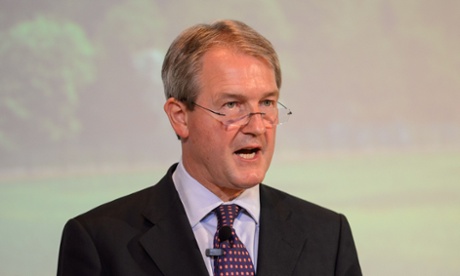
Environment secretary Owen Paterson who has hit out at
Environment secretary Owen Paterson who has hit out at "wicked" opponents of genetically modified crops. Photograph: Dominic Lipinski/PA
Even the most rational of arguments can understandably sometimes get quite heated. But in branding critics so emotively as "wicked" and "disgusting", GM advocates like Owen Paterson relinquish any claims to reason.
Like other hysterically unqualified defences of rationality, this carries a worrying whiff of fundamentalism. If sincere, the unnoticed irony makes the pathology all the more concerning. If not sincere, there is an even worse taint of expedient political manipulation. That science is such a direct victim of this rhetoric compounds the irony.
The issues go far beyond GM. What lies at threat more broadly, are both science and democracy – and their crucial interdependencies. There is a duty for all who value these thereby expediently sundered Enlightenment traditions, to speak out clearly in their defence.


Etiquetas: , , , ,

domingo, septiembre 28, 2008

Natural Alternatives to GM Crops

NOTE: Superb Responses to the UK's Science Minister
--- ---
The Guardian (Letters), 24 September 2008 http://www.guardian.co.uk/theguardian/2008/sep/24/4

Ian Pearson needs to get his science straight before considering taking a stance in support of GM (Science minister attempts to reopen the debate on GM crops, September 22). Properties such as innate pest or blight resistance, drought or salt tolerance and yield are sophisticated processes that manifest from the function of multiple genes working in a tightly regulated, coordinated manner. The introduction of such properly functioning complex gene networks in plants by the crude and genetically disruptive GM transformation process is currently not possible. Fortunately, we have better alternatives that can contribute to alleviating the world's food problems now.

First, the biotechnological procedure of marker-assisted selection (MAS), which uses our increasing knowledge of gene maps, can significantly expedite the identification of new crop varieties with complex desirable properties created by natural cross-breeding programmes. Unlike GM, there are no inherent safety concerns with MAS that makes use of the vast gene pool of any given food crop in a manner that retains natural gene order and function.

Second, a 1996 report by the National Research Council in the US highlighted that there already exist many crops such as fonio, pearl millet, African rice that are naturally adapted to harsh climates and marginal soils as well as being nutritious and tasty. Unfortunately, outside interference has led to these hardy staples being displaced by maize, wheat and Asian rice. In the face of climate change, the world needs fast solutions to its food problems, which MAS and a return to traditional food varieties can provide and which GM simply cannot deliver.

Dr Michael Antoniou
King's College London
*****
Ian Pearson's comments reveal a government increasingly prepared to act as a mouthpiece for the GM industry. GM crops have failed to deliver - they do not yield more than conventional crops and there is not a single GM drought or salt-tolerant crop available commercially.

The government's own GM public debate in 2003 revealed widespread scepticism over both GM crops and corporate control of the food system. Instead of trying to convince the public to support GM and continuing to fund this unpopular and ineffective technology, the government must focus on the real farming solutions backed by 400 scientists in a recent UN report on the future of agriculture. This means meeting local food needs by combining science and technology with communities' traditional knowledge to support localised and diverse farming.

Clare Oxborrow
Food campaigner, Friends of the Earth

Etiquetas: ,